import torch
from torch.export import export

from common.graph_utils import diff_ops, short
from common.models import example_inputs, get_model
from common.pt2e import quiet
from common.viz import draw_stages, table

quiet()
_ = torch.manual_seed(0)M00-3 | Decomposition:為什麼 PT2E 在「還沒拆散」的圖上標註

ATen op 可以再拆成更底層、更小的 op,這叫 decomposition。torch.export 預設給的圖還沒拆: conv2d 是一個 aten.conv2d.default,batch_norm 是一個 aten.batch_norm.default。 呼叫 ep.run_decompositions(表) 之後,大 op 會依傳入的 decomposition 表拆開。拆多深取決於表:
| 呼叫 | 以 conv + bn 為例 |
|---|---|
ep.run_decompositions({})(空表,本 notebook 用這個) |
batch_norm → _native_batch_norm_legit_no_training + getitem;conv2d 不變 |
ep.run_decompositions()(預設表,Core ATen) |
conv2d 也變成 convolution |
這對量化的意義:quantizer 要找的是 conv-bn-relu 這種「語意層級」的樣式,拆散之後就難認了。 所以 PT2E 在 decompose 之前標註;convert 完、交給後端時,再由後端決定要拆到多深。
- A. 同一個 ExportedProgram,拆之前與拆之後的圖。
- B. 整張圖的 op 增減,以及「要比對幾個 node」。
A. decompose 前後的 stem
模型是 TinyConvNet(stem、block、head_conv 裡共 4 組 conv-bn-relu),先 .eval()。
ep = export(get_model("tiny").eval(), example_inputs())
gm_pre = ep.module()                          # PT2E 在這一層標註
gm_post = ep.run_decompositions({}).module()  # 傳入空的 decomposition 表
draw_stages([(gm_pre, "ep.module()"), (gm_post, "ep.run_decompositions({}).module()")],
            focus=["conv2d", "batch_norm", "relu"], hops=0, title="stem 的 conv → bn → relu")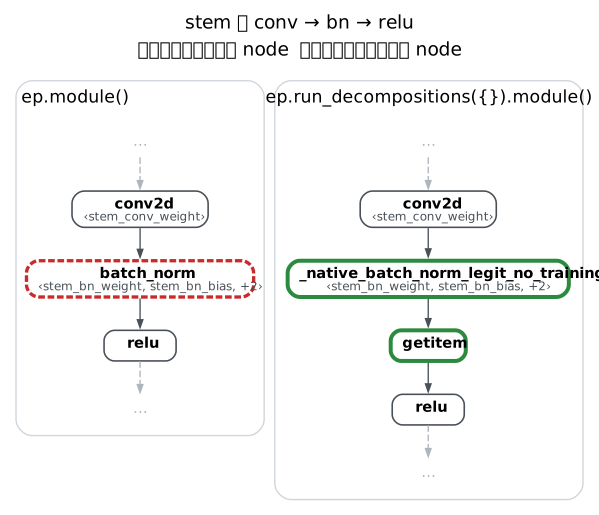
batch_norm(虛線,下一步消失)變成兩個 node(綠框):_native_batch_norm_legit_no_training 回傳好幾個 tensor, getitem 從中取出主要的輸出。conv2d、relu 維持原樣。
注意 run_decompositions 不會修改 ep,而是回傳一個新的 ExportedProgram,所以 gm_pre 不受影響。
B. 整張圖的 op 增減
print(f"node 數量(含 get_attr、placeholder、output):gm_pre {len(gm_pre.graph.nodes)} → gm_post {len(gm_post.graph.nodes)}")
table(diff_ops(gm_pre, gm_post, "gm_pre", "gm_post", tablefmt="html"))
node 數量(含 get_attr、placeholder、output):gm_pre 47 → gm_post 51| op | gm_pre | gm_post | delta |
|---|---|---|---|
| _native_batch_norm_legit_no_training | 0 | 4 | 4 |
| batch_norm | 4 | 0 | -4 |
| flatten | 1 | 0 | -1 |
| getitem | 0 | 4 | 4 |
| view | 0 | 1 | 1 |
| adaptive_avg_pool2d | 1 | 1 | 0 |
| add | 1 | 1 | 0 |
| conv2d | 4 | 4 | 0 |
| linear | 1 | 1 | 0 |
| max_pool2d | 2 | 2 | 0 |
| relu | 4 | 4 | 0 |
def count(gm, op):
    return sum(1 for n in gm.graph.nodes if n.op == "call_function" and short(n.target) == op)


assert count(gm_pre, "batch_norm") == 4 and count(gm_post, "batch_norm") == 0
assert count(gm_post, "_native_batch_norm_legit_no_training") == 4 and count(gm_post, "getitem") == 4
assert count(gm_post, "conv2d") == count(gm_pre, "conv2d")
assert count(gm_pre, "flatten") == 1 and count(gm_post, "view") == 1- 4 個
batch_norm都變成_native_batch_norm_legit_no_training+getitem。 - forward 裡的
.flatten(1)也被換成view。 conv2d、relu、max_pool2d、linear維持原樣(空表只做最基本的轉換;用預設表才會把 conv2d 拆成 convolution)。
思考題:如果要在 gm_post 上找 conv + bn + relu 這個樣式,要比對幾個 node?
def chain_after(gm, start):
    """從 start 一路沿著「唯一的使用者」往下走,回傳經過的 op 名稱。"""
    node, ops = next(n for n in gm.graph.nodes if n.name == start), []
    while node.op == "call_function":
        ops.append(short(node.target))
        if short(node.target) == "relu" or len(node.users) != 1:
            break
        node = next(iter(node.users))
    return ops


pre_chain, post_chain = chain_after(gm_pre, "conv2d"), chain_after(gm_post, "conv2d")
print("gm_pre :", " → ".join(pre_chain))
print("gm_post:", " → ".join(post_chain))
assert len(pre_chain) == 3 and len(post_chain) == 4
gm_pre : conv2d → batch_norm → relu
gm_post: conv2d → _native_batch_norm_legit_no_training → getitem → relu拆之前比對 3 個 node,拆之後要 4 個,而且中間多了一個只是「取值」的 getitem。 若後端用更深的 decomposition,batch norm 還會拆成更多算術 node,樣式更難認。 所以標註要趁 conv + bn + relu 的語意還清楚時做:PT2E 的 quantizer 拿到的就是 ep.module() 這一層的圖。
小結
run_decompositions(表)把大 op 拆成小 op,拆多深由表決定;它回傳新的 ExportedProgram。- PT2E 在拆之前標註,因為語意層級的樣式(conv-bn-relu)在這一層最好認。
- 拆到多深是後端的事:例如 Core ATen 那組約 180 個 op,是給「想把要實作的 op 數量降到最少」的後端用的。