import torch
from torch.fx import Node

from common.pt2e import convert_pt2e, export_module, get_xnnpack_quantizer, prepare_pt2e, quiet
from common.data import calibration_batches, trained_tiny_net
from common.models import example_inputs
from common.viz import draw, table
from vpu_quantizer import ADD, CAT, CONV2D, FLATTEN, LINEAR, MAX_POOL2D, RELU, fused_relu, vpu_ptq

quiet()
_ = torch.manual_seed(0)
QD = torch.ops.quantized_decomposed
Q_T, DQ_T, DQ_C = QD.quantize_per_tensor.default, QD.dequantize_per_tensor.default, QD.dequantize_per_channel.default
BATCH = 16M10-2 | 後端編譯器的視角:檢查 Q/DQ 圖是否滿足硬體約束

M10-1 的 MyVPUQuantizer 承諾會產生符合 VPU 約束的圖。但後端編譯器拿到的只有 convert_pt2e 的 Q/DQ 圖,不知道是哪個 quantizer 標的,也不該相信它。所以編譯器在吃圖之前要自己檢查一遍。
這本 notebook 寫一個只讀 Q/DQ 圖的檢查 pass check_vpu,規則對應 vpu_quantizer.py 的約束 (2)~(8)。約束 (1)(op 清單)不算違規:不在清單上的 op 切回 CPU,由 M10-3 處理。
- A. 七條規則:每條在 Q/DQ 圖上看什麼。
- B. 兩張 Q/DQ 圖過檢查:
MyVPUQuantizer的 vs torchao 測試版 XNNPACKQuantizer 的。 - C. 通過檢查換到什麼:每個 conv/linear 的 requant 倍率都是 \(2^k\),硬體用 shift 就能做。
A. 七條規則
| 規則 | 在 Q/DQ 圖上檢查什麼 | 對應約束 |
|---|---|---|
| R1 | 每個 quantize_per_tensor(activation)是 int8、zero point = 0 |
(2) |
| R2 | 每個 quantize_per_tensor 與 weight 的 dequantize 的 scale 是 \(2^k\) |
(4) |
| R3 | add/cat/max_pool2d/flatten:輸入的 dq 與輸出的 q 是同一個 scale | (6) |
| R4 | conv/linear 的 bias 來自 int32 的 dequantize_per_channel,scale = \(s_{in} \cdot s_w\) |
(5) |
| R5 | relu 的輸入不是「conv/linear/add → q → dq」(中間不能有量化點) | (7) |
| R6 | placeholder 的 shape 沒有 SymInt | (8) |
| R7 | conv/linear 的 weight 來自 dequantize_per_channel,zero point 全 0、範圍 [-127, 127] |
(3) |
檢查 pass 只讀 q/dq 的參數與連接關係,不看標籤(convert 之後標籤已經不重要了)。先寫兩個讀 scale 的小函式:
def scale_of(gm, n: Node) -> torch.Tensor:
    """q/dq node 的 scale:per-tensor 是寫在 args 裡的 float,per-channel 是 get_attr 指到的 buffer。"""
    s = n.args[1]
    if isinstance(s, Node):
        s = getattr(gm, str(s.target))
    return torch.as_tensor(s, dtype=torch.float64).flatten()


def is_pow2(s: torch.Tensor) -> bool:
    return bool(torch.all(torch.log2(s) == torch.round(torch.log2(s))))


def is_call(n, target) -> bool:
    return isinstance(n, Node) and n.op == "call_function" and n.target == target


def requant_inputs(gm, op: Node):
    """conv/linear 的 (s_in, s_w, s_out);s_out 取自輸出(或融合的 relu)後面的 quantize_per_tensor。"""
    act, weight = op.args[0], op.args[1]
    assert isinstance(act, Node) and isinstance(weight, Node)
    out = fused_relu(op) or op
    q = next((u for u in out.users if is_call(u, Q_T)), None)
    return scale_of(gm, act), scale_of(gm, weight), (scale_of(gm, q) if q is not None else None)
檢查 pass 本身:逐一走過圖上的 node,每條規則幾行。
def check_vpu(gm):
    """只讀 Q/DQ 圖,回傳違規清單 [(規則, node 名稱, 說明)]。"""
    bad = []
    for n in gm.graph.nodes:
        if n.op == "placeholder":                                                     # R6
            val = n.meta.get("val")
            if isinstance(val, torch.Tensor) and not all(isinstance(d, int) for d in val.shape):
                bad.append(("R6", n.name, f"shape {tuple(val.shape)}"))
        if n.op != "call_function":
            continue
        if n.target == Q_T and (n.args[2] != 0 or n.args[5] != torch.int8):         # R1
            bad.append(("R1", n.name, f"zero point = {n.args[2]}"))
        if n.target in (Q_T, DQ_C) and not is_pow2(scale_of(gm, n)):                # R2
            bad.append(("R2", n.name, f"scale = {scale_of(gm, n)[0].item():.5g}"))
        if n.target in (ADD, CAT, MAX_POOL2D, FLATTEN):                               # R3
            ins = n.args[0] if n.target == CAT else (n.args[:2] if n.target == ADD else n.args[:1])
            assert isinstance(ins, (list, tuple))
            out = fused_relu(n) or n
            scales = {float(scale_of(gm, a)) for a in ins if is_call(a, DQ_T)}
            scales |= {float(scale_of(gm, q)) for q in out.users if is_call(q, Q_T)}
            if len(scales) > 1:
                bad.append(("R3", n.name, "scale = " + ", ".join(f"{s:.5g}" for s in sorted(scales))))
        if n.target in (CONV2D, LINEAR) and len(n.args) > 2 and isinstance(b := n.args[2], Node):   # R4
            if not (is_call(b, DQ_C) and b.args[-1] == torch.int32):
                bad.append(("R4", n.name, f"bias 來自 {b.op} node {b.name}(fp32)"))
            else:
                s_in, s_w, _ = requant_inputs(gm, n)
                if not torch.equal(scale_of(gm, b), s_in * s_w):
                    bad.append(("R4", n.name, "bias scale ≠ s_in × s_w"))
        if n.target in (CONV2D, LINEAR):
            w, zp = n.args[1], None
            assert isinstance(w, Node)
            if is_call(w, DQ_T) and not is_pow2(scale_of(gm, w)):                     # R2:per-tensor 的 weight
                bad.append(("R2", w.name, f"scale = {scale_of(gm, w)[0].item():.5g}"))
            if is_call(w, DQ_C) and isinstance(z := w.args[2], Node):
                zp = getattr(gm, str(z.target))
            if zp is None:                                                            # R7
                bad.append(("R7", n.name, f"weight 來自 {w.op} node {w.name},不是 per-channel"))
            elif torch.any(zp != 0) or w.args[4:6] != (-127, 127):
                bad.append(("R7", n.name, f"範圍 {w.args[4:6]},或 zero point 不是 0"))
        if n.target == RELU:                                                          # R5
            src = n.args[0]
            if is_call(src, DQ_T) and is_call(q := src.args[0], Q_T) and isinstance(op := q.args[0], Node) \
                    and op.target in (CONV2D, LINEAR, ADD):
                bad.append(("R5", n.name, f"{op.name} 與 relu 之間有 q/dq"))
    return bad
B. 兩張 Q/DQ 圖過檢查
兩張圖都來自訓練好的 TinyConvNet、同一份校準資料:
- VPU 的圖:
vpu_ptq(vpu_quantizer.py)=torch.export.export(model, x)(static shape)→prepare_pt2e(…, MyVPUQuantizer())→ 校準 →convert_pt2e。 - XNNPACK 的圖:
export_module的預設(動態 batch)→prepare_pt2e(…, torchao 測試版 XNNPACKQuantizer, per-channel)→ 校準 →convert_pt2e。
model, x = trained_tiny_net(), example_inputs(BATCH)
xnn_prepared = prepare_pt2e(export_module(model, x), get_xnnpack_quantizer(is_per_channel=True)[0])
with torch.no_grad():
    for b in calibration_batches(n=64, batch_size=BATCH):
        xnn_prepared(*b)
graphs = {"MyVPUQuantizer": vpu_ptq(model, x), "XNNPACKQuantizer": convert_pt2e(xnn_prepared)}
results = {name: check_vpu(g) for name, g in graphs.items()}
RULES = ["R1", "R2", "R3", "R4", "R5", "R6", "R7"]
table([[r] + [sum(v[0] == r for v in results[name]) for name in graphs] for r in RULES],
["規則"] + [f"{name} 的圖:違規數" for name in graphs])| 規則 | MyVPUQuantizer 的圖:違規數 | XNNPACKQuantizer 的圖:違規數 |
|---|---|---|
| R1 | 0 | 10 |
| R2 | 0 | 16 |
| R3 | 0 | 1 |
| R4 | 0 | 5 |
| R5 | 0 | 0 |
| R6 | 0 | 1 |
| R7 | 0 | 0 |
assert results["MyVPUQuantizer"] == []MyVPUQuantizer 的圖 0 違規:M10-1 的每條約束都真的落實到 Q/DQ 圖上了。
XNNPACK 的圖,每條規則的第一筆違規:
WHY = {
    "R1": "activation spec 是 per_tensor_affine:zero point 跟著值域走,relu 之後是 -128",
    "R2": "用一般的 observer,scale 是任意浮點數",
    "R3": "add 的兩個輸入各自量化,沒有用 SharedQuantizationSpec(M03-4)",
    "R4": "不標 bias:bias 以 fp32 常數留在圖上,交給後端自己量化(M08、M09 的後端都這麼做)",
    "R5": "conv/add 和 relu 之間多了一組 q/dq",
    "R6": "這張圖用動態 batch export,而 XNNPACKQuantizer 的 validate() 不檢查 shape",
    "R7": "weight spec 不是 per-channel symmetric",
}
first = {}
for v in results["XNNPACKQuantizer"]:
    first.setdefault(v[0], v)
table([[r, node, detail, WHY[r]] for r, (_, node, detail) in sorted(first.items())], ["規則", "node", "看到的", "原因"])| 規則 | node | 看到的 | 原因 |
|---|---|---|---|
| R1 | quantize_per_tensor_default_1 | zero point = -128 | activation spec 是 per_tensor_affine:zero point 跟著值域走,relu 之後是 -128 |
| R2 | dequantize_per_channel_default | scale = 0.0038905 | 用一般的 observer,scale 是任意浮點數 |
| R3 | add | scale = 0.016419, 0.027519, 0.039895 | add 的兩個輸入各自量化,沒有用 SharedQuantizationSpec(M03-4) |
| R4 | conv2d | bias 來自 get_attr node stem_conv_weight_bias(fp32) | 不標 bias:bias 以 fp32 常數留在圖上,交給後端自己量化(M08、M09 的後端都這麼做) |
| R6 | x | shape (s77, 3, 16, 16) | 這張圖用動態 batch export,而 XNNPACKQuantizer 的 validate() 不檢查 shape |
R3 畫出來看:add 的兩個輸入來自兩個 dequantize,scale 不同。
draw(graphs["XNNPACKQuantizer"], focus="add", hops=1, title="XNNPACK 的圖:add 的兩個輸入 scale 不同(R3)")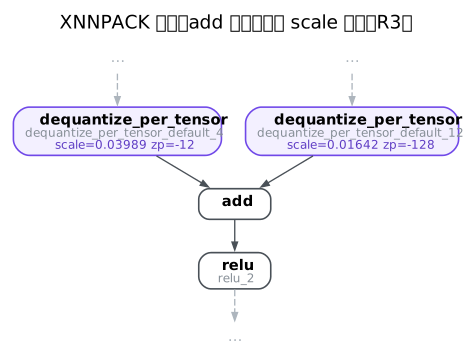
passed = [r for r in RULES if r not in first]
print("XNNPACK 的圖通過的規則:", passed)
assert passed == ["R5", "R7"]
XNNPACK 的圖通過的規則: ['R5', 'R7']- R5 通過:XNNPACKQuantizer 也把 conv+relu、add+relu 當一個 pattern(M04-1)。
- R7 通過,是因為這裡傳了
is_per_channel=True;不傳的話 weight 是 per-tensor,這條就會違規。
XNNPACK 的圖在 CPU 上完全合理(M08 的 XNNPACK 就吃這種圖),只是不合這顆 VPU 的規格。同一張 Q/DQ 圖能不能部署,取決於後端;所以後端要附自己的 Quantizer,編譯器也要自己檢查。
C. 通過檢查換到什麼:requant 倍率
整數 conv 的累加器是 int32,scale = \(s_{in} \cdot s_w\);要寫回 int8(scale = \(s_{out}\))得乘上
\[ M = \frac{s_{in} \cdot s_w}{s_{out}} \tag{1} \]
從 VPU 的圖讀出每個 conv/linear 的三個 scale(weight 是 per-channel,列最小~最大):
vpu = graphs["MyVPUQuantizer"]
rows, all_pow2 = [], True
for n in vpu.graph.nodes:
    if n.op != "call_function" or n.target not in (CONV2D, LINEAR):
        continue
    s_in, s_w, s_out = requant_inputs(vpu, n)
    assert s_out is not None
    m = s_in * s_w / s_out
    all_pow2 &= is_pow2(m)
    shift = (-torch.log2(m)).round().long()
    rows.append([n.name, f"2^{torch.log2(s_in).item():.0f}", f"2^{torch.log2(s_w).min():.0f}~2^{torch.log2(s_w).max():.0f}",
                 f"2^{torch.log2(s_out).item():.0f}", f"{shift.min().item()}~{shift.max().item()}"])
table(rows, ["node", "s_in", "s_w", "s_out", "右移位數(−log2 M)"])| node | s_in | s_w | s_out | 右移位數(−log2 M) |
|---|---|---|---|---|
| conv2d | 2^-5 | 2^-8~2^-7 | 2^-4 | 8~9 |
| conv2d_1 | 2^-4 | 2^-9~2^-8 | 2^-4 | 8~9 |
| conv2d_2 | 2^-4 | 2^-8~2^-7 | 2^-4 | 7~8 |
| conv2d_3 | 2^-4 | 2^-9~2^-7 | 2^-4 | 7~9 |
| linear | 2^-5 | 2^-7~2^-6 | 2^-3 | 8~9 |
print("VPU 的圖:所有 M 都是 2^k:", all_pow2)
assert all_pow2
xnn = graphs["XNNPACKQuantizer"]
conv = next(n for n in xnn.graph.nodes if n.op == "call_function" and n.target == CONV2D)
s_in, s_w, s_out = requant_inputs(xnn, conv)
assert s_out is not None
m0 = (s_in * s_w / s_out)[0]
print(f"對照 XNNPACK 的圖:{conv.name} 第 0 個 channel 的 M = {m0.item():.6g}(log2 = {torch.log2(m0).item():.3f})")
VPU 的圖:所有 M 都是 2^k: True
對照 XNNPACK 的圖:conv2d 第 0 個 channel 的 M = 0.00646425(log2 = -7.273)VPU 圖的三個 scale 都由 Pow2 observer 決定,所以 \(M\) 的指數就是三個指數相加減:累加器右移幾位就完成 requant。XNNPACK 圖的 \(M\) 不是 2 的冪次,整數硬體一般要用「int32 乘數 + shift」的定點乘法做 requant(一般作法,本專案沒有實作)。
小結
- 檢查 pass 是後端那一側的防線:只讀 Q/DQ 圖上的 q/dq 參數與連接關係,就能判斷這張圖能不能上這顆 VPU。
- 每條規則都對應
vpu_quantizer.py的一條約束;quantizer 沒做到時,這裡直接指出是哪個 node。 - 2 的冪次 scale 的好處變成具體的數字:每個 conv 的 requant 只是一個右移位數。