import copy

import torch

from common.models import example_inputs, get_model
from common.pt2e import export_module, quiet
from common.viz import draw

quiet()
_ = torch.manual_seed(0)


def first_line(e):
    """例外訊息只取第一行(後面多半是建議與 stack 資訊)。"""
    return str(e).splitlines()[0]


class Scale(torch.nn.Module):
    """示範用的小模組:把輸入乘上 k。只是為了有個看得出效果的 call_module 目標。"""

    def __init__(self, k):
        super().__init__()
        self.k = k

    def forward(self, x):
return x * self.kM00-4 | 改圖:後面會用到的 torch.fx 圖操作

前面三本只「讀」圖。PT2E 的 prepare 和 convert 本質上都是「改圖」:
prepare_pt2e在圖上插入 observer(M02-2 會親手做一次)。convert_pt2e把 observer 換成 quantize/dequantize,並預先算好 int8 weight(M02-3 會親手做一次)。
這本 notebook 用一個 conv → relu 的小圖,把這兩章會用到的改圖動作拆成六步:
| 步驟 | 動作 | 用到的 API | 之後在哪裡用 |
|---|---|---|---|
| 1 | 插入新 node | add_submodule、inserting_after、call_module |
M02-2 |
| 2 | 改接下游 | replace_all_uses_with(delete_user_cb=...) |
M02-2 |
| 3 | 重新產生 forward | recompile |
M02-2、M02-3 |
| 4 | 用 call_function 取代 | inserting_before、call_function、erase_node |
M02-3 |
| 5 | 把常數放進圖裡 | register_buffer、get_attr |
M02-3 |
| 6 | 清理與檢查 | eliminate_dead_code、lint |
M02-3 |
不熟 Graph/Node 的概念(op 種類、args、users…),建議先讀〈PyTorch FX 的 Graph/Node 一些基礎概念〉, 再搭配官方的 torch.fx 文件。
請依序執行。 六個步驟都在原地修改同一個
gm,跳著執行或重複執行某一格,圖就會和說明對不上。要重來請 Restart 後從頭執行全部。
起點:conv → relu
export_module() 底下是 torch.export.export(...).module()。base 存下原始輸出,之後每一步都拿來驗證。
x = example_inputs(4)[0]
gm = export_module(get_model("conv_relu").eval(), (x,))
with torch.no_grad():
    base = gm(x).clone()
graph = gm.graph
nodes = {n.name: n for n in graph.nodes}  # 用名字找 node:x、conv2d、relu、output…
relu = nodes["relu"]
draw(gm, title="改圖前的 gm")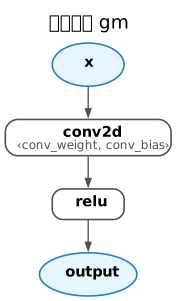
print(f"relu.args  = {relu.args}   ← 它吃誰(上游)")
print(f"relu.users = {list(relu.users)}   ← 誰吃它(下游)")
relu.args = (conv2d,) ← 它吃誰(上游)
relu.users = [output] ← 誰吃它(下游)改圖時幾乎都在處理這兩件事:「新 node 插在誰後面」與「讓誰改吃新的 node」。
Step 1:插入新 node
call_module 的目標必須先掛在 GraphModule 上(add_submodule)。在 inserting_after(relu) 這個 context 裡建立的 node,會放在 relu 之後。
gm.add_submodule("scale_out", Scale(2.0))
with graph.inserting_after(relu):
    scale = graph.call_module("scale_out", (relu,))  # scale_out(relu)
draw(gm, highlight=["scale_out"], title="Step 1 之後:建立了 scale_out(relu)")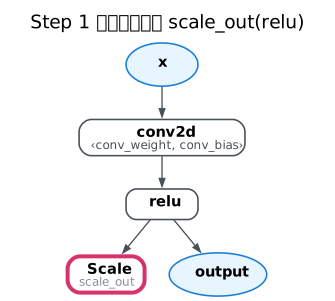
print(f"scale.users = {list(scale.users)}")
assert not scale.users
scale.users = []scale_out 吃 relu,但沒有人吃它:output 仍然吃 relu。建立 node 不會自動把它接進圖裡,接下游是下一步。
Step 2:改接下游
目標是讓原本吃 relu 的人(output)改吃 scale_out。直覺的寫法是 relu.replace_all_uses_with(scale)。 先在副本 gm_bad 上試試看:
gm_bad = copy.deepcopy(gm)
relu_bad = next(n for n in gm_bad.graph.nodes if n.name == "relu")
scale_bad = next(n for n in gm_bad.graph.nodes if n.name == "scale_out")
relu_bad.replace_all_uses_with(scale_bad)
draw(gm_bad, highlight=["scale_out"], title="錯誤示範:沒有 delete_user_cb")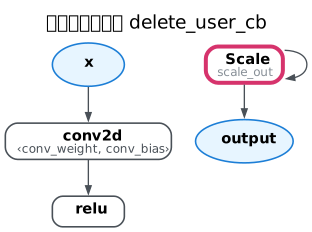
print(f"gm_bad 的 scale_out.args = {scale_bad.args}")
try:
    gm_bad.graph.lint()
    lint_error = None
except RuntimeError as e:
    lint_error = first_line(e)
print(f"gm_bad.graph.lint():{lint_error}")
assert scale_bad.args == (scale_bad,) and lint_error is not None
gm_bad 的 scale_out.args = (scale_out,)
gm_bad.graph.lint():Argument 'scale_out' of Node 'scale_out' was used before it has been defined! Please check that Nodes in the graph are topologically orderedscale_out 被改成吃自己(圖上的自我迴圈),relu 反而沒人吃了。 因為 Step 1 建立時 scale_out.args = (relu,),scale_out 自己也是 relu 的使用者;replace_all_uses_with 把「所有」使用者都改掉,連它自己也一起改了。
正確做法是用 delete_user_cb 排除新 node 自己:
relu.replace_all_uses_with(scale, delete_user_cb=lambda user: user is not scale)
draw(gm, highlight=["scale_out"], title="Step 2 之後:output 改吃 scale_out")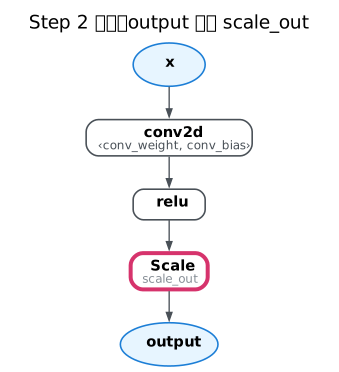
print(f"relu.users = {list(relu.users)}   scale.args = {scale.args}")
assert list(relu.users) == [scale] and scale.args == (relu,)
relu.users = [scale_out] scale.args = (relu,)「在 A 後面插新 node B」的標準寫法:B 吃 A,其餘原本吃 A 的人改吃 B(B 自己除外)。 這正是 prepare_pt2e 插 observer 的動作。
Step 3:recompile
圖改好了,但呼叫 gm(x) 的結果呢?
with torch.no_grad():
    before_recompile = torch.equal(gm(x), base)
gm.recompile()
with torch.no_grad():
    after_recompile = torch.allclose(gm(x), base * 2)
print(f"改完圖、還沒 recompile:輸出仍等於原輸出? {before_recompile}")
print(f"recompile 之後:輸出 == 2 × 原輸出?       {after_recompile}")
assert before_recompile and after_recompile
改完圖、還沒 recompile:輸出仍等於原輸出? True
recompile 之後:輸出 == 2 × 原輸出? TrueGraphModule 的 forward 是由圖產生的程式碼。改圖不會自動重新產生,每次改完都要 recompile()。
Step 4:用 call_function 取代 call_module
把 scale_out 這個 call_module 換成一個 aten.mul 的 call_function。convert_pt2e 把 observer(call_module)換成 q/dq(call_function)就是同一個模式。 順序是:建新 node → 下游改吃新的 → 刪舊的。先看看順序錯了會怎樣:
with graph.inserting_before(scale):
    mul = graph.call_function(torch.ops.aten.mul.Tensor, (relu, 2.0))
try:
    graph.erase_node(scale)  # 還有人吃 scale,不能刪
    erase_error = None
except RuntimeError as e:
    erase_error = first_line(e)
print(f"直接 erase_node(scale):{erase_error}")
assert erase_error is not None
直接 erase_node(scale):Tried to erase Node scale_out but it still had 1 users in the graph: {output: None}!還有人吃 scale_out 時不能刪。照正確順序做:
scale.replace_all_uses_with(mul)  # 先讓下游改吃新 node
graph.erase_node(scale)           # 沒有人吃了,才能刪
gm.delete_submodule("scale_out")  # 模組也一併丟掉
gm.recompile()
with torch.no_grad():
    assert torch.allclose(gm(x), base * 2)
draw(gm, highlight=[mul.name], title="Step 4 之後:scale_out 換成 aten.mul")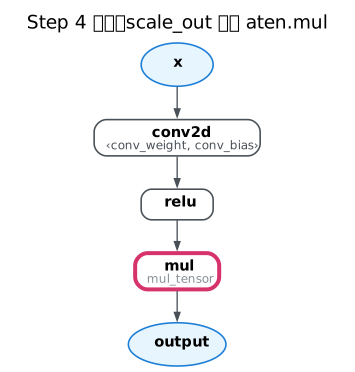
輸出仍是 2 倍。mul 的第二個參數 2.0 是直接寫在 node 參數裡的 Python 常數(圖上看不到,它不是 node)。
Step 5:把 tensor 常數放進圖裡
Python 數字可以直接寫在參數裡,對應 per-tensor 的 scale/zero point(M01 看過 q/dq 上的 scale 就是這樣)。 tensor 常數(對應 per-channel 的 scale/zero point)要先註冊成 buffer,再用 get_attr node 讀出來:
gm.register_buffer("two", torch.tensor(2.0))
with graph.inserting_before(mul):
    two = graph.get_attr("two")  # 讀 GraphModule 上名叫 two 的屬性
    mul_t = graph.call_function(torch.ops.aten.mul.Tensor, (relu, two))
mul.replace_all_uses_with(mul_t)
graph.erase_node(mul)
gm.recompile()
with torch.no_grad():
    assert torch.allclose(gm(x), base * 2)
draw(gm, highlight=[mul_t.name], title="Step 5 之後:常數改成 buffer + get_attr")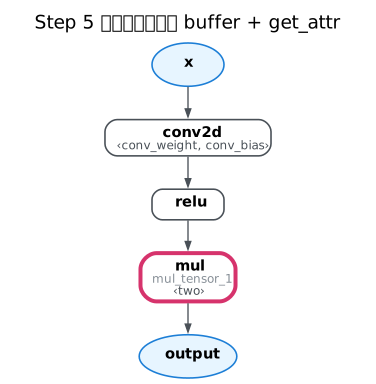
two 是 get_attr,畫在使用它的 mul 標籤的 ‹…› 裡。
Step 6:清理與檢查
故意建一個沒人用的 neg,再用 eliminate_dead_code 清掉。lint 檢查圖的結構是否一致(例如 node 是否先定義再使用),有問題會丟例外。
with graph.inserting_after(relu):
    graph.call_function(torch.ops.aten.neg.default, (relu,))  # 沒有人吃它
n_before = len(graph.nodes)
graph.eliminate_dead_code()  # 刪掉所有「沒有使用者、也沒有副作用」的 node
n_after = len(graph.nodes)
graph.lint()
gm.recompile()
print(f"node 數:插入 neg 後 {n_before} → eliminate_dead_code 後 {n_after}")
assert n_after == n_before - 1 and not any(n.name.startswith("neg") for n in graph.nodes)
node 數:插入 neg 後 10 → eliminate_dead_code 後 9convert 把 weight 的 quantize 預先算好、換成 get_attr 之後,原本的 weight node 就沒人吃了,也是靠 eliminate_dead_code 清掉(M02-3)。
小結
| 要做的事 | 動作 |
|---|---|
| 插 observer | add_submodule + inserting_after + call_module + replace_all_uses_with(delete_user_cb=...) |
| observer → q/dq | inserting_before + call_function + replace_all_uses_with + erase_node(+ delete_submodule) |
| 存 scale/zero point | Python 常數寫在參數裡,或 register_buffer + get_attr |
| 收尾 | eliminate_dead_code、lint、recompile |
M02-2 的插 observer 就是 Step 1~3;M02-3 把 observer 換成 q/dq、預先量化 weight,就是 Step 4~6。