import copy

import torch

from common.graph_utils import observer_nodes
from common.models import example_inputs, get_model
from common.pt2e import (
    ANNOTATION_KEY,
    MinMaxObserver,
    QuantizationAnnotation,
    QuantizationSpec,
    Quantizer,
    export_module,
    prepare_pt2e,
    quiet,
)
from common.viz import draw, draw_stages, table

quiet()
_ = torch.manual_seed(0)M03-1 | observer 為什麼出現在那個位置:標籤、Quantizer、prepare_pt2e

M02 手插 observer 時,位置是直接照 XNNPACKQuantizer 抄的。這一章回答:prepare_pt2e 插 observer 的位置是誰決定的?
一句話的答案:有人在那個位置貼了標籤,prepare_pt2e 只是照著標籤插 observer。
這件事牽涉三個角色:
| 角色 | 是什麼 | 做什麼 |
|---|---|---|
QuantizationAnnotation |
標籤,存在 node.meta["quantization_annotation"] |
記錄這個 node 的哪些輸入邊、或它的輸出要量化 |
Quantizer.annotate |
貼標籤的人,由後端作者實作 | 決定哪些位置要量化、用什麼規格 |
prepare_pt2e |
讀標籤的人 | 每個標籤位置插一個 observer,沒有標籤的地方什麼都不做 |
這本 notebook 不用任何現成的 quantizer,全部手寫:
- A. 標籤長什麼樣:親手貼兩張標籤。
- B. 三個角色的分工:寫一個最小的 Quantizer,標籤一張一張加,看 observer 一個一個長出來。
- C. 邊標籤與輸出標籤:同一個 tensor 有兩個使用者時差在哪。
一份 QuantizationSpec 回答「這個位置要怎麼量化」:dtype、整數範圍、方案,以及用哪種 observer 收集統計。 這本 notebook 所有標籤都用同一份:
SPEC = QuantizationSpec(
    dtype=torch.int8,
    quant_min=-128,
    quant_max=127,
    qscheme=torch.per_tensor_affine,
    observer_or_fake_quant_ctr=MinMaxObserver,
)
A. 標籤長什麼樣
QuantizationAnnotation 有兩個欄位,分別對應兩種位置:
input_qspec_map:{上游 node: spec}。貼在 consumer 上,表示「上游 → 這個 node」這條邊要量化。注意 key 是上游的 producer,不是 consumer 自己。output_qspec:表示這個 node 的輸出要量化。
在 conv → relu 的小模型上貼兩張:x → conv2d 這條邊,以及 relu 的輸出。
gm = export_module(get_model("conv_relu").eval(), example_inputs(4))
nodes = {n.name: n for n in gm.graph.nodes}  # 用名字找 node:x、conv_weight、conv2d、relu…

nodes["conv2d"].meta[ANNOTATION_KEY] = QuantizationAnnotation(input_qspec_map={nodes["x"]: SPEC})  # pyright: ignore[reportCallIssue]
nodes["relu"].meta[ANNOTATION_KEY] = QuantizationAnnotation(output_qspec=SPEC)  # pyright: ignore[reportCallIssue]

draw(gm, notes={"conv2d": "標籤:input_qspec_map = {x: SPEC}", "relu": "標籤:output_qspec = SPEC"},
     title="貼了兩張標籤的 conv → relu")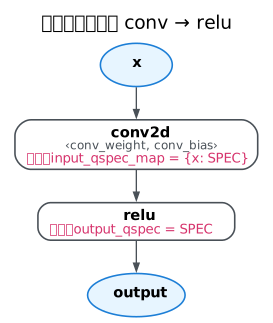
print(f"貼了 2 張標籤,圖上的 observer 數量 = {len(observer_nodes(gm))}")
assert len(observer_nodes(gm)) == 0
貼了 2 張標籤,圖上的 observer 數量 = 0標籤只是寫在 node.meta 裡的資料,圖本身完全沒變。誰來讀它、把它變成 observer?
B. 三個角色的分工
寫一個最小的 Quantizer:照著傳進來的清單貼標籤,不做任何判斷。Quantizer 只有兩個必須實作的方法:
annotate(model):貼標籤,回傳 model。validate(model):貼完之後的檢查(這裡什麼都不檢查,用途在 M03-3)。
兩個方法被呼叫時,都記到 calls 裡,等一下看是誰呼叫了它們。
calls = []


class LabelQuantizer(Quantizer):
    def __init__(self, labels):
        self.labels = labels  # ("out", node 名稱) 或 ("edge", 上游名稱, consumer 名稱)

    def annotate(self, model):
        calls.append("annotate")
        nodes = {n.name: n for n in model.graph.nodes}
        for label in self.labels:
            if label[0] == "out":
                ann = nodes[label[1]].meta.setdefault(ANNOTATION_KEY, QuantizationAnnotation())
                ann.output_qspec = SPEC
            else:
                _, producer, consumer = label
                ann = nodes[consumer].meta.setdefault(ANNOTATION_KEY, QuantizationAnnotation())
                ann.input_qspec_map[nodes[producer]] = SPEC
        return model

    def validate(self, model):
        calls.append("validate")
從沒有標籤開始,每一步多貼一張,每一步都只呼叫 prepare_pt2e(圖的複本, LabelQuantizer(標籤)):
gm = export_module(get_model("conv_relu").eval(), example_inputs(4))
steps = [
    ("不貼標籤", []),
    ("+ relu 的輸出", [("out", "relu")]),
    ("+ 邊 x → conv2d", [("out", "relu"), ("edge", "x", "conv2d")]),
    ("+ 邊 conv_weight → conv2d", [("out", "relu"), ("edge", "x", "conv2d"), ("edge", "conv_weight", "conv2d")]),
]
prepared, rows = [], []
for title, labels in steps:
    calls.clear()
    p = prepare_pt2e(copy.deepcopy(gm), LabelQuantizer(labels))
    prepared.append((p, title))
    rows.append([title, len(labels), len(observer_nodes(p)), " → ".join(calls)])
table(rows, ["步驟", "標籤數", "observer 數", "prepare_pt2e 呼叫了"])| 步驟 | 標籤數 | observer 數 | prepare_pt2e 呼叫了 |
|---|---|---|---|
| 不貼標籤 | 0 | 0 | annotate → validate |
| + relu 的輸出 | 1 | 1 | annotate → validate |
| + 邊 x → conv2d | 2 | 2 | annotate → validate |
| + 邊 conv_weight → conv2d | 3 | 3 | annotate → validate |
assert [r[2] for r in rows] == [0, 1, 2, 3]
assert all(r[3] == "annotate → validate" for r in rows)- 我們從頭到尾只呼叫
prepare_pt2e,annotate和validate是它替我們呼叫的:先貼標籤、再檢查、最後插 observer。 - 沒有標籤就沒有 observer;多一張標籤就多一個 observer。
prepare_pt2e自己不知道哪裡該量化,全部來自 Quantizer 貼的標籤。
完整來說,prepare_pt2e 依序做這幾件事(torchao 0.18 quantize_pt2e.py):
- 把 BN 折進前面的 conv(M04)。
- 呼叫
quantizer.transform_for_annotation(model):讓 Quantizer 在標註前改寫圖,例如把純量常數變成 tensor 屬性。這是選用的方法,基底類別的預設不改圖。 - 呼叫
quantizer.annotate(model):貼標籤。 - 呼叫
quantizer.validate(model):檢查標籤。 - 照標籤插 observer:每個標籤位置依 spec 建一個 observer、插一個
call_modulenode(M02-2 手做過這個動作)。
把四個步驟的圖畫出來(第一個 row 是前兩步,第二個 row 是後兩步),綠框是這一步新長出來的 observer:
draw_stages(prepared, title="標籤一張一張加")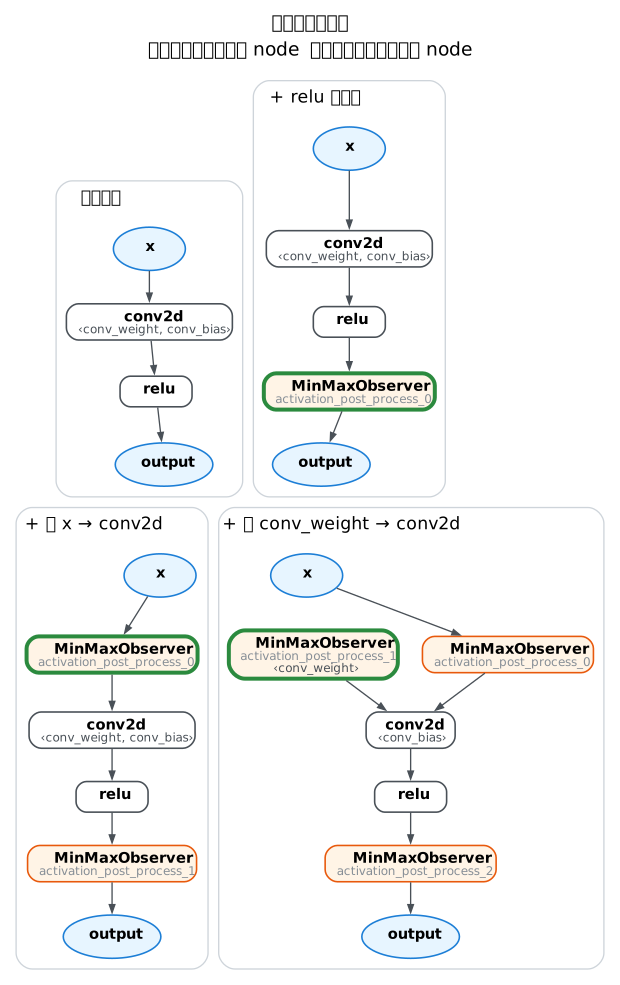
conv2d 的輸出沒有貼標籤,所以 conv2d 與 relu 之間沒有 observer。要不要在這裡量化完全由 Quantizer 決定,M04 的 fusion 就是這件事。 最後一步的三個 observer,和 M02-2 不用 Quantizer、直接改圖插的位置相同。
C. 邊標籤與輸出標籤
換一個模型 cat_pool:輸入 x 同時餵給兩個 conv(conv2d、conv2d_1)。比較兩種標籤:
- 只貼邊
x → conv2d(input_qspec_map)。 - 貼
x的輸出(output_qspec)。
C_FOCUS = ["x", "activation_post_process_0", "conv2d", "conv2d_1"]  # x、observer、兩個 conv
gm_cat = export_module(get_model("cat_pool").eval(), example_inputs(4))
edge_only = prepare_pt2e(copy.deepcopy(gm_cat), LabelQuantizer([("edge", "x", "conv2d")]))
draw(edge_only, focus=C_FOCUS, hops=0, title="1. 邊標籤:只有 x → conv2d")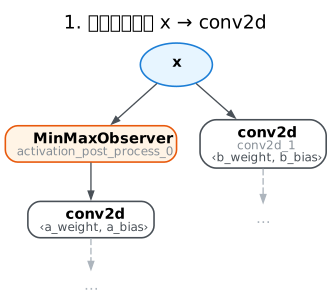
out_label = prepare_pt2e(copy.deepcopy(gm_cat), LabelQuantizer([("out", "x")]))
draw(out_label, focus=C_FOCUS, hops=0, title="2. 輸出標籤:x 的輸出")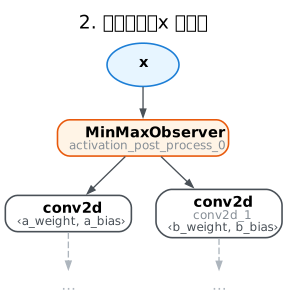
def first_input(gm, name):
    return next(n for n in gm.graph.nodes if n.name == name).args[0]


obs_names = {n.name for n, _ in observer_nodes(edge_only)} | {n.name for n, _ in observer_nodes(out_label)}
rows = []
for label, p in [("1. 邊標籤", edge_only), ("2. 輸出標籤", out_label)]:
    for consumer in ("conv2d", "conv2d_1"):
        src = first_input(p, consumer).name
        rows.append([label, consumer, src, "量化後的 x" if src in obs_names else "原本的 x"])
table(rows, ["標籤", "consumer", "吃到的輸入", "意思"])| 標籤 | consumer | 吃到的輸入 | 意思 |
|---|---|---|---|
| 1. 邊標籤 | conv2d | activation_post_process_0 | 量化後的 x |
| 1. 邊標籤 | conv2d_1 | x | 原本的 x |
| 2. 輸出標籤 | conv2d | activation_post_process_0 | 量化後的 x |
| 2. 輸出標籤 | conv2d_1 | activation_post_process_0 | 量化後的 x |
assert [r[3] for r in rows] == ["量化後的 x", "原本的 x", "量化後的 x", "量化後的 x"]
assert first_input(out_label, "conv2d") is first_input(out_label, "conv2d_1") # 兩個 conv 共用同一個 observer- 邊標籤只影響那一個 consumer:
conv2d吃量化後的 x,conv2d_1吃原本的 x。 - 輸出標籤影響這個 tensor 的所有 consumer:兩個 conv 共用同一個 observer。
同一個 tensor 被好幾個 op 使用時,後端可以讓其中一個吃量化值、另一個吃原值,所以標籤要能貼在「邊」上,而不只是貼在 node 上。 同一個 tensor 同時有邊標籤和輸出標籤時,不是誰覆蓋誰:兩份 spec 的屬性不同,兩個 observer 會串接(量化兩次); 屬性完全相同才會合併成一個。這是 M03-4 的「隱式共用」。
小結
- 標籤(
QuantizationAnnotation)只是node.meta裡的資料,貼了不會改圖。 prepare_pt2e先呼叫quantizer.annotate、quantizer.validate,再照標籤插 observer。input_qspec_map標一條邊,只影響一個 consumer;output_qspec標一個輸出,影響所有 consumer。- 手寫標籤不會推廣到別的模型。M03-2 先讀懂 XNNPACKQuantizer 貼的標籤,M03-3 改用規則(依
node.target)自動找 node,M03-4 處理「不同位置共用同一組 scale」。