import copy

import torch
from torch.fx import Graph
from torch.fx.passes.infra.pass_manager import PassManager
from torch.fx.passes.utils.matcher_utils import SubgraphMatcher

from common.data import calibration_batches
from common.graph_utils import diff_ops, observer_nodes, op_counts
from common.models import example_inputs, get_model
from common.pt2e import DuplicateDQPass, convert_pt2e, export_module, get_xnnpack_quantizer, prepare_pt2e, quiet
from common.viz import draw_stages, table

quiet()
_ = torch.manual_seed(0)

QD = torch.ops.quantized_decomposed # convert_pt2e 產生的 q/dq op 都在這個 namespaceM02-3 | 手動重做 convert_pt2e:observer → quantize/dequantize

M02-2 手做了 prepare_pt2e。這本 notebook 手做 convert_pt2e,最後和它的結果逐項比對。
先看 convert_pt2e 依序做了什麼(torchao 0.18 quantize_pt2e.py):
| 順序 | 步驟 | 做什麼 | 本 notebook |
|---|---|---|---|
| 1 | observer → q/dq | 每個 observer 換成一對 quantize/dequantize,scale 與 zero point 寫進圖裡 | B 段 |
| 2 | _fold_conv_bn_qat |
折掉 QAT 訓練時留著的 conv + bn 子圖 | 略過(PTQ 的 BN 在 prepare 就折掉了,M04) |
| 3 | DuplicateDQPass |
一個 dequantize 有多個使用者時,替每個使用者複製一份 | C 段 |
| 4 | PortNodeMetaForQDQ |
把標註等 metadata 搬到 q/dq node 上 | 略過(不影響圖的結構與數值) |
| 5 | constant_fold |
weight 的 quantize 輸入是常數,預先算好,只存 int8 | D 段 |
開始之前,A 段先確認 quantize/dequantize 這兩個 op 的數學。
A. quantize/dequantize 的數學
兩個 op 就是 M01 的公式:\(q = \text{clamp}(\text{round}(x/s) + z,\ q_{\min}, q_{\max})\),\(\hat{x} = (q - z)\cdot s\)。 選一個偏小的 scale,讓部分元素超出範圍、被 clamp:
x = torch.randn(8) * 2
scale, zp, qmin, qmax = 0.02, 3, -128, 127

q_op = QD.quantize_per_tensor(x, scale, zp, qmin, qmax, torch.int8)
dq_op = QD.dequantize_per_tensor(q_op, scale, zp, qmin, qmax, torch.int8)
q_hand = (torch.round(x / scale) + zp).clamp(qmin, qmax).to(torch.int8)
dq_hand = (q_hand.to(torch.float32) - zp) * scale
clamped = ((torch.round(x / scale) + zp < qmin) | (torch.round(x / scale) + zp > qmax))

table([["x", *[f"{v:.3f}" for v in x.tolist()]],
       ["q(op)", *q_op.tolist()],
       ["q(手寫)", *q_hand.tolist()],
       ["dq(op)", *[f"{v:.3f}" for v in dq_op.tolist()]],
["被 clamp", *["✱" if c else "" for c in clamped.tolist()]]])| x | 3.082 | -0.587 | -4.358 | 1.137 | -2.169 | -2.797 | 0.807 | 1.676 |
| q(op) | 127 | -26 | -128 | 60 | -105 | -128 | 43 | 87 |
| q(手寫) | 127 | -26 | -128 | 60 | -105 | -128 | 43 | 87 |
| dq(op) | 2.480 | -0.580 | -2.620 | 1.140 | -2.160 | -2.620 | 0.800 | 1.680 |
| 被 clamp | ✱ | ✱ | ✱ |
assert torch.equal(q_op, q_hand) and torch.equal(dq_op, dq_hand) and clamped.any()op 與手寫公式逐位元相同。被 clamp 的元素還原後停在範圍邊界(\((q_{\max} - z)\cdot s\) 或 \((q_{\min} - z)\cdot s\)),這就是 clipping 誤差。
準備:一張校準好、還沒 convert 的圖
TinyConvNet(conv-bn-relu、residual block、linear),用 XNNPACKQuantizer(per-channel weight)prepare 並校準。 official 是 convert_pt2e 的結果,後面每一步都和它比。
model = get_model("tiny").eval()
quantizer, _ = get_xnnpack_quantizer(is_per_channel=True)
prepared = prepare_pt2e(export_module(model, example_inputs(8)), quantizer)
with torch.no_grad():
    for batch in calibration_batches(n=128, batch_size=16):
        prepared(*batch)

official = convert_pt2e(copy.deepcopy(prepared))  # convert_pt2e 會原地修改,對複本呼叫
x_test = torch.randn(8, 3, 16, 16)


def max_diff(a, b):
    with torch.no_grad():
        return float((a(x_test) - b(x_test)).abs().max())


print(f"prepared 圖上的 observer 數量 = {len(observer_nodes(prepared))}")
prepared 圖上的 observer 數量 = 16B. 步驟 1:observer → q/dq
對每個 observer:用 calculate_qparams() 取出 scale、zero point,在它前面插 quantize、dequantize,讓下游改吃 dequantize,再刪掉 observer。 改圖的動作就是 M00-4 的 Step 4~5(用 call_function 取代 call_module、把常數放進圖裡)。scale 與 zero point 放的位置依量化方式而定:
- per-tensor:scale、zero point 是 Python 數字,直接寫在 node 的參數裡。
- per-channel:scale、zero point 是 tensor,先註冊成 buffer,再用
get_attrnode 讀出來。
def replace_observers_with_qdq(gm):
    """把圖上每個 observer(call_module)換成 quantize → dequantize 兩個 call_function。"""
    graph = gm.graph
    for k, (node, obs) in enumerate(observer_nodes(gm)):
        scale, zp = obs.calculate_qparams()
        qmin, qmax, dtype = obs.quant_min, obs.quant_max, obs.dtype
        src = node.args[0]
        with graph.inserting_before(node):
            if scale.numel() > 1:  # per-channel:tensor 註冊成 buffer,用 get_attr 取
                gm.register_buffer(f"_scale_{k}", scale.detach().clone())
                gm.register_buffer(f"_zero_point_{k}", zp.detach().clone())
                s_node, z_node = graph.get_attr(f"_scale_{k}"), graph.get_attr(f"_zero_point_{k}")
                axis = int(obs.ch_axis)
                q = graph.call_function(QD.quantize_per_channel.default, (src, s_node, z_node, axis, qmin, qmax, dtype))
                dq = graph.call_function(QD.dequantize_per_channel.default, (q, s_node, z_node, axis, qmin, qmax, dtype))
            else:                  # per-tensor:Python 數字直接寫在參數裡
                s, z = float(scale), int(zp)
                q = graph.call_function(QD.quantize_per_tensor.default, (src, s, z, qmin, qmax, dtype))
                dq = graph.call_function(QD.dequantize_per_tensor.default, (q, s, z, qmin, qmax, dtype))
        node.replace_all_uses_with(dq)
        graph.erase_node(node)
        gm.delete_submodule(node.target)  # observer 模組用完就丟
    graph.lint()
    gm.recompile()
    return gm


manual = replace_observers_with_qdq(copy.deepcopy(prepared))
draw_stages([(prepared, "校準後的 prepared"), (manual, "步驟 1 之後")], focus=["conv2d"], hops=2,
            title="stem 的 conv2d:observer 換成 q/dq")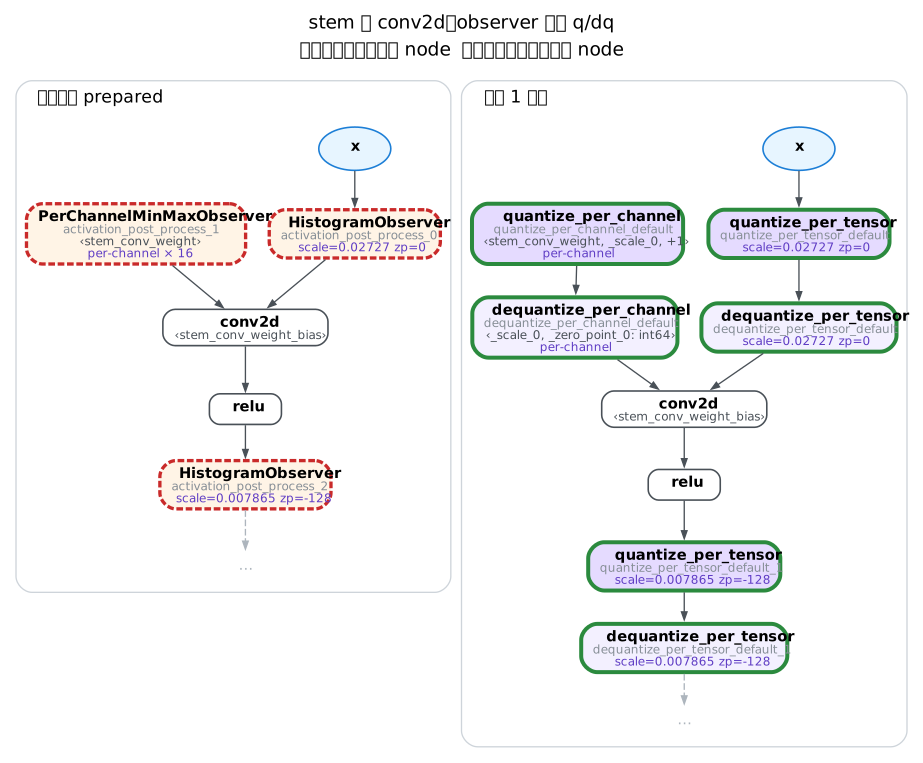
左邊的三個 observer(虛線,下一步消失)在右邊各變成一對 q/dq(綠框)。 weight 那對是 per-channel,參數裡的 _scale_0 就是剛註冊的 buffer;activation 那對是 per-tensor,scale 直接寫在參數裡。
輸出和 convert_pt2e 比:
print(f"步驟 1 之後,與 convert_pt2e 的輸出最大差 = {max_diff(official, manual):.3e}")
assert max_diff(official, manual) == 0
步驟 1 之後,與 convert_pt2e 的輸出最大差 = 0.000e+00數值已經完全一樣。但圖的 op 組成還有兩處不同(official = convert_pt2e,manual = 只做了步驟 1):
table(diff_ops(official, manual, "official", "manual", tablefmt="html"))| op | official | manual | delta |
|---|---|---|---|
| dequantize_per_tensor | 12 | 11 | -1 |
| quantize_per_channel | 0 | 5 | 5 |
| adaptive_avg_pool2d | 1 | 1 | 0 |
| add | 1 | 1 | 0 |
| conv2d | 4 | 4 | 0 |
| dequantize_per_channel | 5 | 5 | 0 |
| flatten | 1 | 1 | 0 |
| linear | 1 | 1 | 0 |
| max_pool2d | 2 | 2 | 0 |
| quantize_per_tensor | 11 | 11 | 0 |
| relu | 4 | 4 | 0 |
co, cm = op_counts(official), op_counts(manual)
assert co["quantize_per_channel"] == 0 and cm["quantize_per_channel"] == 5
assert co["dequantize_per_tensor"] == cm["dequantize_per_tensor"] + 1quantize_per_channel:official沒有,因為 weight 的 quantize 被預先算掉了(步驟 5,D 段)。dequantize_per_tensor:official多一個(步驟 3,C 段)。
C. 步驟 3:DuplicateDQPass
找出目前被多個使用者共用的 dequantize:
def shared_dqs(gm):
    return [n.name for n in gm.graph.nodes
            if n.op == "call_function" and n.target == QD.dequantize_per_tensor.default and len(n.users) > 1]


before = copy.deepcopy(manual)
shared = shared_dqs(manual)
manual = PassManager([DuplicateDQPass()])(manual).graph_module
print(f"套用前,被多個使用者共用的 dequantize:{shared}")
print(f"套用後:{shared_dqs(manual)}")
assert len(shared) == 1 and shared_dqs(manual) == []
套用前,被多個使用者共用的 dequantize:['dequantize_per_tensor_default_2']
套用後:[]draw_stages([(before, "套用前"), (manual, "DuplicateDQPass 之後")], focus=shared,
title="residual block 的入口:一個 dq 餵兩個 op")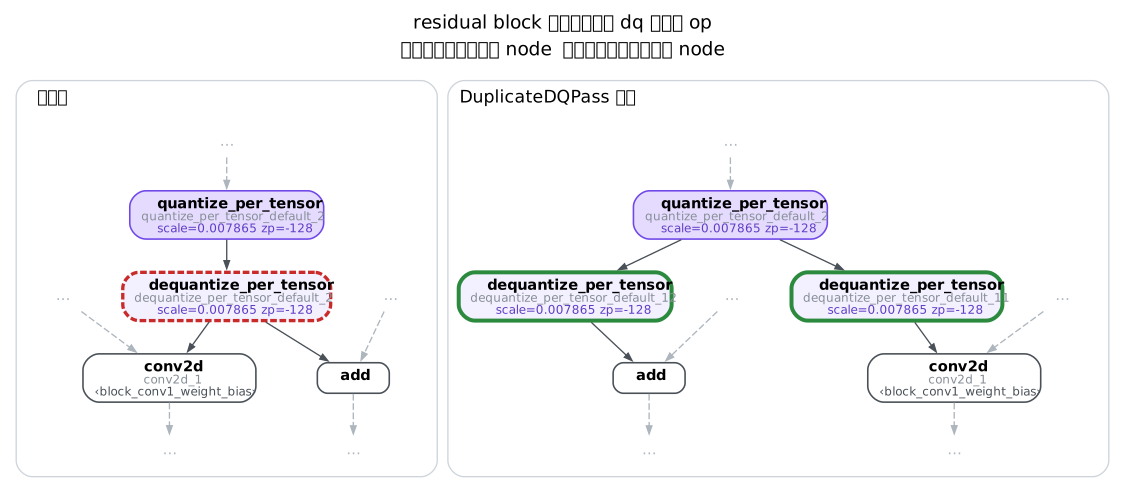
這是 residual block 的入口:同一個 dequantize 同時餵給 conv2d_1 和 add。套用之後,兩個使用者各有一份自己的 dequantize。
共用一個 dq 會有什麼問題?M01 概覽提過,後端要讓 int8 真的變快,是在 Q/DQ 圖上找「dq → op → q」這個 pattern, 把整段換成一個 int8 kernel。這個「把 Q/DQ 圖換成後端 kernel」的動作叫 lowering(M07 起實際做)。
換掉的時候,pattern 裡的 dq 會跟著消失。但上圖左邊那個 dq 還要餵給 add: 如果把「dq → conv2d_1」換成一個 int8 conv,add 就少了輸入。 所以比對 pattern 時,只要 pattern 內部的 node 還有外面的使用者,這一段就不能算配對成功。 torch.fx 的 SubgraphMatcher 就是這樣規定的(原始碼的 _is_contained:配到的 node 不能有 pattern 以外的使用者,pattern 的輸入與輸出除外)。
實際用 SubgraphMatcher 在兩張圖上找「dq → conv2d」(只比對 pattern 的前半段,參數的數值不比對),看哪些 conv 配得到:
def dq_conv_matcher(gm):
    """「dequantize → conv2d」的 pattern;參數個數照圖上的 conv2d,數值不比對(ignore_literals)。"""
    conv = next(n for n in gm.graph.nodes if n.target == torch.ops.aten.conv2d.default)
    dq = conv.args[0]
    pattern = Graph()
    xq, w, b = pattern.placeholder("xq"), pattern.placeholder("w"), pattern.placeholder("b")
    x = pattern.call_function(dq.target, (xq, *dq.args[1:]))
    pattern.output(pattern.call_function(conv.target, (x, w, b, *conv.args[3:])))
    return SubgraphMatcher(pattern, ignore_literals=True)


matcher = dq_conv_matcher(manual)


def matched_convs(gm):
    return sorted(n.name for m in matcher.match(gm.graph) for n in m.nodes_map.values()
                  if n.target == torch.ops.aten.conv2d.default)


table([["套用前(dq 共用)", ", ".join(matched_convs(before))],
       ["DuplicateDQPass 之後", ", ".join(matched_convs(manual))]],
["圖", "配得到「dq → conv2d」的 conv"])| 圖 | 配得到「dq → conv2d」的 conv |
|---|---|
| 套用前(dq 共用) | conv2d, conv2d_2, conv2d_3 |
| DuplicateDQPass 之後 | conv2d, conv2d_1, conv2d_2, conv2d_3 |
assert "conv2d_1" not in matched_convs(before) and "conv2d_1" in matched_convs(manual)套用前,conv2d_1 配不到:它前面的 dq 還要餵 add。套用之後,conv2d_1 和 add 各有自己的 dq, 「dq → conv2d_1」自成一段,後端可以把它換成 int8 conv,add 用自己那份 dq,不受影響。 這就是 DuplicateDQPass 的用途,它的 docstring 也這樣寫:共用一個 dequantize 的使用者無法各自被標註與 lowering。
複製只是多一個參數相同的 node,數值完全等價:
print(f"套用後與 convert_pt2e 的輸出最大差 = {max_diff(official, manual):.3e}")
assert max_diff(official, manual) == 0
套用後與 convert_pt2e 的輸出最大差 = 0.000e+00D. 步驟 5:constant folding
weight 的 quantize 輸入是常數(get_attr 讀的參數),結果不必等到執行時才算。 預先用 op 算出 int8 weight,註冊成 buffer,圖上改用 get_attr 讀它,原本的 quantize node 就沒人用了。
def get_attr_value(gm, target):
    obj = gm
    for part in target.split("."):
        obj = getattr(obj, part)
    return obj


def fold_weight_quantize(gm):
    """quantize_per_channel(get_attr weight) 的結果是常數:預先算好,存成 int8 buffer。"""
    graph = gm.graph
    folded = 0
    for node in list(graph.nodes):
        if node.op != "call_function" or node.target != QD.quantize_per_channel.default:
            continue
        if node.args[0].op != "get_attr":  # 只折 weight;activation 的輸入要到執行時才知道
            continue
        w, scale, zp = (get_attr_value(gm, a.target) for a in node.args[:3])
        w_int8 = QD.quantize_per_channel(w, scale, zp, *node.args[3:])  # 直接呼叫 op,算出 int8 weight
        name = f"_frozen_param{folded}"
        gm.register_buffer(name, w_int8)
        with graph.inserting_before(node):
            new = graph.get_attr(name)
        node.replace_all_uses_with(new)
        graph.erase_node(node)
        folded += 1
    graph.eliminate_dead_code()  # fp32 weight 的 get_attr 沒人用了,一併清掉
    graph.lint()
    gm.recompile()
    return folded


before = copy.deepcopy(manual)
n_fold = fold_weight_quantize(manual)
draw_stages([(before, "folding 前"), (manual, "folding 後")],
            focus=["quantize_per_channel_default", "dequantize_per_channel_default", "conv2d"], hops=0,
            title="stem 的 weight:quantize 預先算好")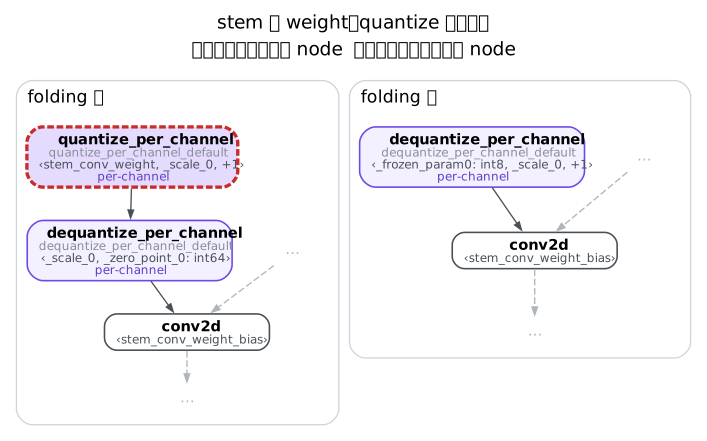
左邊的 quantize_per_channel 吃 fp32 的 stem_conv_weight;右邊它消失了,dequantize 直接讀 int8 的 _frozen_param0。 圖上實際使用的 weight(get_attr 讀的、≥ 2 維的 tensor,bias 是 1 維不算)變小了:
def graph_weight_bytes(gm):
    total = 0
    for n in gm.graph.nodes:
        if n.op == "get_attr":
            t = get_attr_value(gm, n.target)
            if isinstance(t, torch.Tensor) and t.dim() >= 2:
                total += t.numel() * t.element_size()
    return total


table([["folding 前", f"{graph_weight_bytes(before):,}"],
       ["folding 後", f"{graph_weight_bytes(manual):,}"],
       ["convert_pt2e", f"{graph_weight_bytes(official):,}"]],
["圖", "weight 大小(bytes)"])| 圖 | weight 大小(bytes) |
|---|---|
| folding 前 | 39,104 |
| folding 後 | 9,776 |
| convert_pt2e | 9,776 |
assert n_fold == 5
assert graph_weight_bytes(before) == 4 * graph_weight_bytes(manual) == 4 * graph_weight_bytes(official)
fp32 是 4 bytes、int8 是 1 byte,正好縮小 4 倍,與 convert_pt2e 相同。最後比一次 op 組成與輸出:
table(diff_ops(official, manual, "official", "manual", tablefmt="html"))| op | official | manual | delta |
|---|---|---|---|
| adaptive_avg_pool2d | 1 | 1 | 0 |
| add | 1 | 1 | 0 |
| conv2d | 4 | 4 | 0 |
| dequantize_per_channel | 5 | 5 | 0 |
| dequantize_per_tensor | 12 | 12 | 0 |
| flatten | 1 | 1 | 0 |
| linear | 1 | 1 | 0 |
| max_pool2d | 2 | 2 | 0 |
| quantize_per_tensor | 11 | 11 | 0 |
| relu | 4 | 4 | 0 |
print(f"與 convert_pt2e 的輸出最大差 = {max_diff(official, manual):.3e}")
assert op_counts(official) == op_counts(manual) and max_diff(official, manual) == 0
與 convert_pt2e 的輸出最大差 = 0.000e+00三個步驟做完,手寫的圖與 convert_pt2e 的 op 組成、輸出都完全相同。被略過的兩步(_fold_conv_bn_qat、PortNodeMetaForQDQ)在這張 PTQ 圖上不影響結果。
小結
- observer → q/dq 是把校準得到的 scale、zero point 寫死進圖:convert 之前它們存在 observer 模組裡,之後是圖上的常數或 buffer。
- convert 只透過
calculate_qparams()讀 qparams(torchaoconvert.py),FakeQuantize也有這個方法,所以 QAT 的圖走同一條路。 - weight 的 quantize 輸入是常數,可以預先算好、只存 int8;activation 的 q/dq 要等執行時才有輸入,必須留在圖上。
- 結果仍是 Q/DQ 圖:dequantize 後面接的還是 fp32 的
conv2d,不會變快。換成整數 kernel 是後端的事(M07~M09)。