import copy

import torch

from common.models import ConvBnReLU, ConvReLU, example_inputs
from common.pt2e import convert_pt2e, export_module, prepare_qat_pt2e, quiet
from common.qat import freeze_for_eval, qat_quantizer
from common.viz import draw, draw_stages, table
from common.weight_norm import add_weight_norm, strip_weight_norm

quiet()
_ = torch.manual_seed(0)


def make(cls):
    """小模型,BN 先暖過幾個 batch,再對 conv.weight 套用 weight_norm。"""
    torch.manual_seed(0)
    m = cls(3, 8).train()
    with torch.no_grad():
        for _ in range(3):
            m(torch.randn(16, 3, 16, 16))
    add_weight_norm(m.eval())
    return m


def prepare(model):
    return prepare_qat_pt2e(export_module(model, example_inputs(), train=True), qat_quantizer(bits=8))


def short_train(prepared, steps=5):
    """幾步 SGD,只為了確認 g、v 會被更新;loss 隨便取。"""
    opt = torch.optim.SGD(prepared.parameters(), lr=1e-2)
    for _ in range(steps):
        opt.zero_grad()
        prepared(torch.randn(16, 3, 16, 16)).pow(2).mean().backward()
opt.step()M06-6(選讀)| weight_norm 在 QAT:訓練時保留 g、v,convert 前才從圖上拔掉

weight_norm 是什麼、export 之後長什麼樣、PTQ 怎麼處理,見 M05-5。 PTQ 不訓練,拿掉 weight_norm 沒有損失;QAT 要訓練,在 export 前 remove_parametrizations 就等於放棄訓練 \(g\)、\(v\)。 這本 notebook 看「保留到訓練結束」要怎麼做:
- A. 沒有 BN:\(g\)、\(v\) 都有梯度、都在更新;convert 把
_weight_norm折成常數,不需要額外處理。 - B. 有 BN:
prepare_qat_pt2e成功,convert_pt2e在折 BN 時報ValueError。 - C. 解法:訓練之後、convert 之前,用
strip_weight_norm把 weight 改回get_attr。
改圖的基本動作見 M00-4,QAT 的 conv + BN 子圖見 M04-2。
add_weight_norm、strip_weight_norm 是本專案的工具(common/weight_norm.py),M05-5 介紹過;qat_quantizer、freeze_for_eval 見 M06-1、M06-2。
A. 沒有 BN:g、v 都在訓練
conv + relu 套上 weight_norm 之後做 prepare_qat_pt2e:
p = prepare(make(ConvReLU))
NOTES = {"_weight_norm": "W = g·v/‖v‖", "activation_post_process_1": "weight 的 fake quant"}
draw(p, title="prepare_qat_pt2e 之後:weight 的 fake quant 接在 _weight_norm 的輸出", notes=NOTES)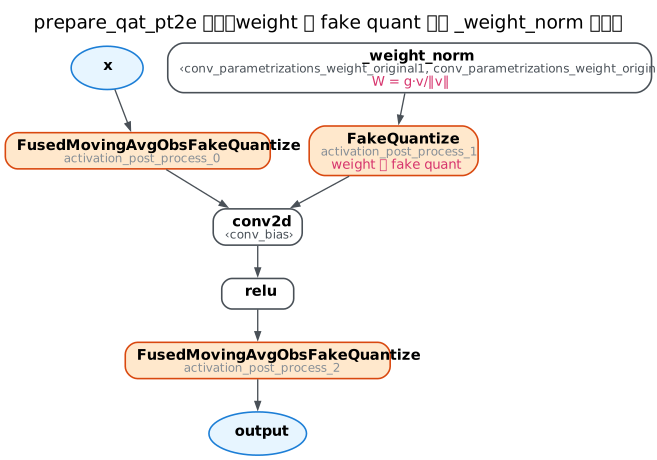
weight 的 fake quant 接在 _weight_norm 的輸出上,量化的是算出來的 \(W\),和 PTQ 的 observer 位置相同(M05-5)。 訓練幾步,看哪些參數有梯度、有更新:
params = dict(p.named_parameters())
before = {k: v.detach().clone() for k, v in params.items()}
short_train(p)
updated = {k: (v.grad is not None and bool(v.grad.abs().sum() > 0), not torch.equal(v, before[k])) for k, v in params.items()}
table([[k, g, u] for k, (g, u) in updated.items()], ["參數", "有梯度", "有更新"])| 參數 | 有梯度 | 有更新 |
|---|---|---|
| conv.bias | True | True |
| conv.parametrizations.weight.original0 | True | True |
| conv.parametrizations.weight.original1 | True | True |
assert all(g and u for g, u in updated.values())
assert any("original0" in k for k in updated) and any("original1" in k for k in updated)
original0 是 \(g\)、original1 是 \(v\)。STE 的梯度穿過 fake quant,再經 _weight_norm 傳回 \(g\)、\(v\),所以 QAT 期間訓練的是 \(g\) 與 \(v\),re-parametrization 仍然有效。\(g\)、\(v\) 的梯度怎麼推、這樣拆對優化有什麼好處,見部落格〈Weight Normalization 的筆記〉。
沒有 BN 時,convert 不需要額外處理:
freeze_for_eval(p)
c = convert_pt2e(copy.deepcopy(p))
draw_stages([(p, "訓練後的 fake quant 圖"), (c, "convert_pt2e")],
            focus=["_weight_norm", "activation_post_process_0", "activation_post_process_1", "conv2d"], hops=0,
            notes=[{"activation_post_process_0": "輸入的 fake quant", "activation_post_process_1": "weight 的 fake quant"}, {}],
            title="沒有 BN:convert 把 _weight_norm 連同 quantize 折成常數")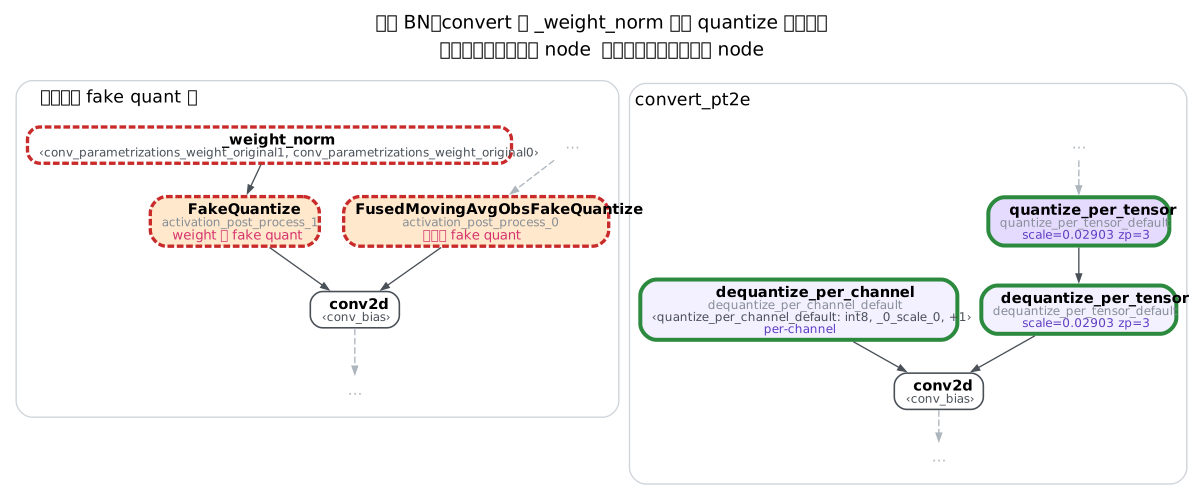
assert "_weight_norm" not in {n.name for n in c.graph.nodes}左圖的兩個 fake quant,在 convert 之後各換成不同的東西:
- 輸入的 fake quant →
quantize_per_tensor+dequantize_per_tensor:輸入的值要到執行時才知道,q/dq 留在圖上(右圖上方那兩個綠框)。 - weight 的 fake quant 連同
_weight_norm→ 一個 int8 常數 +dequantize_per_channel:_weight_norm的輸入全是常數,convert 預設fold_quantize=True,把它連同 weight 的 quantize 一起預先算成 int8 常數(和 M05-5 B 段相同),所以右圖只剩 dequantize。
B. 有 BN:prepare 成功,convert 失敗
p_bn = prepare(make(ConvBnReLU))
FOCUS = ["_weight_norm", "mul", "activation_post_process_1", "conv2d_1"]
draw(p_bn, focus=FOCUS, hops=1, notes={"_weight_norm": "conv + BN 子圖的 weight 來源"},
     title="有 BN:QAT 子圖照常建好,weight 仍來自 _weight_norm")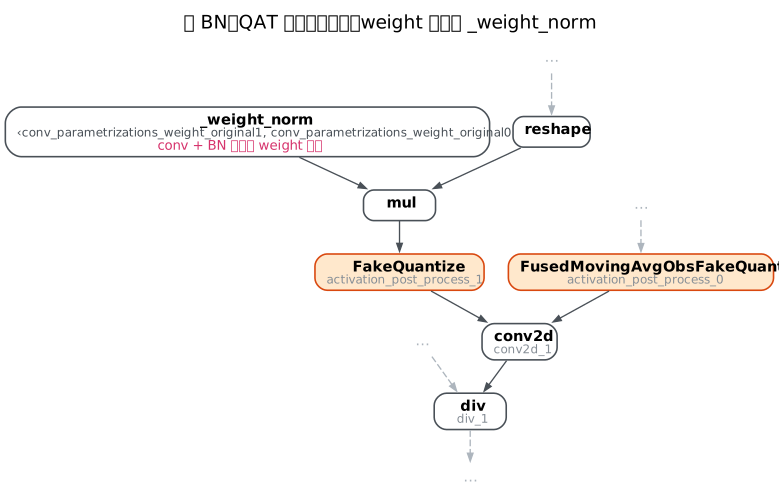
prepare_qat_pt2e 不折 BN,而是把 conv + BN 換成 QAT 子圖(M04-2):weight 先乘上 BN 的係數(mul)再進 fake quant。 建子圖的 pattern 比對不管 weight 從哪裡來,所以接 _weight_norm 也建得起來,訓練照常。問題在最後一步:
short_train(p_bn)
freeze_for_eval(p_bn)
try:
    convert_pt2e(copy.deepcopy(p_bn))
    error = None
except ValueError as e:
    error = e
print("convert_pt2e →", f"{type(error).__name__}: {error}")
assert error is not None
convert_pt2e → ValueError: Expected get_attr node, got call_functionconvert_pt2e 要真的把 BN 折進 conv(_fold_conv_bn_qat,M02-3 的五步之一),得把 weight 當常數讀出來改寫。 讀常數的 torchao 內部函式只接受 get_attr(讀 torchao 0.18 原始碼),weight 是 _weight_norm 這個 call_function 時就報錯。 和 PTQ 的差別是報錯的時機:PTQ 在 prepare_pt2e 一開始就報(M05-5),QAT 要到訓練全部做完、convert 時才報。
C. 解法:訓練之後、convert 之前,把 weight 改回 get_attr
strip_weight_norm(gm) 用圖上同一顆 _weight_norm、同一組 \(g\)、\(v\) 算出 weight,存成參數、插一個 get_attr node,replace_all_uses_with 讓下游改接它,再刪掉 _weight_norm(M00-4 的改圖動作):
fixed = copy.deepcopy(p_bn)
x = torch.randn(32, 3, 16, 16)
with torch.no_grad():
    y_before = fixed(x)
print("拔掉的 weight:", strip_weight_norm(fixed))
print("strip 之後的參數:", [n for n, _ in fixed.named_parameters()])
draw_stages([(p_bn, "訓練後的 fake quant 圖"), (fixed, "strip_weight_norm 之後")], focus=FOCUS, hops=1,
            title="_weight_norm 換成 get_attr(‹conv_weight›)")
拔掉的 weight: ['conv.weight']
strip 之後的參數: ['conv.weight', 'bn.weight', 'bn.bias']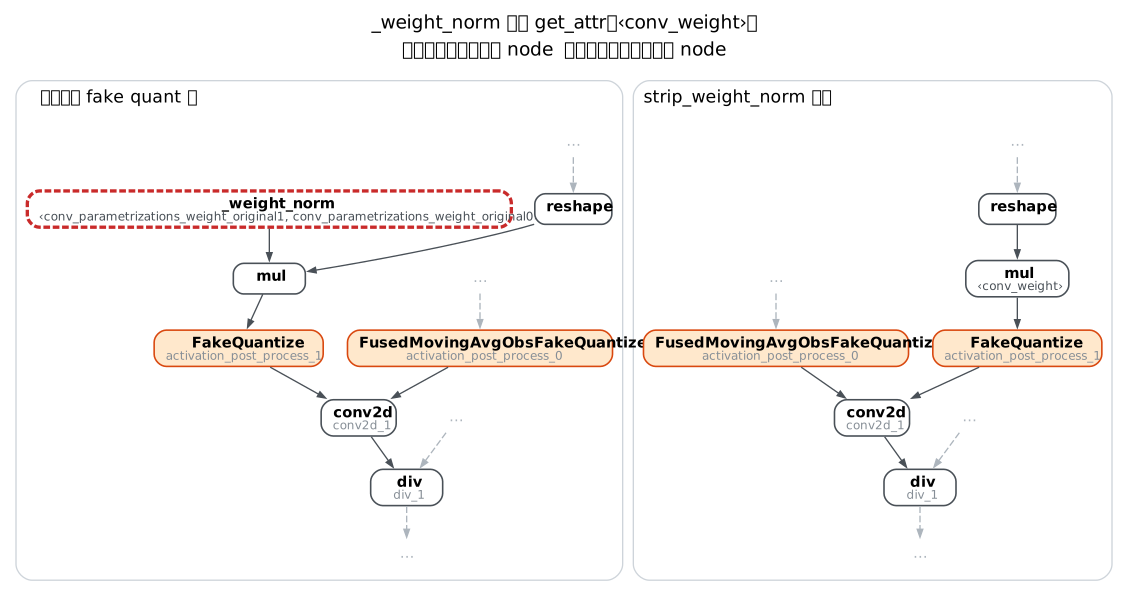
圖上 mul 的 weight 輸入變成 ‹conv_weight›。現在可以 convert,BN 也折進 conv 了:
converted = convert_pt2e(copy.deepcopy(fixed))
draw(converted, focus=lambda n: n.name.startswith("conv2d"), hops=2, title="convert_pt2e 之後:batch_norm 已折進 conv")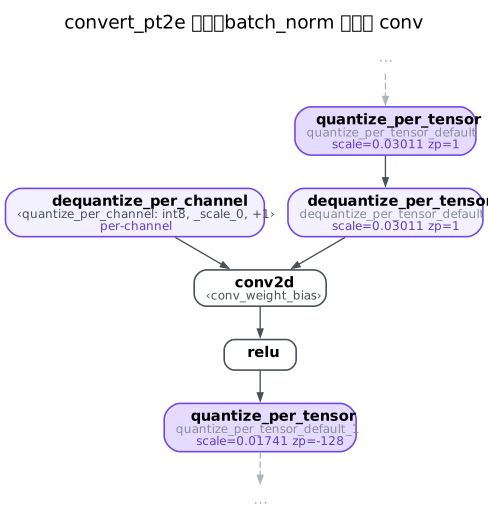
with torch.no_grad():
    y_after, y_conv = fixed(x), converted(x)
checks = {"strip 前 vs 後的 fake quant 圖(torch.equal)": torch.equal(y_before, y_after),
          "strip 後的 fake quant 圖 vs convert 圖(torch.allclose)": torch.allclose(y_after, y_conv)}
table([[k, v] for k, v in checks.items()], ["同一批 32 筆輸入的輸出", "結果"])| 同一批 32 筆輸入的輸出 | 結果 |
|---|---|
| strip 前 vs 後的 fake quant 圖(torch.equal) | True |
| strip 後的 fake quant 圖 vs convert 圖(torch.allclose) | True |
assert all(checks.values())
assert not any("batch_norm" in str(n.target) for n in converted.graph.nodes)
兩項檢查各查一件事:
- strip 前後逐位元相同:查改圖有沒有接錯。weight 是用同一顆 op、同一組 \(g\)、\(v\) 算的,數值必然相同;會出錯的是新的
get_attr指到哪個參數、下游是否都改接過去。 - convert 圖和 fake quant 圖一致:B 段在這一步失敗,這裡跑得完,而且輸出一致,表示折 BN 讀到的是正確的 weight。
為什麼要在訓練之後才拔:拔掉之後圖上只剩 \(W\) 這個常數,訓練前呼叫就等於 remove_parametrizations,放棄訓練 \(g\)、\(v\)。
小結
- QAT 時 fake quant 接在
_weight_norm的輸出上,梯度經它傳回 \(g\)、\(v\)。 - 沒有 BN 不必處理;有 BN 時
prepare_qat_pt2e能過,convert_pt2e折 BN 才報錯。 - 流程:
export(train=True)→prepare_qat_pt2e→ 訓練 →freeze_for_eval→strip_weight_norm→convert_pt2e。 - 這裡沒有比較 weight_norm 對 QAT 精度的影響。