import copy

import torch
from torch.nn.utils import parametrize

from common.data import calibration_batches
from common.graph_utils import op_counts
from common.models import ConvBnReLU, ConvReLU, example_inputs
from common.pt2e import convert_pt2e, export_module, get_xnnpack_quantizer, prepare_pt2e, quiet
from common.viz import draw, draw_stages, table
from common.weight_norm import add_weight_norm, strip_weight_norm

quiet()
_ = torch.manual_seed(0)


def make(cls, wrap=True):
    """小模型,BN 先暖過幾個 batch;wrap=True 時對 conv.weight 套用 weight_norm。"""
    torch.manual_seed(0)
    m = cls(3, 8).train()
    with torch.no_grad():
        for _ in range(3):
            m(torch.randn(16, 3, 16, 16))
    m.eval()
    if wrap:
        add_weight_norm(m)
    return m


def ptq(gm, **convert_kwargs):
    """prepare → 校準 128 筆 → convert,回傳 (prepared, converted)。"""
    prepared = prepare_pt2e(gm, get_xnnpack_quantizer(is_per_channel=True)[0])
    with torch.no_grad():
        for batch in calibration_batches(128):
            prepared(*batch)
    return prepared, convert_pt2e(copy.deepcopy(prepared), **convert_kwargs)


x = torch.randn(8, 3, 16, 16)M05-5(選讀)| weight_norm 在 PTQ:沒有 BN 能過,有 BN 要先拿掉

torch.nn.utils.parametrize 讓一個參數變成「由別的參數算出來」。weight_norm 就是一例:它把 conv.weight 換成 \(g \cdot v / \lVert v \rVert\)(\(g\) 存在 original0、\(v\) 存在 original1),每次存取 conv.weight 都重新計算。 不熟 parametrize 的話,先看官方的 parametrize 教學 與 weight_norm 文件。 weight_norm 為什麼這樣拆、\(g\) 與 \(v\) 的梯度長什麼樣,建議先讀部落格〈Weight Normalization 的筆記〉。文中用的是舊的 torch.nn.utils.weight_norm,本教材用 torch.nn.utils.parametrizations.weight_norm,拆法相同,只是 \(g\)、\(v\) 存放的名稱不同。
- A. export 之後:weight 變成圖上的一段計算。
- B. 沒有 BN:prepare、convert 都正常。
- C. 有 BN:
prepare_pt2e在折 BN 時報錯。 - D. 兩個解法:export 前在 module 上拿掉,或 export 後在圖上拿掉。
改圖的基本動作見 M00-4,BN 折疊見 M04-1。QAT 要在訓練期間保留 weight_norm,做法不同,見 M06-6。
add_weight_norm(model) 是本專案的工具(common/weight_norm.py),等於對 model.conv 呼叫 torch.nn.utils.parametrizations.weight_norm(model.conv, dim=0)。
A. export 之後:weight 變成一段計算
wn = make(ConvReLU)
with torch.no_grad():
    same = torch.allclose(make(ConvReLU, wrap=False)(x), wn(x), atol=1e-6)
print("model 的參數:", [n for n, _ in wn.named_parameters()])
print("套用 weight_norm 前後,eval 輸出 allclose:", same, "(g 初始化成 ‖v‖,所以一開始值不變)")
assert same

gm = export_module(copy.deepcopy(wn), example_inputs())
draw(gm, title="export 之後:conv 的 weight 來自 _weight_norm")
model 的參數: ['conv.bias', 'conv.parametrizations.weight.original0', 'conv.parametrizations.weight.original1']
套用 weight_norm 前後,eval 輸出 allclose: True (g 初始化成 ‖v‖,所以一開始值不變)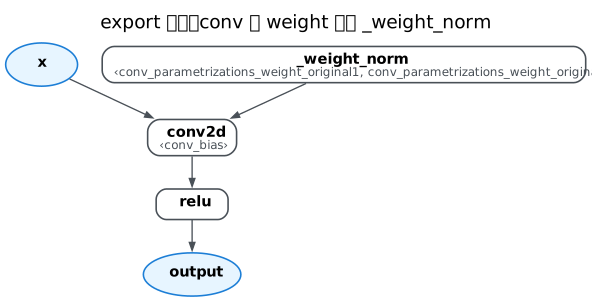
parametrize 把 weight 變成一個 property,export 只是追蹤 forward 的執行過程,所以 \(g \cdot v / \lVert v \rVert\) 這段計算進了圖(aten._weight_norm)。 真正的參數是 original0(\(g\))與 original1(\(v\)),寫在 _weight_norm 底下。 之後每個「對 weight 做事」的步驟,看到的都是這個 call_function node,不是 get_attr。
B. 沒有 BN:prepare、convert 都正常
prepared, converted = ptq(copy.deepcopy(gm))
_, no_fold = ptq(copy.deepcopy(gm), fold_quantize=False)
draw_stages([(gm, "export"), (prepared, "prepare_pt2e"), (converted, "convert_pt2e")], title="沒有 BN 的 weight_norm conv")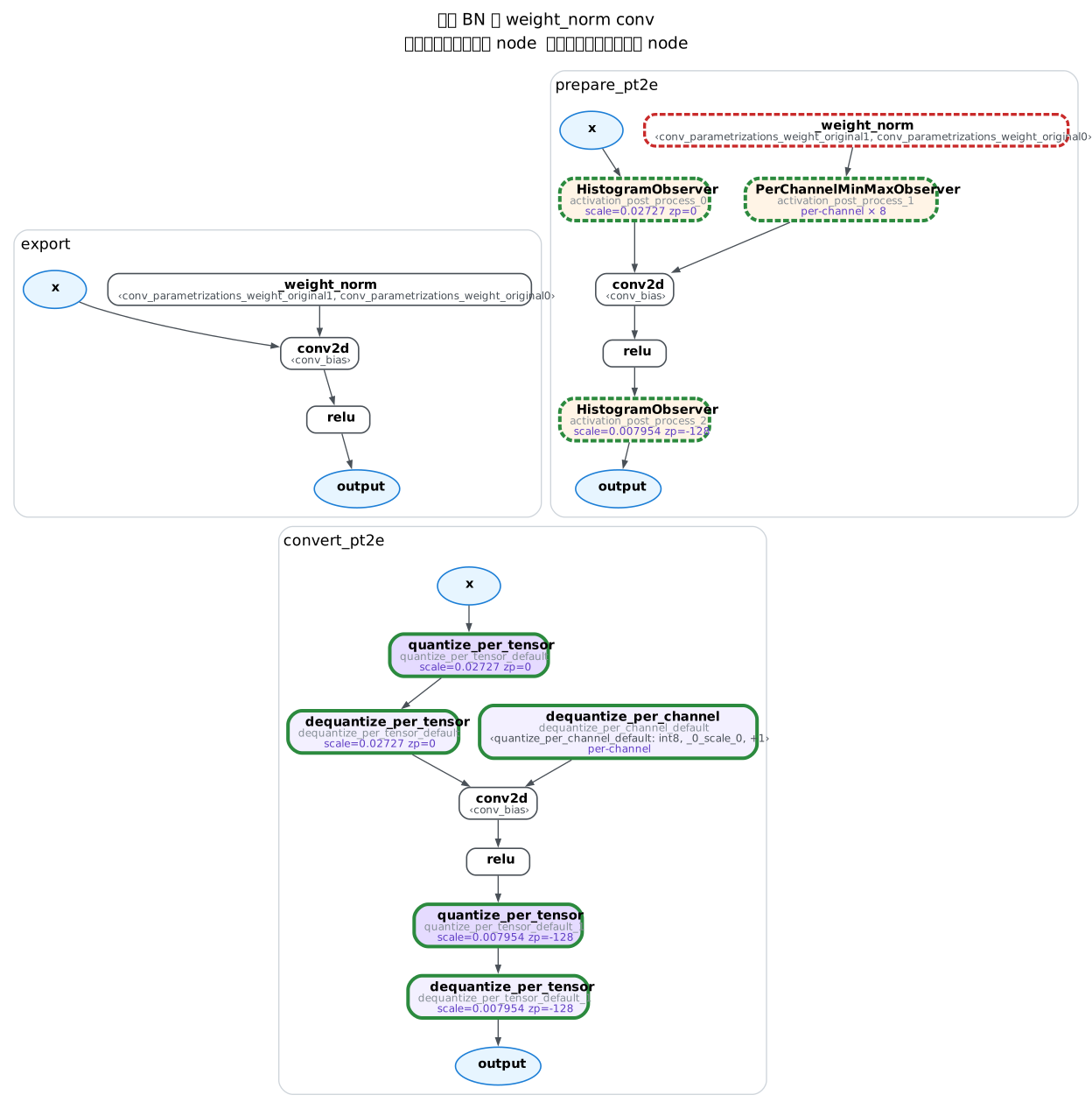
rows = [["prepare_pt2e 之後", "_weight_norm" in op_counts(prepared)],
        ["convert_pt2e(prepared)", "_weight_norm" in op_counts(converted)],
        ["convert_pt2e(prepared, fold_quantize=False)", "_weight_norm" in op_counts(no_fold)]]
table(rows, ["哪一張圖", "還有 _weight_norm?"])| 哪一張圖 | 還有 _weight_norm? |
|---|---|
| prepare_pt2e 之後 | True |
| convert_pt2e(prepared) | False |
| convert_pt2e(prepared, fold_quantize=False) | True |
assert [r[1] for r in rows] == [True, False, True]- prepare 之後,weight 的 observer 掛在
_weight_norm的輸出上:量化的是「算出來的 weight」,和一般的 conv 一樣。 convert_pt2e預設fold_quantize=True,會把「輸入全是常數」的 quantize 預先算成 int8 常數(M02-3),_weight_norm的輸入也全是常數,所以跟著 quantize 一起消失。fold_quantize=False時兩者都留著。
C. 有 BN:prepare_pt2e 在折 BN 時報錯
wn_bn = make(ConvBnReLU)
with torch.no_grad():
    y_wn_bn = wn_bn(x)
gm_bn = export_module(copy.deepcopy(wn_bn), example_inputs())
draw(gm_bn, title="有 BN 的 weight_norm conv:export 之後")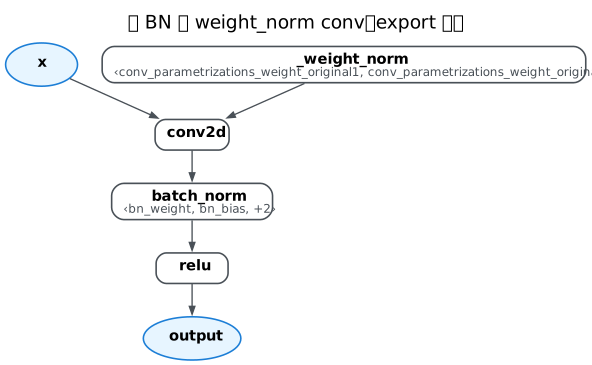
try:
    prepare_pt2e(copy.deepcopy(gm_bn), get_xnnpack_quantizer(is_per_channel=True)[0])
    error = None
except ValueError as e:
    error = e
print("prepare_pt2e →", f"{type(error).__name__}: {error}")
assert error is not None
prepare_pt2e → ValueError: Expected get_attr node, got call_functionPTQ 在 prepare_pt2e 一開始就折 BN(M04-1):要把 conv 的 weight 當常數讀出來、乘上 BN 的係數再寫回去。 讀常數的是 torchao 內部函式 _get_tensor_constant_from_node,它只接受 get_attr(讀原始碼)。 weight 是 _weight_norm 這個 call_function 時,就直接報錯,不會默默跳過。
D. 兩個解法
解法一:export 之前,在 module 上呼叫 remove_parametrizations
leave_parametrized=True 會把當下算出來的 weight 存成一般的參數,再拿掉 parametrization:
parametrize.remove_parametrizations(wn_bn.conv, "weight", leave_parametrized=True)
with torch.no_grad():
    same = torch.equal(wn_bn(x), y_wn_bn)
print("remove_parametrizations 之後的參數:", [n for n, _ in wn_bn.named_parameters()], ";輸出 torch.equal:", same)
assert same
remove_parametrizations 之後的參數: ['conv.weight', 'bn.weight', 'bn.bias'] ;輸出 torch.equal: True這個解法有一個陷阱:deepcopy 出一份複本,只對複本拿掉 parametrization,原模型也跟著壞:
orig = make(ConvReLU)
clone = copy.deepcopy(orig)
parametrize.remove_parametrizations(clone.conv, "weight", leave_parametrized=True)
try:
    orig(x)
    trap = None
except AttributeError as e:
    trap = e
print("原模型 forward →", f"{type(trap).__name__}: {trap}")
assert trap is not None
原模型 forward → AttributeError: 'ParametrizedConv2d' object has no attribute 'weight'parametrize 把 module 的 __class__ 換成動態產生的 ParametrizedConv2d,deepcopy 不會複製類別,原模型和複本共用同一個類別。 對複本拿掉 parametrization 時,weight property 從共用的類別上被刪掉,原模型就找不到 weight 了。
解法二:export 之後,在圖上把 _weight_norm 換成常數
strip_weight_norm(gm) 是本專案的工具(common/weight_norm.py):用圖上同一顆 _weight_norm 算出 weight, 存成新的參數、插一個 get_attr node,replace_all_uses_with 讓 conv 改吃它,再刪掉 _weight_norm(M00-4 的改圖動作)。
fixed = copy.deepcopy(gm_bn)
print("拔掉的 weight:", strip_weight_norm(fixed))
with torch.no_grad():
    same = torch.equal(fixed(x), gm_bn(x))
print("strip 前後輸出 torch.equal:", same)
assert same
draw_stages([(gm_bn, "export"), (fixed, "strip_weight_norm 之後")], title="解法二:_weight_norm 換成 get_attr")
拔掉的 weight: ['conv.weight']
strip 前後輸出 torch.equal: True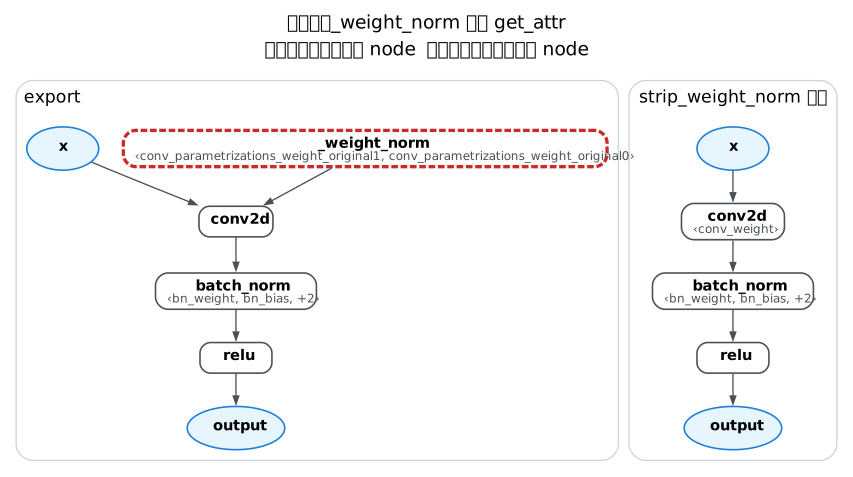
_, c_fixed = ptq(fixed)
print("prepare_pt2e、convert_pt2e 都成功;convert 之後的 op:", dict(op_counts(c_fixed)))
assert "batch_norm" not in op_counts(c_fixed)
prepare_pt2e、convert_pt2e 都成功;convert 之後的 op: {'quantize_per_tensor': 2, 'dequantize_per_tensor': 2, 'dequantize_per_channel': 1, 'conv2d': 1, 'relu': 1}解法二不碰 nn.Module:export 圖上的 conv 是普通的 module,\(g\)、\(v\) 只是它底下的參數,改圖只動這張圖,不必擔心動態類別。 PTQ 不訓練,\(g\)、\(v\) 本來就沒有用處,兩個解法都可以。
小結
- export 把 weight_norm 的計算追蹤進圖,conv 的 weight 變成
aten._weight_norm。 - 沒有 BN 時 PTQ 正常,convert 把它連同 quantize 折成常數;有 BN 時
prepare_pt2e折 BN 要讀常數,直接報錯。 - PTQ 用不到 weight_norm:export 前用
remove_parametrizations(小心 deepcopy 的陷阱),或 export 後用strip_weight_norm。 QAT 要在訓練時保留 \(g\)、\(v\),prepare 也不折 BN,做法見 M06-6。