M07 的三種處理都還在 PyTorch 裡,沒有產生 int8 kernel。這本 notebook 走路線 A(M07 概覽):把 Q/DQ 圖交給 ExecuTorch 的 XNNPACK backend,產生部署檔 .pte,再用 ExecuTorch runtime 執行。
export(static shape)→ PT2E                 Q/DQ 圖(executorch 版 XNNPACKQuantizer,M08-1)
  → to_edge_transform_and_lower             XnnpackPartitioner 切出子圖,編譯成 delegate
  → to_executorch                           memory planning,序列化成 .pte
  → ExecuTorch runtime                      載入 .pte、執行
A. lowering 前後的圖:Q/DQ 圖上的 op 去了哪裡。B. .pte 的檔案大小:fp32 與 int8。C. 用 ExecuTorch runtime 執行 .pte;換一個 batch 大小會怎樣。
每一步的名詞(Edge dialect、partitioner、delegate、memory planning)在 M08 概覽 。這本 notebook 需要 executorch(uv sync --group executorch)。
import tempfilefrom pathlib import Pathimport torchfrom common.pt2e import quiet # 必須在 executorch 之前 import(executorch 會 import torchao) from common.data import trained_tiny_netfrom common.env import capture_stderr, env_summaryfrom common.executorch_utils import PteRunner, delegation_summary, lower_to_xnnpack, xnnpack_ptqfrom common.graph_utils import op_counts, shortfrom common.models import example_inputsfrom common.viz import draw, tablefrom executorch.backends.xnnpack.partition.xnnpack_partitioner import XnnpackPartitioner # noqa: E402 from executorch.exir import to_edge_transform_and_lower # noqa: E402 = torch.manual_seed(0 )print (env_summary())
Darwin arm64|torch 2.14.0|threads=4|mkldnn=False|nnpack=True
起點:static shape 的 Q/DQ 圖
模型是 M05 的 TinyConvNet(訓練過)。xnnpack_ptq 是本專案的包裝(common/executorch_utils.py,不是 executorch 的 API),做的是 M01 起熟悉的 PTQ,只有兩處不同:
export_module(..., dynamic_batch=False):關掉動態 batch,圖只吃 example_inputs 的 batch 大小(這裡是 1)。原因在 C 段。quantizer 用 executorch 版 XNNPACKQuantizer(per-channel weight)。
因為 batch 固定是 1,校準資料也切成一筆一筆餵。
= trained_tiny_net().eval ()= example_inputs(1 )= xnnpack_ptq(model, x) # export(static)→ prepare_pt2e → 校準 → convert_pt2e = op_counts(qdq)= sum (counts.values())= sum (v for k, v in counts.items() if "quantize" in k)print (f"Q/DQ 圖: { n_before} 個 call_function,其中 q/dq { n_qdq} 個" )
Q/DQ 圖:42 個 call_function,其中 q/dq 28 個
A. lowering:Q/DQ 圖上的 op 去了哪裡
只用 executorch 的原始 API,分三步:
= torch.export.export(qdq, x) # 1. 再 export 一次,得到 ExportedProgram = to_edge_transform_and_lower(ep, partitioner= [XnnpackPartitioner()]) # 2. 轉成 Edge dialect,切 delegate = edge.to_executorch().buffer # 3. memory planning,序列化成 .pte 的 bytes = edge.exported_program().graph_module # 第 2 步之後的圖 print (f"Lowering 之後的 GraphModule: { len (lowered.graph.nodes)} 個 node;.pte { len (pte)} bytes" )
Lowering 之後的 GraphModule:5 個 node;.pte 20880 bytes
第 1 步再 export 一次,是因為 to_edge_transform_and_lower 吃的是 ExportedProgram,而 convert_pt2e 回傳的是 GraphModule。這一步也把 shape 依 x 寫死。 本專案把這三步包成 lower_to_xnnpack(gm, example_inputs),回傳 (edge, pte),M08-3、M08-4 用它。
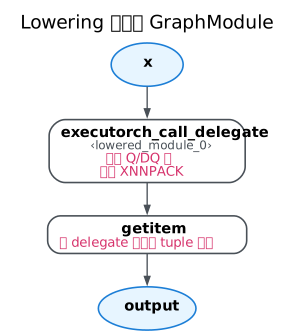
第 2 步之後的圖(lowering 之後的 GraphModule):
= {"executorch_call_delegate" : "整張 Q/DQ 圖 \n 交給 XNNPACK" ,"getitem" : "從 delegate 的輸出 tuple 取值" },= "Lowering 之後的 GraphModule" )
Q/DQ 圖上的 conv、relu、q/dq 都不見了,只剩一顆 executorch_call_delegate。‹lowered_module_0› 是它的 delegate:XNNPACK 編譯好的子圖。
哪些 op 進了 delegate?delegation_summary(本專案的包裝)呼叫 executorch 的 get_delegation_info(lowered),逐一數每個 op 是交給 XNNPACK、還是留在 ExecuTorch。op 名稱是 Edge dialect 的寫法:
= delegation_summary(edge)for op, (d, nd) in sorted (by_op.items())], ["op(Edge dialect 名稱)" , "交給 XNNPACK" , "留在 ExecuTorch" ])
aten_add_tensor
1
0
aten_convolution_default
4
0
aten_linear_default
1
0
aten_max_pool2d_default
2
0
aten_mean_dim
1
0
aten_relu_default
4
0
aten_view_copy_default
1
0
getitem
0
1
quantized_decomposed_dequantize_per_channel_default
5
0
quantized_decomposed_dequantize_per_tensor_default
12
0
quantized_decomposed_quantize_per_tensor_default
11
0
= sorted (op for op, (_, nd) in by_op.items() if nd)print (f"delegate { n_sub} 個;交給 XNNPACK 的 node { n_del} 個(lowering 前有 { n_before} 個),留下的: { left} " )assert n_sub == 1 and n_del == n_before and left == ["getitem" ]
delegate 1 個;交給 XNNPACK 的 node 42 個(lowering 前有 42 個),留下的:['getitem']
Lowering 前的 op 全部進了同一個 delegate,留下的只有 getitem:它是 lowering 時新增的,不是運算。執行時 ExecuTorch 只呼叫 XNNPACK 一次。
名稱變了:conv2d 在 Edge dialect 已經 decompose 成 convolution,adaptive_avg_pool2d 變成 mean,flatten 變成 view_copy。
q/dq 也交給了 XNNPACK,但夾在兩個 op 中間的 q/dq 不會變成運算,只留下 int8 tensor 的 scale 與 zero point(M08 概覽〈lowering 時 q/dq 去哪了〉)。
B. .pte 的檔案大小:fp32 與 int8
不量化,直接把 fp32 模型 lower,當作對照:
= lower_to_xnnpack(model, x)= sum (p.numel() for p in model.parameters())"fp32 .pte" , len (pte_fp32), n_params * 4 ], ["int8 .pte" , len (pte), n_params]],"" , ".pte bytes" , "參數全部存成 fp32/int8 的大小" ])
fp32 .pte
45968
39760
int8 .pte
20880
9940
= len (pte) / len (pte_fp32)print (f"int8 .pte 是 fp32 .pte 的 { ratio:.0%} (模型共 { n_params} 個參數)" )assert len (pte) < len (pte_fp32)
int8 .pte 是 fp32 .pte 的 45%(模型共 9940 個參數)
.pte 是自包含的部署檔:圖、weight、delegate 的資料、memory plan 都在裡面。int8 版的 weight 存成 int8,per-channel 的 scale 另外存;Q/DQ 圖上是 fp32 的 bias,lowering 時被量化成 int32 存進去(M08 概覽)。所以第三個 column 的 int8 估計值(每個參數 1 byte)略低於實際。
其餘是圖結構、XNNPACK 子圖的描述、memory plan。這部分不隨參數量成比例變大,模型越大,int8 對 fp32 的比例越接近 1/4(推論,沒有量更大的模型)。
C. 用 ExecuTorch runtime 執行
部署時交出去的就是 .pte 檔。先寫到檔案,再從檔案載入。 PteRunner 是本專案的包裝:executorch.runtime.Runtime.get().load_program(...) 載入、load_method("forward") 取出 method、execute([...]) 執行(原始 API 在 M08 概覽)。它會一直留著 load_program 回傳的 Program:只留 Method、讓 Program 被回收的話,Method 執行時會讀到已釋放的記憶體。
with tempfile.TemporaryDirectory() as d:= Path(d) / "tiny_int8.pte" = PteRunner(path)= runner(x[0 ])with torch.no_grad():= qdq(x[0 ])= [n for n in qdq.graph.nodes if short(n.target) == "quantize_per_tensor" ][- 1 ].args[1 ]print (f"輸入 { tuple (x[0 ].shape)} → 輸出 { tuple (y_pte.shape)} " )print (f"與 Q/DQ 圖的最大差: { (y_pte - y_qdq). abs (). max ():.3g} ( { (y_pte - y_qdq). abs (). max () / out_scale:.2f} 個輸出 LSB)" )
輸入 (1, 3, 16, 16) → 輸出 (1, 4)
與 Q/DQ 圖的最大差:0.0643(1.00 個輸出 LSB)
輸出 LSB 是最後一個 quantize 的 scale:int8 的一格。.pte 用 XNNPACK 的整數 kernel 算,Q/DQ 圖用 fp32 模擬,兩者不保證逐位元相同(M08 概覽〈和 Q/DQ 圖的數值差異〉);M08-3 C 段用多筆輸入量差多少。
換一個 batch 大小
.pte 是用 batch 1 匯出的。餵 batch 4 試試。ExecuTorch runtime 的 C++ 層會把原因印到 stderr,用本專案的 capture_stderr()(common/env.py)收下來一起印:
with capture_stderr() as log:try :4 , 3 , 16 , 16 ))= None except RuntimeError as e:= str (e)print ("Python 端:" , error)print ("C++ log:" )print (log.text.strip())
Python 端: method->set_inputs() for method 'forward' failed with error 0x10
C++ log:
[tensor_impl.cpp:140] Attempted to resize a static tensor. Expected shape (1, 3, 16, 16), but received (4, 3, 16, 16).
[method.cpp:1246] Error resizing tensor at input 0
assert error is not None and "static tensor" in log.text
to_executorch() 依匯出時的 shape 把每個中間 tensor 的記憶體事先規劃好(memory planning),執行時不再配置記憶體。輸入 tensor 的 shape 因此固定,餵不同的 batch 會在 set_inputs 這一步就失敗。
這就是 M00 起 export_module() 預設開動態 batch(校準時要餵不同 batch 大小)、到了 M08 卻要關掉的原因。ExecuTorch 也支援匯出時給上限的動態 shape(torch.export.Dim("batch", max=…)),本專案沒有用。
小結
to_edge_transform_and_lower 把 XNNPACK 吃得下的子圖整塊交出去;TinyConvNet 整張圖都進了同一個 delegate。.pte 自帶圖、int8 weight 與 memory plan,用 ExecuTorch runtime 載入就能執行。memory plan 依匯出時的 shape 決定,所以 static shape 匯出的 .pte 只吃那個 batch。
不支援的 op 會怎樣在 M08-3;有沒有變快在 M08-4。