import copy

import torch
from torch.fx import Node

from common.graph_utils import observer_nodes
from common.models import example_inputs, get_model
from common.pt2e import (
    ANNOTATION_KEY,
    MovingAverageMinMaxObserver,
    QuantizationSpec,
    Quantizer,
    SharedQuantizationSpec,
    annotate_input_qspec_map,
    annotate_output_qspec,
    convert_pt2e,
    export_module,
    prepare_pt2e,
    quiet,
)
from common.qspecs import act_spec
from common.viz import draw, table

quiet()
_ = torch.manual_seed(0)
ADD = torch.ops.aten.add.TensorM03-4 | 共用 qparams:SharedQuantizationSpec 與隱式共用

兩個 int8 tensor 要做整數加法(或 concat)時,必須在同一個尺度上:scale 不同的整數不能直接相加,硬體得先 rescale 其中一個。 所以有些後端要求 add、cat 的所有輸入與輸出共用同一組 (scale, zero point)。
在 PT2E 裡,「共用 qparams」的做法是讓幾個位置共用同一個 observer 實例:這個 observer 看過所有位置的數值,算出一組 scale,大家一起用。 共用有兩種來源:
- 顯式:標籤的規格寫
SharedQuantizationSpec(某個位置),意思是「和那個位置用同一個 observer」。 - 隱式:同一個 tensor 上的兩張標籤屬性相同時,
prepare_pt2e自動合併成一個 observer。M03-1 的 C 段提過。
段落:
- A. 顯式共用:讓 add 的輸入與輸出共用一組 qparams。
- B. 隱式共用:同一個 tensor 同時有輸出標籤與邊標籤時,什麼時候合併、什麼時候串接。
A. 顯式共用:SharedQuantizationSpec
AddQuantizer 用 node.target 找所有 add。第一個輸入邊用一般的 spec;share=True 時,其餘的輸入邊與輸出都寫 SharedQuantizationSpec((第一個輸入, add)):參數是一個位置,邊用 (producer, consumer),node 的輸出直接給 node。
只有 activation 才需要標籤,所以要排除兩種輸入:add(x, 1.0) 的 Python 純量(不是 Node,不能當 input_qspec_map 的 key), 以及 add(x, self.b) 的模型常數(get_attr)。add(x, x) 兩個輸入是同一個 node,要去重。
class AddQuantizer(Quantizer):
    def __init__(self, share: bool):
        self.share = share

    def annotate(self, model):
        for node in model.graph.nodes:
            if node.op != "call_function" or node.target != ADD:
                continue
            ann = node.meta.get(ANNOTATION_KEY)
            if ann is not None and ann._annotated:
                continue
            inputs = list(dict.fromkeys(a for a in node.args[:2] if isinstance(a, Node) and a.op != "get_attr"))
            if not inputs:
                continue
            spec = act_spec()
            annotate_input_qspec_map(node, inputs[0], spec)
            rest = SharedQuantizationSpec((inputs[0], node)) if self.share else spec  # 和「第一個輸入 → add」共用
            for other in inputs[1:]:
                annotate_input_qspec_map(node, other, rest)
            annotate_output_qspec(node, rest)
            node.meta[ANNOTATION_KEY]._annotated = True
        return model

    def validate(self, model):
        pass
第一個模型只有一個 add,兩個輸入的範圍刻意差很多(b 是 a 的 5 倍)。共用與不共用各 prepare 一次、校準,圖上的 observer 會顯示算出的 scale:
class AddOnly(torch.nn.Module):
    def forward(self, a, b):
        return a + b


def make_inputs():
    return torch.randn(4, 8), torch.randn(4, 8) * 5


def prepare_add(gm, share, make_inputs):
    prepared = prepare_pt2e(copy.deepcopy(gm), AddQuantizer(share))
    with torch.no_grad():
        for _ in range(8):
            prepared(*make_inputs())
    return prepared


def instance_notes(prepared):
    """每個 observer node 標上它用的是第幾個 observer 實例。"""
    number: dict[int, int] = {}
    return {n.name: f"實例 #{number.setdefault(id(mod), len(number))}" for n, mod in observer_nodes(prepared)}


gm_add = export_module(AddOnly(), make_inputs())
separate = prepare_add(gm_add, False, make_inputs)
draw(separate, notes=instance_notes(separate), title="不共用:每個位置各有一個 observer")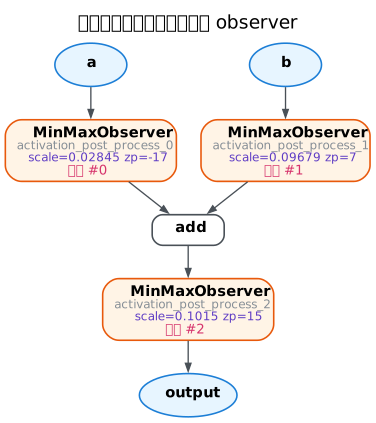
shared = prepare_add(gm_add, True, make_inputs)
draw(shared, notes=instance_notes(shared), title="共用:三個 observer node 指向同一個實例")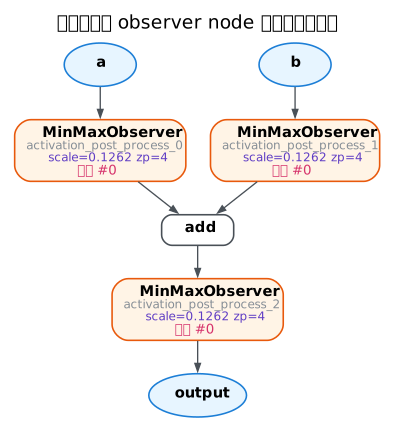
def summary(prepared):
    mods = [mod for _, mod in observer_nodes(prepared)]
    scales = sorted({round(float(m.calculate_qparams()[0]), 6) for m in mods})
    return len(mods), len({id(m) for m in mods}), scales


for title, p in [("不共用", separate), ("共用", shared)]:
    n_nodes, n_instances, scales = summary(p)
    print(f"{title}:observer node {n_nodes} 個、實例 {n_instances} 個、scale {scales}")
assert summary(separate)[1] == 3 and summary(shared)[1] == 1
不共用:observer node 3 個、實例 3 個、scale [0.028452, 0.09679, 0.101465]
共用:observer node 3 個、實例 1 個、scale [0.126223]- 不共用:三個位置各算各的 scale,
b的範圍大,它的 scale 也大。 - 共用:圖上仍有三個 observer node(每個位置都要被觀察),但它們是同一個 observer 實例。這個實例看過
a、b和輸出的所有數值,算出一組涵蓋全部的 scale。
同一個 AddQuantizer 不需要知道模型長什麼樣。換成 residual 模型(add 的輸入是 conv 的輸出與 skip connection 的 x),只畫 add 附近:
gm_res = export_module(get_model("residual").eval(), example_inputs(4))
res_shared = prepare_add(gm_res, True, lambda: (torch.randn(4, 3, 16, 16),))
draw(res_shared, focus="add", hops=2, notes=instance_notes(res_shared), title="residual 的 add:共用")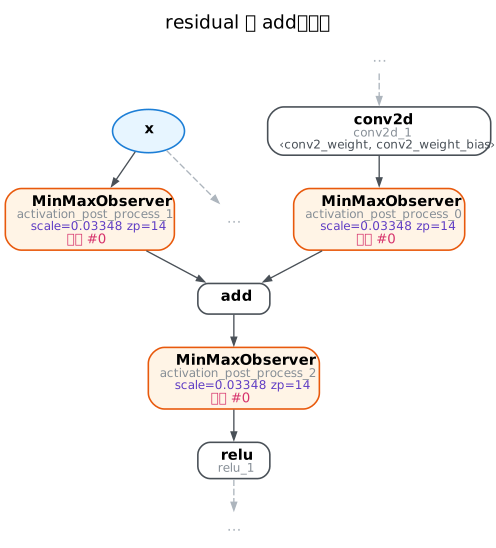
n_nodes, n_instances, _ = summary(res_shared)
print(f"observer node {n_nodes} 個、實例 {n_instances} 個")
assert n_instances == 1 and n_nodes == 3
observer node 3 個、實例 1 個B. 隱式共用:輸出標籤 + 邊標籤
M03-1 的 C 段看過:同一個 tensor 可以有輸出標籤(影響所有 consumer),也可以有邊標籤(只影響一個 consumer)。 兩張都貼的時候會發生什麼?
用 cat_pool 模型(輸入 x 同時餵給 conv2d 與 conv2d_1)。TwoLabelQuantizer 在 x 的輸出貼 spec A,在邊 x → conv2d_1 貼 spec B。 它是為了這個實驗點名寫的,node 名稱只適用 cat_pool。allow_implicit_sharing 是 QuantizationAnnotation 的欄位(預設 True),設成 False 可以關掉合併。
class TwoLabelQuantizer(Quantizer):
    def __init__(self, spec_a, spec_b, implicit=True):
        self.spec_a, self.spec_b, self.implicit = spec_a, spec_b, implicit

    def annotate(self, model):
        nodes = {n.name: n for n in model.graph.nodes}
        annotate_output_qspec(nodes["x"], self.spec_a)
        annotate_input_qspec_map(nodes["conv2d_1"], nodes["x"], self.spec_b)
        nodes["conv2d_1"].meta[ANNOTATION_KEY].allow_implicit_sharing = self.implicit
        return model

    def validate(self, model):
        pass
四種情況的 spec B:
a = act_spec()  # int8 per-tensor affine [-128, 127],MinMaxObserver
different = QuantizationSpec(  # qscheme 與整數範圍都和 A 不同
    dtype=torch.int8, quant_min=-127, quant_max=127, qscheme=torch.per_tensor_symmetric,
    observer_or_fake_quant_ctr=a.observer_or_fake_quant_ctr,
)
other_observer = QuantizationSpec(  # 量化屬性和 A 完全相同,只有 observer 類別不同
    dtype=a.dtype, quant_min=a.quant_min, quant_max=a.quant_max, qscheme=a.qscheme,
    observer_or_fake_quant_ctr=MovingAverageMinMaxObserver,
)
cases = [
    ("B 與 A 屬性不同", TwoLabelQuantizer(a, different)),
    ("B 與 A 屬性相同", TwoLabelQuantizer(a, a)),
    ("屬性相同,但 allow_implicit_sharing=False", TwoLabelQuantizer(a, a, implicit=False)),
    ("B 與 A 只有 observer 類別不同", TwoLabelQuantizer(a, other_observer)),
]
每種情況都 prepare、校準、convert,印出 x 走到 conv2d_1 的路上經過什麼(obs = observer,q/dq = quantize/dequantize):
def path_to(gm, consumer):
    """x 走到 consumer 的路上依序經過的 node。"""
    steps, src = [], next(n for n in gm.graph.nodes if n.name == consumer).args[0]
    while src.op != "placeholder":
        target = str(src.target)
        steps.append("obs" if src.op == "call_module" else "dq" if "dequantize" in target else "q")
        src = src.args[0]
    return " → ".join(["x", *reversed(steps), consumer])


gm_cat = export_module(get_model("cat_pool").eval(), example_inputs(4))
rows = []
for title, quantizer in cases:
    prepared = prepare_pt2e(copy.deepcopy(gm_cat), quantizer)
    obs = observer_nodes(prepared)
    kinds = ", ".join(sorted({type(m).__name__ for _, m in obs}))
    before = path_to(prepared, "conv2d_1")
    with torch.no_grad():
        for _ in range(4):
            prepared(torch.randn(4, 3, 16, 16))
    rows.append([title, len(obs), kinds, before, path_to(convert_pt2e(prepared), "conv2d_1")])
table(rows, ["情況", "observer 數", "observer 類別", "prepare 之後", "convert 之後"])| 情況 | observer 數 | observer 類別 | prepare 之後 | convert 之後 |
|---|---|---|---|---|
| B 與 A 屬性不同 | 2 | MinMaxObserver | x → obs → obs → conv2d_1 | x → q → dq → q → dq → conv2d_1 |
| B 與 A 屬性相同 | 1 | MinMaxObserver | x → obs → conv2d_1 | x → q → dq → conv2d_1 |
| 屬性相同,但 allow_implicit_sharing=False | 2 | MinMaxObserver | x → obs → obs → conv2d_1 | x → q → dq → q → dq → conv2d_1 |
| B 與 A 只有 observer 類別不同 | 1 | MinMaxObserver | x → obs → conv2d_1 | x → q → dq → conv2d_1 |
assert [r[1] for r in rows] == [2, 1, 2, 1]
assert rows[0][4] == "x → q → dq → q → dq → conv2d_1" and rows[1][4] == "x → q → dq → conv2d_1"
assert rows[3][2] == "MinMaxObserver"- 屬性不同:兩張標籤串接。
x先被 A 量化,再被 B 量化一次,convert 之後是兩層 q/dq,捨入兩次。不是誰覆蓋誰,也不會報錯。 - 屬性相同:自動合併成一個 observer,只量化一次。它們本來就是同一個 tensor,沒必要量化兩次,這就是隱式共用。
allow_implicit_sharing=False:不合併,回到兩個 observer 串接。關掉之後要自己負責同一個 tensor 不被量化兩次。- 比的是量化屬性(dtype、整數範圍、qscheme…),不比 observer 類別。只有 observer 類別不同時也會合併, 留下的是 A 的
MinMaxObserver,B 指定的MovingAverageMinMaxObserver被默默忽略(這張圖上 A 的標籤在 graph 順序上先出現)。
要讓同一個 tensor 只量化一次:讓所有標籤的屬性一致,或明確用 SharedQuantizationSpec 指向同一個位置。
小結
- 共用 qparams = 幾個位置共用同一個 observer 實例;圖上仍是好幾個 observer node。
- 顯式:
SharedQuantizationSpec(位置),位置是(producer, consumer)的邊或一個 node 的輸出。 - 隱式:同一個 tensor 上屬性相同的標籤自動合併;屬性不同則串接成兩次量化,不報錯。