Partitioner 在圖上找出後端吃得下的連通子圖,每一塊編譯成一個 delegate;吃不下的 op 留在圖上,由 ExecuTorch 自己的 portable kernel(通用的 C++ 實作)執行。 M08-2 的 TinyConvNet 整張圖都進了 XNNPACK。這裡刻意在兩個 conv 中間塞一個 cumsum:XNNPACKQuantizer 不標它,XnnpackPartitioner 也不收它(executorch 1.5.0 實測)。
- A. 量化:
cumsum 沒有標籤,在 Q/DQ 圖上跑 fp32。
- B. lowering:圖在
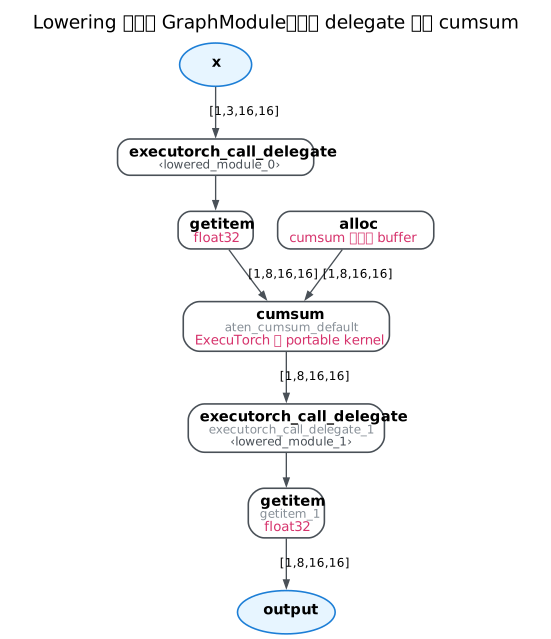
cumsum 前後被切成兩個 delegate,兩塊之間傳 fp32。
- C. 執行:
.pte 和 Q/DQ 圖的輸出差多少。
這本 notebook 需要 executorch(uv sync --group executorch)。
import torch
import torch.nn as nn

from common.pt2e import quiet  # 必須在 executorch 之前 import
from common.env import env_summary
from common.executorch_utils import PteRunner, delegation_summary, lower_to_xnnpack, xnnpack_ptq
from common.graph_utils import op_counts, short
from common.models import example_inputs
from common.pt2e import get_xnnpack_quantizer, export_module
from common.viz import annotation_notes, draw, table

quiet()
_ = torch.manual_seed(0)
print(env_summary())
Darwin arm64|torch 2.14.0|threads=4|mkldnn=False|nnpack=True
class ConvCumsumConv(nn.Module):
    """conv → relu → cumsum → conv。cumsum 沿 channel 累加。"""

    def __init__(self, ch=8):
        super().__init__()
        self.conv1 = nn.Conv2d(3, ch, 3, padding=1)
        self.conv2 = nn.Conv2d(ch, ch, 3, padding=1)

    def forward(self, x):
        y = torch.relu(self.conv1(x))
        y = torch.cumsum(y, dim=1)
        return self.conv2(y)


model = ConvCumsumConv().eval()
x = example_inputs(1)
A. 量化:cumsum 沒有標籤
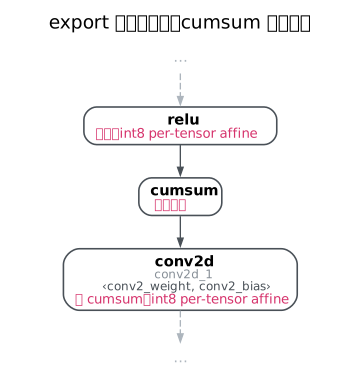
先只看標籤:export 之後呼叫 executorch 版 XNNPACKQuantizer 的 annotate,標籤畫在 node 底下(M03-2):
labeled = export_module(model, x, dynamic_batch=False)
get_xnnpack_quantizer("executorch", is_per_channel=True)[0].annotate(labeled)
notes = annotation_notes(labeled, unlabeled=True)
draw(labeled, focus=["relu", "cumsum", "conv2d_1"], hops=0,
     notes={k: notes[k] for k in ["relu", "cumsum"]} | {"conv2d_1": notes["conv2d_1"].split("\n")[0]},
     title="export 圖上的標籤:cumsum 沒有標籤")
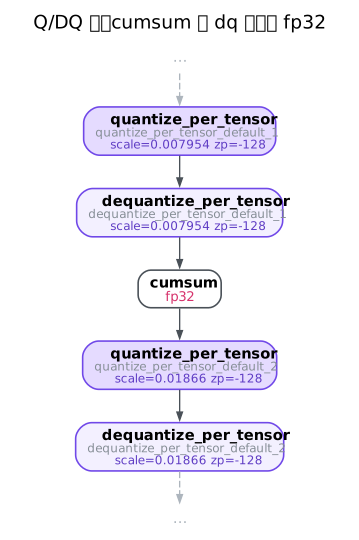
XNNPACKQuantizer 沒有 cumsum 的 annotator,所以 cumsum 沒有標籤(M03-6 的 fallback)。它的上下游都有標籤:relu 的輸出要量化(conv-relu 的輸出),conv2d_1 的輸入邊要量化。 做完 PTQ(xnnpack_ptq,M08-2)之後,cumsum 前後各一對 q/dq:
qdq = xnnpack_ptq(model, x)
draw(qdq, focus="cumsum", hops=2, notes={"cumsum": "fp32"}, title="Q/DQ 圖:cumsum 吃 dq 出來的 fp32")
cumsum 吃 dequantize 出來的 fp32,輸出 fp32,再被量化一次給 conv2d_1。
B. lowering:圖被切成兩個 delegate
edge, pte = lower_to_xnnpack(qdq, x)  # 本專案的包裝:export → to_edge_transform_and_lower → to_executorch(M08-2 A)
lowered = edge.exported_program().graph_module
draw(lowered, show_shapes=True,
     notes={"aten_cumsum_default": "ExecuTorch 的 portable kernel", "alloc": "cumsum 的輸出 buffer",
            **{n.name: str(n.meta["val"].dtype).removeprefix("torch.") for n in lowered.graph.nodes
               if short(n.target) == "getitem"}},
     title="Lowering 之後的 GraphModule:兩個 delegate 夾著 cumsum")
請看兩個 executorch_call_delegate 之間:getitem 取出前一塊的輸出,交給 cumsum,cumsum 的輸出再進後一塊。邊上標的是 shape,getitem 底下標的是它輸出的 dtype(取自 node.meta["val"]):float32。 cumsum 前後的 dq、q 被收進兩邊的 delegate,前一塊最後把 int8 轉回 fp32,後一塊開頭再轉成 int8。
alloc 是 to_executorch() 替 cumsum 事先配好的輸出 buffer(memory planning,M08-2 C),getitem 從 delegate 的輸出 tuple 取值,兩者都不是運算。
用 delegation_summary 數每個 op 的去向:
n_sub, n_del, n_non, by_op = delegation_summary(edge)
table([[op, d, nd] for op, (d, nd) in sorted(by_op.items())], ["op(Edge dialect 名稱)", "交給 XNNPACK", "留在 ExecuTorch"])
| alloc |
0 |
1 |
| aten_convolution_default |
2 |
0 |
| aten_cumsum_default |
0 |
1 |
| aten_relu_default |
1 |
0 |
| getitem |
0 |
2 |
| quantized_decomposed_dequantize_per_channel_default |
2 |
0 |
| quantized_decomposed_dequantize_per_tensor_default |
4 |
0 |
| quantized_decomposed_quantize_per_tensor_default |
4 |
0 |
n_before = sum(op_counts(qdq).values())
left = {op: nd for op, (_, nd) in by_op.items() if nd}
print(f"delegate {n_sub} 個;Q/DQ 圖的 {n_before} 個 op 中,{n_del} 個進了 delegate;留下:{left}")
assert n_sub == 2 and n_del == n_before - 1 and set(left) == {"aten_cumsum_default", "alloc", "getitem"}
assert all(n.meta["val"].dtype == torch.float32 for n in lowered.graph.nodes if short(n.target) == "getitem")  # 邊界傳 fp32
delegate 2 個;Q/DQ 圖的 14 個 op 中,13 個進了 delegate;留下:{'getitem': 2, 'alloc': 1, 'aten_cumsum_default': 1}
Q/DQ 圖上只有 cumsum 沒進 delegate,其餘留下的都是 lowering 新增的 alloc、getitem。 每多一個邊界,就多一次 int8 ↔︎ fp32 轉換,以及一次 ExecuTorch 與 XNNPACK 之間的往返。
量化前用標籤確認「哪些 op 沒被標」(M03-2),部署前用這張表確認「哪些 op 沒進 delegate」。兩者是獨立的決定:
| quantizer 標不標 |
沒標的 op 在 Q/DQ 圖上跑 fp32 |
| partitioner 收不收 |
不收的 op 留在 delegate 外,跑 ExecuTorch 的 portable kernel |
C. 執行:.pte 和 Q/DQ 圖的輸出
.pte 只吃匯出時的 batch 1(M08-2 C),所以 64 筆隨機輸入一次餵一筆:
runner = PteRunner(pte)
xs = torch.randn(64, 3, 16, 16)
with torch.no_grad():
    y_pte = torch.cat([runner(xs[i : i + 1]) for i in range(len(xs))])
    y_qdq = torch.cat([qdq(xs[i : i + 1]) for i in range(len(xs))])
lsb = [n for n in qdq.graph.nodes if short(n.target) == "quantize_per_tensor"][-1].args[1]
same = (y_pte == y_qdq).float().mean().item()
max_lsb = ((y_pte - y_qdq).abs() / lsb).round().max().item()
print(f"輸出逐位元相同:{same:.2%};最大差 {max_lsb:.0f} 個輸出 LSB(輸出 LSB = 最後一個 quantize 的 scale {lsb:.4g})")
輸出逐位元相同:99.69%;最大差 1 個輸出 LSB(輸出 LSB = 最後一個 quantize 的 scale 0.01771)
切成兩塊照樣能跑。和 Q/DQ 圖的差只有幾個輸出 LSB,來自整數 kernel 的捨入(M08 概覽〈和 Q/DQ 圖的數值差異〉)。 不支援的 op 不會讓匯出失敗,只是那一段不在 XNNPACK 上跑。
小結
- quantizer 沒標的 op 跑 fp32;partitioner 不收的 op 留在 delegate 外,跑 ExecuTorch 的 portable kernel。
- 不支援的 op 夾在中間會把圖切開,邊界上傳 fp32,多出 int8 ↔︎ fp32 轉換與 runtime 往返。
- 部署前用
get_delegation_info(delegation_summary)確認哪些 op 沒進 delegate。