import copy
from collections import Counter

import torch

from common.data import calibration_batches, trained_tiny_net
from common.env import cpu_profile, env_summary
from common.graph_utils import QDQ_PREFIXES, diff_ops, op_counts, qdq_nodes, short
from common.models import example_inputs, get_model
from common.pt2e import convert_pt2e, export_module, get_xnnpack_quantizer, lower_pt2e_quantized_to_x86, prepare_pt2e, quiet
from common.viz import draw, table

quiet()
_ = torch.manual_seed(0)
QD = torch.ops.quantized_decomposedM07-2 | 同一張 Q/DQ 圖,經過三種處理各變成什麼 op

到 M06 為止,convert_pt2e 的結果都是 Q/DQ 圖:運算仍是 fp32(conv2d、linear…),前後包著 quantize/dequantize,本身不會變快(M02-3)。 要變成整數運算,得有人把圖「改寫」。這本 notebook 拿同一張 Q/DQ 圖,看三種處理各做了什麼。三個名詞的定義與彼此的關係在 M07 概覽。
- A. 起點:Q/DQ 圖上的「dq → op → q」單元,後端要認出、要換成 int8 kernel 的就是這些。
- B. reference representation:
convert_pt2e(..., use_reference_representation=True)。 - C. lowering:
lower_pt2e_quantized_to_x86。 - D. Inductor:
torch.compile對 Q/DQ 圖做了什麼(用 profiler 看實際跑的 kernel)。
最後用一張總表比較 conv 單元在三種處理後變成什麼。
結果和平台有關:A、B 是純粹的圖改寫,只隨 torch/torchao 的版本變;C、D 取決於機器(有沒有 mkldnn、conv 走哪個 kernel)。 下面存的輸出是在這個環境跑的;表格下的說明依實測印出:
print(env_summary())Darwin arm64|torch 2.14.0|threads=4|mkldnn=False|nnpack=True模型是 M05 的 TinyConvNet,用 XNNPACKQuantizer(per-channel weight)做 PTQ,得到 Q/DQ 圖:
def calibrated(model, per_channel=True):
    """export → prepare(XNNPACKQuantizer)→ 校準,回傳還沒 convert 的 prepared 圖。"""
    prepared = prepare_pt2e(export_module(model, example_inputs()), get_xnnpack_quantizer(is_per_channel=per_channel)[0])
    with torch.no_grad():
        for batch in calibration_batches(128):
            prepared(*batch)
    return prepared


model = trained_tiny_net()
qdq = convert_pt2e(calibrated(model))
(x,) = next(calibration_batches(16, seed=9))
A. 起點:Q/DQ 圖上的「dq → op → q」單元
從每個 activation 的 quantize 往回走,走到 dequantize 為止,中間經過的 op 就是一個單元。 下面的 qdq_units 只認 XNNPACKQuantizer 產生的 per-tensor activation q/dq,不是通用的 pattern 偵測器:
def qdq_units(gm):
    """回傳 {單元的 op: (個數, 輸入與輸出的 (scale, zp) 是否全部相同)}。"""
    units, same = Counter(), {}
    for q in gm.graph.nodes:
        if q.target != QD.quantize_per_tensor.default:
            continue
        ops, in_qparams, frontier = [], set(), [q.args[0]]
        while frontier:
            n = frontier.pop()
            if n.target == QD.dequantize_per_tensor.default:
                in_qparams.add(tuple(n.args[1:3]))  # 輸入的 (scale, zp)
            if n.op != "call_function" or str(n.target).startswith(QDQ_PREFIXES):
                continue  # 走到 dequantize/quantize/placeholder/get_attr 就停
            ops.append(short(n.target))
            frontier += n.all_input_nodes
        if ops:
            key = " + ".join(reversed(ops))
            units[key] += 1
            same[key] = same.get(key, True) and in_qparams == {tuple(q.args[1:3])}
    return {k: (v, same[k]) for k, v in units.items()}


units = dict(sorted(qdq_units(qdq).items(), key=lambda kv: -kv[1][0]))
table([[k, n, "是" if s else "否"] for k, (n, s) in units.items()], ["dq → [op] → q 的 op", "個數", "輸入輸出同 qparams?"])| dq → [op] → q 的 op | 個數 | 輸入輸出同 qparams? |
|---|---|---|
| conv2d + relu | 3 | 否 |
| max_pool2d | 2 | 是 |
| conv2d | 1 | 否 |
| add + relu | 1 | 否 |
| adaptive_avg_pool2d | 1 | 是 |
| flatten | 1 | 是 |
| linear | 1 | 否 |
assert units["conv2d + relu"][0] >= 1 and not units["conv2d + relu"][1]
assert units["max_pool2d"][1]  # max_pool2d 的輸入輸出共用 qparams(M03-4)
以殘差 block 的 add + relu 單元為例:兩個 dequantize 進、一個 quantize 出,中間的 add、relu 都是 fp32:
draw(qdq, focus=["add", "relu_2"], hops=1, title="add + relu 單元:int8 進、int8 出,中間用 fp32 算")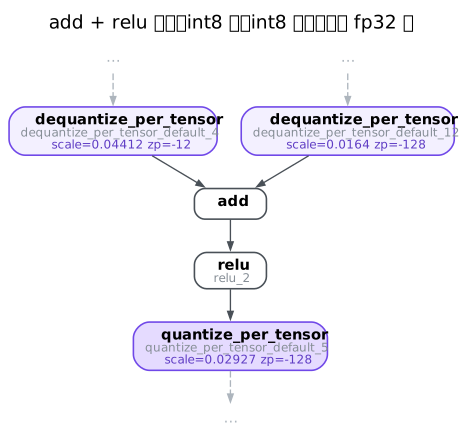
- 每個單元的語意都是「int8 進、int8 出,中間用 fp32 算」。後端要做的,是認出這些單元,換成自己的 int8 kernel(例如 conv2d + relu 換成一顆 int8 conv-relu)。
- Q/DQ 圖不綁任何後端:同一張圖可以交給 Inductor(本 notebook 的 C、D)、XNNPACK(M08)、ONNX Runtime(M09),各自用自己的 pattern 去認。這就是「Q/DQ 是後端中立的交換格式」的意思。
- 輸入輸出共用 qparams 的單元(上表「是」的那幾種,M03-4 的 Shared):整數 kernel 不必換 scale,max/flatten 直接搬 int8 值。
- 輸出 scale 和輸入不同的單元:整數 kernel 最後要 requantize,把累加結果換到輸出的 scale。
B. reference representation
convert_pt2e(..., use_reference_representation=True) 把 Q/DQ 寫成看得到的算術,並把對得上 torchao pattern 的單元改成整數運算。 先看最小的 conv_relu。下面兩張圖畫的是 conv 的輸入 x 進 conv2d 之前的那一段,node 底下是常數參數(scale、zp、dtype):
small = convert_pt2e(calibrated(get_model("conv_relu").eval()), use_reference_representation=True)


def literal(node):
    args = [a for a in node.args[1:] if not hasattr(a, "op")]
    if args:
        return ", ".join(f"{a:.4g}" if isinstance(a, float) else str(a).replace("torch.", "") for a in args)
    return str(node.kwargs.get("dtype", "")).replace("torch.", "")


chain, n = [], next(n for n in small.graph.nodes if n.name == "conv2d").args[0]
while n.op == "call_function":
    chain.append(n)
    n = n.args[0]
chain.reverse()  # x 之後的第一個 op 到 conv2d 之前
split = next(i for i, c in enumerate(chain) if torch.int8 in c.args) + 1  # 轉成 int8(to(int8))為止是 quantize
quant_part, dequant_part = chain[:split], chain[split:]
notes = {c.name: literal(c) for c in chain}
draw(small, focus=["x"] + [c.name for c in quant_part], hops=0, notes=notes, rankdir="LR",
     title="quantize 寫成算術:÷ scale → round → int32 → + zp → clamp → int8")
draw(small, focus=[c.name for c in dequant_part] + ["conv2d"], hops=0, notes=notes, rankdir="LR",
     title="dequantize 寫成算術:clamp → fp32 → − zp → × scale,再進 fp32 的 conv2d")
assert [short(c.target) for c in quant_part][:2] == ["div", "round"] and short(dequant_part[-2].target) == "mul"quantize、dequantize 都變成一般的 ATen 算術,其中 ÷ scale、round、× scale 仍是浮點運算:這一步是「把公式寫出來」,不是換成 int8 kernel。conv2d 本身沒變。
換到 TinyConvNet,比較 per-channel 與 per-tensor weight 兩種設定。torchao 把改成 int32 運算的 op 用 out_dtype 包起來,數它就知道哪些單元被改寫了:
def integer_ops(gm):
    """被 out_dtype(以 int32 計算)包起來的 op;out_dtype 的第一個參數就是被包的 op。"""
    return Counter(short(n.args[0]) for n in gm.graph.nodes if short(n.target) == "out_dtype")


b = {}
for label, per_channel in (("per-channel weight(預設)", True), ("per-tensor weight", False)):
    ref = convert_pt2e(calibrated(model, per_channel), use_reference_representation=True)
    c = op_counts(ref)
    b[label] = (sum(v for k, v in c.items() if k.startswith(("quantize", "dequantize"))), c["conv2d"], c["linear"],
                integer_ops(ref))
table([[k, q, cv, ln, ", ".join(f"{op}×{m}" for op, m in ints.items()) or "—"] for k, (q, cv, ln, ints) in b.items()],
["TinyConvNet", "剩下的 q/dq", "fp32 conv2d", "fp32 linear", "以 int32 計算的 op(out_dtype)"])| TinyConvNet | 剩下的 q/dq | fp32 conv2d | fp32 linear | 以 int32 計算的 op(out_dtype) |
|---|---|---|---|---|
| per-channel weight(預設) | 0 | 4 | 1 | mul×2 |
| per-tensor weight | 0 | 4 | 0 | mul×3, linear×1, div×1 |
q_left, n_conv, _, _ = b["per-channel weight(預設)"]
assert q_left == 0 and n_conv == 4  # torchao 0.18:q/dq 全變算術,conv 沒被改寫
assert b["per-tensor weight"][2] == 0 and b["per-tensor weight"][3]["linear"] == 1 # per-tensor linear 改成整數- q/dq 全部變成算術,一個都不剩。
- conv2d 還在,吃的是 dequantize 出來的 fp32:conv 單元沒有被改寫成整數運算。原因(讀 torchao 0.18 的
reference_representation_rewrite.py):conv 的 pattern 用aten.convolution寫,torch.export產生的是aten.conv2d,對不上;pattern 只寫了 per-tensor weight,而且 conv 的輸出要直接接 quantize(中間不能有 relu)。三個條件都成立時整個單元會變成什麼,見 M07 概覽〈對上的話:整個單元換成整數運算〉。 - 被改成整數運算的:add + relu 的兩個輸入各用一個 int32 的 mul 換到輸出的 scale;per-tensor weight 時,linear 用 int32 累加、bias 用 div 量化、最後 mul 做 requantize。這類整數運算怎麼從 affine 量化公式推出來,見部落格〈Quantization 的那些事〉的〈純用 Integer 運算〉一節。
所以 reference representation 是「部分」改寫:q/dq 一定變算術,運算能不能變整數,要看 pattern 有沒有對上。
C. lowering:lower_pt2e_quantized_to_x86
這個函式做三件事:重新 export 並 decompose(例如 conv2d → convolution)、跑 Inductor 的 freezing pass、constant folding。 x86 的 int8 pattern(例如 dq → conv → q 換成 onednn.qconv_pointwise)只在 mkldnn 可用時才註冊(概覽〈三者的關係〉)。下表是 lowering 前後的 op 增減:
lowered = lower_pt2e_quantized_to_x86(copy.deepcopy(qdq), (x,))
table(diff_ops(qdq, lowered, "Q/DQ 圖", "lowering 之後", tablefmt="html"))| op | Q/DQ 圖 | lowering 之後 | delta |
|---|---|---|---|
| adaptive_avg_pool2d | 1 | 0 | -1 |
| addmm | 0 | 1 | 1 |
| conv2d | 4 | 0 | -4 |
| convolution | 0 | 4 | 4 |
| flatten | 1 | 0 | -1 |
| getitem | 0 | 2 | 2 |
| linear | 1 | 0 | -1 |
| max_pool2d | 2 | 0 | -2 |
| max_pool2d_with_indices | 0 | 2 | 2 |
| mean | 0 | 1 | 1 |
| permute | 0 | 1 | 1 |
| view | 0 | 1 | 1 |
| add | 1 | 1 | 0 |
| dequantize_per_channel | 5 | 5 | 0 |
| dequantize_per_tensor | 12 | 12 | 0 |
| quantize_per_tensor | 11 | 11 | 0 |
| relu | 4 | 4 | 0 |
onednn = Counter(short(n.target) for n in lowered.graph.nodes if "onednn" in str(n.target))
n_before, n_after = len(qdq_nodes(qdq)), len(qdq_nodes(lowered))
mkldnn = torch.backends.mkldnn.is_available()
print(f"onednn op:{dict(onednn) or '無'};q/dq:{n_before} → {n_after};mkldnn 可用:{mkldnn}")
if onednn:
    print(f"pattern 對上了:q/dq 從 {n_before} 個變成 {n_after} 個,這些單元換成了 oneDNN 的 int8 op。")
elif not mkldnn:
    print("沒有 mkldnn:pattern 沒有註冊,結果只是 decompose 過的 Q/DQ 圖,q/dq 一個都沒少。")
else:
    print("有 mkldnn 卻沒有 onednn op:pattern 有註冊但沒對上,請對照上方的 op 增減表(這裡沒有追查)。")
if not mkldnn:
    assert not onednn and n_after == n_before
onednn op:無;q/dq:28 → 28;mkldnn 可用:False
沒有 mkldnn:pattern 沒有註冊,結果只是 decompose 過的 Q/DQ 圖,q/dq 一個都沒少。上表的增減大多是 decompose(conv2d → convolution、linear → addmm 等)。在沒有 mkldnn 的環境,lowering 只剩這一步;x86 上 lowering 後實際有哪些 op,這裡沒有驗證。
D. Inductor:torch.compile 對 Q/DQ 圖做了什麼
torch.compile 產生的 kernel 不會以 ATen op 的名字出現在 profiler 裡,所以比較兩件事:q/dq 還有沒有以獨立的 kernel 被呼叫,以及 conv 實際走哪個 kernel。 profiler 用 M07-1 介紹過的 cpu_profile():
CONV_WRAPPERS = ("aten::conv2d", "aten::convolution", "aten::_convolution", "aten::_nnpack_available")
INT8_HINTS = ("qconv", "onednn::q", "quantized::")  # 名稱含這些字就當成 int8 conv(推論,依 x86.py 的 op 名稱)


def kernel_calls(fn, x):
    """回傳 (q/dq 的 kernel 呼叫次數, conv 實際走的 kernel, op 呼叫總數)。"""
    with torch.no_grad():
        fn(x)  # 先跑一次:compile 在這裡編譯
        with cpu_profile() as prof:
            fn(x)
    names = [e.name for e in prof.events() or []]
    convs = sorted({s for s in names if "conv" in s and s not in CONV_WRAPPERS})
    return sum(s.startswith("quantized_decomposed::") for s in names), convs, sum("::" in s for s in names)


eager, compiled = kernel_calls(qdq, x), kernel_calls(torch.compile(copy.deepcopy(qdq)), x)
table([[name, n, ", ".join(k), total] for name, (n, k, total) in (("Q/DQ 圖(eager)", eager), ("torch.compile(Q/DQ 圖)", compiled))],
["", "q/dq 的 kernel 呼叫", "conv 實際走的 kernel", "op 呼叫總數"])| q/dq 的 kernel 呼叫 | conv 實際走的 kernel | op 呼叫總數 | |
|---|---|---|---|
| Q/DQ 圖(eager) | 28 | aten::_nnpack_spatial_convolution | 526 |
| torch.compile(Q/DQ 圖) | 0 | aten::_nnpack_spatial_convolution | 66 |
is_int8 = any(h in k for k in compiled[1] for h in INT8_HINTS)
print(f"q/dq 的 kernel 呼叫:{eager[0]} → {compiled[0]};op 呼叫:{eager[2]} → {compiled[2]}")
print("conv:" + ("int8 kernel" if is_int8 else "仍是 fp32,沒有 int8 conv"))
assert compiled[0] < eager[0]
q/dq 的 kernel 呼叫:28 → 0;op 呼叫:526 → 66
conv:仍是 fp32,沒有 int8 conv- Inductor 把 dequantize、relu、quantize 這些逐元素運算融合進它產生的 kernel,所以 q/dq 不再是獨立的呼叫,op 呼叫次數也大幅減少。
- conv 是否變成 int8,看上面印出的結果。
torch.compile只有在 Inductor 的 freezing 設定開啟、且在no_grad下,才會跑 C 段那些 int8 pattern;freezing 預設是關的(概覽〈三者的關係〉)。
總表:conv 單元在三種處理後變成什麼
rows = [
    ["reference representation", "變成算術" if q_left == 0 else f"剩 {q_left} 個",
     f"fp32 conv2d({n_conv} 個)" if n_conv else "整數 conv", "否" if n_conv else "是"],
    ["lower_pt2e_quantized_to_x86", "保留" if n_after == n_before else f"{n_before} → {n_after}",
     ", ".join(onednn) if onednn else "fp32 convolution", "是" if onednn else "否"],
    ["torch.compile", "融進產生的 kernel" if compiled[0] == 0 else "部分保留", ", ".join(compiled[1]) or "—",
     "是" if is_int8 else "否"],
]
table(rows, ["處理", "q/dq", "conv", "conv 是整數運算?"])| 處理 | q/dq | conv | conv 是整數運算? |
|---|---|---|---|
| reference representation | 變成算術 | fp32 conv2d(4 個) | 否 |
| lower_pt2e_quantized_to_x86 | 保留 | fp32 convolution | 否 |
| torch.compile | 融進產生的 kernel | aten::_nnpack_spatial_convolution | 否 |
n_int = sum(r[3] == "是" for r in rows)
print(f"有 {n_int} 種處理把 conv 變成整數運算。" if n_int else "三種處理都沒有把 conv 變成 int8 kernel。")
三種處理都沒有把 conv 變成 int8 kernel。Q/DQ 圖只是「哪裡要量化、用什麼 qparams」的規格;真正的整數 kernel,要靠後端的 pattern 認出單元並替換。x86 需要 oneDNN;arm 上的路徑是 XNNPACK(M08)。 後端真正的 int8 kernel 和 Q/DQ 圖的數值差多少,M08、M09 再量。
小結
- Q/DQ 圖由「dq → op → q」單元組成,是後端中立的交換格式。
- reference representation 把 q/dq 寫成算術;運算要對上 torchao 的 pattern 才變成整數(torchao 0.18 的 conv 對不上)。
- lowering 與
torch.compile要有後端的 int8 pattern 才會換 kernel;沒有時,lowering 只剩 decompose,torch.compile只融合逐元素運算。