import copy

import torch

from common.graph_utils import qspec_summary, unannotated_ops
from common.models import example_inputs, get_model
from common.pt2e import ANNOTATION_KEY, Quantizer, export_module, get_xnnpack_quantizer, prepare_pt2e, quiet
from common.viz import annotation_notes, draw

quiet()
_ = torch.manual_seed(0)M03-2 | 讀懂 XNNPACKQuantizer 貼的標籤

M03-1 的標籤是手貼的:我們決定位置、我們決定規格。寫自己的 Quantizer 之前,先讀懂一個真實的 Quantizer 貼了什麼。 這裡用 torchao 測試版的 XNNPACKQuantizer(torchao.testing.pt2e._xnnpack_quantizer,torchao 為自己的單元測試留的一份 XNNPACK 後端 Quantizer), per-channel weight 的設定。
讀每一張標籤時,只要回答三個問題:
- 位置:哪一條輸入邊(
input_qspec_map),或哪個 node 的輸出(output_qspec)。 - 規格:哪一份
QuantizationSpec(dtype、整數範圍、方案、observer)。 - 有沒有:沒有標籤、或規格是
None的位置,就不量化。
這本 notebook 讀三個模型:
- A. conv → relu:conv 和 relu 之間為什麼沒有量化點。
- B. residual:add 的兩條輸入邊,以及 conv 什麼時候自己有輸出標籤。
- C. cat_pool:哪些 op 沒被標到。
拿到 Quantizer 真正標過的圖
最直接的做法是對 export 出來的圖呼叫 quantizer.annotate(gm),但這樣看到的圖和 Quantizer 實際標的不一樣: M03-1 列過 prepare_pt2e 的步驟,BN 在 annotate 之前就被折進 conv 了。而 annotate 一結束,prepare_pt2e 就接著插 observer,標籤不好讀。
所以包一層:CaptureLabels 把每個方法轉給裡面的 Quantizer,只在 annotate 結束的當下複製一份圖。
class CaptureLabels(Quantizer):
    def __init__(self, inner: Quantizer):
        self.inner = inner
        self.annotated: torch.fx.GraphModule | None = None

    def transform_for_annotation(self, model):
        return self.inner.transform_for_annotation(model)

    def annotate(self, model):
        self.inner.annotate(model)
        self.annotated = copy.deepcopy(model)  # 標完、還沒插 observer 的圖
        return model

    def validate(self, model):
        self.inner.validate(model)


def read_labels(model_name):
    """對指定模型跑一次 prepare_pt2e,回傳 XNNPACKQuantizer 標完的圖。"""
    gm = export_module(get_model(model_name).eval(), example_inputs(4))
    xnnpack, _ = get_xnnpack_quantizer(is_per_channel=True)
    capture = CaptureLabels(xnnpack)
    prepare_pt2e(gm, capture)
    assert capture.annotated is not None
    return capture.annotated
下面三段都把 Quantizer 貼的標籤直接寫在圖上每個 node 底下:每條輸入邊一行「邊 上游:規格」,輸出一行「輸出:規格」。 規格縮寫成 dtype + 粒度 + 方案,例如 int8 per-tensor affine;不量化 表示這條邊的規格是 None。
程式裡的 annotation_notes(圖) 是本專案畫圖用的小工具(common/viz.py),不是 torchao 的 API: 它讀每個 node 的 node.meta["quantization_annotation"],轉成上面這些文字,交給 draw 的 notes 參數畫在 node 底下。 讀標籤只要看圖上的文字。
A. conv → relu:conv 和 relu 之間沒有量化點
labeled = read_labels("conv_relu")
draw(labeled, notes=annotation_notes(labeled), title="XNNPACKQuantizer 在 conv → relu 上貼的標籤")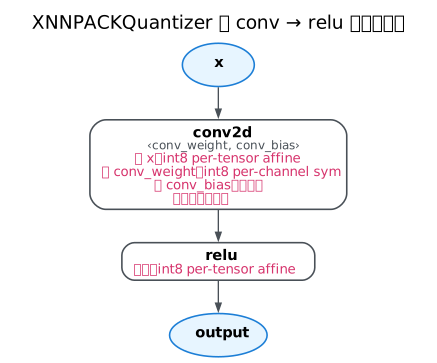
請看 conv2d 底下的四行:
- 三條輸入邊:activation
x、weight、bias。activation 是 per-tensor affine,weight 是 per-channel symmetric,bias 的規格是None(這份設定不量化 bias,保持 fp32)。 - conv2d 的輸出沒有標籤,輸出標籤貼在 relu 上。所以 conv 和 relu 之間不會插 observer,後端可以把 conv + relu 當成一個 kernel。這就是 PT2E 裡的 fusion:它不是改圖,只是「不在中間貼標籤」。
兩份規格的完整內容(common.graph_utils.qspec_summary):
conv = next(n for n in labeled.graph.nodes if n.name == "conv2d")
ann = conv.meta[ANNOTATION_KEY]
# 複製出來的圖,標籤裡的 key 仍是原圖的 node 物件,所以改用名字查
specs = {producer.name: spec for producer, spec in ann.input_qspec_map.items()}
x, weight, bias = (a.name for a in conv.args[:3])
print("activation:", qspec_summary(specs[x]).replace("\n", ","))
print("weight:    ", qspec_summary(specs[weight]).replace("\n", ","))
activation: int8 per-tensor affine [-128,127],HistogramObserver
weight: int8 per-channel symmetric [-127,127],PerChannelMinMaxObserver, ch_axis=0relu = next(n for n in labeled.graph.nodes if n.name == "relu")
assert ann.output_qspec is None and specs[bias] is None
assert relu.meta[ANNOTATION_KEY].output_qspec is not Noneactivation 用 HistogramObserver、weight 用 PerChannelMinMaxObserver 並沿 output channel(ch_axis=0)各算一個 scale,這是這份 XNNPACKQuantizer 預設設定的選擇(M02-1 比較過各種 observer)。
B. residual:add 的兩條輸入邊
labeled = read_labels("residual")
draw(labeled, notes=annotation_notes(labeled), title="XNNPACKQuantizer 在 residual 上貼的標籤(BN 已折進 conv)")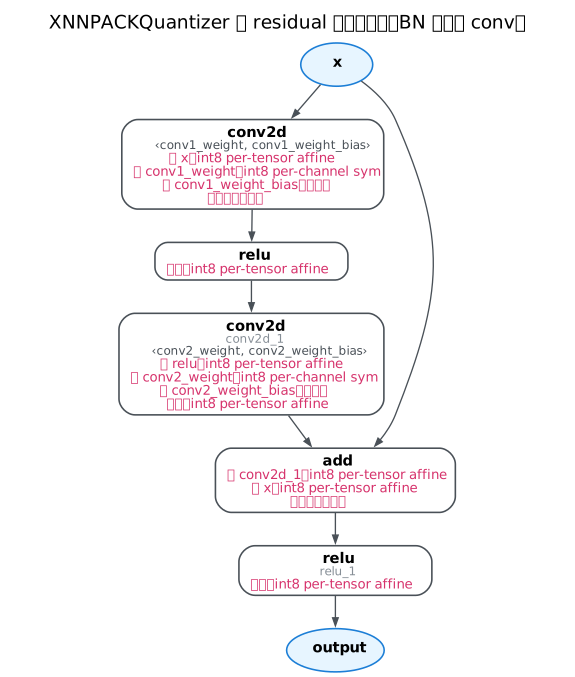
- 圖上已經沒有
batch_norm:Quantizer 看到的是 BN 折完的圖。conv 的 weight 換成折過的值,bias 是折 BN 時算出的新常數(conv1_weight_bias)。 add的兩條輸入邊(conv2d_1 → add、x → add)都有標籤,輸出標籤貼在後面的relu_1:add + relu 也被當成一個 pattern。- 第一個 conv 後面接 relu,所以沒有輸出標籤;第二個 conv(
conv2d_1)後面接的是 add,沒有 relu 可以融,它自己就有輸出標籤。
同一個 Quantizer、同一種 op,標籤卻不一樣:Quantizer 是看 op 的前後文決定的,不是一種 op 對應一種標籤。
anns = {n.name: n.meta.get(ANNOTATION_KEY) for n in labeled.graph.nodes}
assert "batch_norm" not in anns
assert anns["conv2d"].output_qspec is None and anns["conv2d_1"].output_qspec is not None
assert len(anns["add"].input_qspec_map) == 2 and anns["add"].output_qspec is None
assert anns["relu_1"].output_qspec is not None
C. cat_pool:哪些 op 沒被標到
沒被標到的 op 不會報錯,只是留在 fp32。用 unannotated_ops(common.graph_utils)列出沒有標籤的 op,在圖上也標成「沒有標籤」(annotation_notes 加上 unlabeled=True):
labeled = read_labels("cat_pool")
left = [n.name for n in unannotated_ops(labeled)]
print("沒有標籤的 op:", left)
draw(labeled, focus=["cat", "max_pool2d"], hops=1, notes=annotation_notes(labeled, unlabeled=True),
     title="cat_pool 的 cat → max_pool2d 一段")
沒有標籤的 op: ['cat', 'max_pool2d']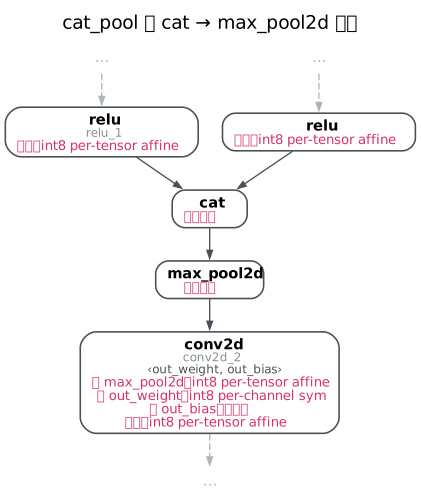
assert {"cat", "max_pool2d"} <= set(left)cat 與 max_pool2d 是 XNNPACK 能量化的 op,卻沒有標籤。原因在 M01-2 查過:
- 這份 torchao 測試版的
catannotator 靠node.meta["source_fn_stack"]找 pattern,torch 2.14 的 export 不再填這個欄位,於是靜默失效。 max_pool2d的 annotator 本身沒壞:它的規則是「和輸入共用 qparams」,輸入cat沒有標籤,它也就跟著沒標。
executorch 版的 XNNPACKQuantizer 沒有這個問題(M08-1 對照)。
教訓:用任何 Quantizer 之前,先把標籤畫出來,確認以為會被量化的 op 真的有標籤。 自己寫 Quantizer 時,用 node.target 找 op 比依賴 source_fn_stack 這類 metadata 穩定,這是 M03-3 的做法。
小結
- 每張標籤只回答三件事:位置(邊或輸出)、規格(
QuantizationSpec)、有沒有。 - fusion 在標籤上的樣子:pattern 中間的 node 不貼輸出標籤,輸出標籤貼在 pattern 的最後一個 op(conv + relu 貼在 relu、add + relu 貼在 relu)。
- Quantizer 看的是 BN 折完的圖,並依 op 的前後文決定標籤;沒被標到的 op 不會報錯,要自己檢查。