M08 把 Q/DQ 圖交給 ExecuTorch;這一章走路線 B(M07 概覽):先匯出成 .onnx,再交給 ONNX Runtime(ORT)。這本 notebook 只看第一步,匯出:
PT2E                              Q/DQ 圖(torchao 測試版 XNNPACKQuantizer)
  → torch.onnx.export(dynamo=True)  ONNX ModelProto(存檔就是 .onnx)
A. ONNX 圖長什麼樣:PT2E 的 op 各變成哪個 ONNX op。B. 檔案裡存了什麼:int8 weight、per-channel scale、fp32 bias;.onnx 的大小。C. 動態 batch:GraphModule 上的動態 batch 不會自動帶進 ONNX。
ORT 怎麼執行這個檔案在 M09-2。
import onnxruntime as ortimport torchfrom onnx import numpy_helperfrom torch.export import Dimfrom common.pt2e import quiet # 必須在 onnx/torchao 之前 import from common.data import trained_tiny_netfrom common.env import env_summaryfrom common.graph_utils import op_countsfrom common.models import example_inputsfrom common.onnx_utils import onnx_op_counts, ort_run, ort_session, to_onnx, xnnpack_qdqfrom common.viz import draw_onnx, table= torch.manual_seed(0 )print (env_summary() + f"|onnxruntime { ort. __version__} " )
Darwin arm64|torch 2.14.0|threads=4|mkldnn=False|nnpack=True|onnxruntime 1.30.0
模型是 M05 的 TinyConvNet(訓練過)。xnnpack_qdq 是本專案的包裝(common/onnx_utils.py,不是 torchao 的 API),做的就是 M05-1 的 PTQ:export_module(動態 batch)→ prepare_pt2e(torchao 測試版 XNNPACKQuantizer,per-channel weight)→ 校準 → convert_pt2e。
匯出只要一行 torch.onnx.export(..., dynamo=True)。它會拿 x 重新 torch.export 一次,再把每個 ATen op 翻成 ONNX op;dynamic_shapes 的用途在 C 段。
= trained_tiny_net()= example_inputs() # batch 2 = xnnpack_qdq(model, x) # Q/DQ 圖 = torch.onnx.export(qdq, x, dynamo= True , verbose= False , dynamic_shapes= ({0 : Dim("batch" )},))assert program is not None = program.model_proto # QDQ ONNX print (f"QDQ ONNX: { len (onnx_model.graph.node)} 個 node、 { len (onnx_model.graph.initializer)} 個 initializer" )
QDQ ONNX:41 個 node、31 個 initializer
本專案把這一行包成 to_onnx(gm, x)(common/onnx_utils.py),後面的 notebook 用它。
A. ONNX 圖長什麼樣
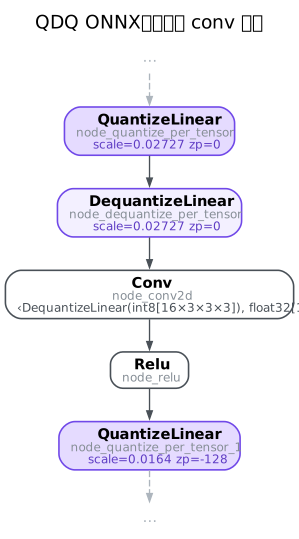
先看第一個 conv 單元。draw_onnx 是本專案畫 ONNX 圖的工具(common/viz.py),用法和前幾章畫 fx 圖的 draw 一樣:node 的第二行是 ONNX node 的名字,‹…› 裡是存在檔案裡的常數,Q/DQ 底下印 scale 與 zero point。
= "node_conv2d" , hops= 2 , title= "QDQ ONNX:第一個 conv 單元" )
和 M01 看過的 Q/DQ 圖一模一樣,只是換了名字:quantize_per_tensor → QuantizeLinear,dequantize_per_tensor → DequantizeLinear,conv2d → Conv。weight 那一邊的 DequantizeLinear(int8[…]) 只吃常數,所以收進 Conv 的標籤裡。
整張圖的對照:
= ["quantize_per_tensor" , "QuantizeLinear" , "activation 的 fp32 → int8" ),"dequantize_per_tensor" , "DequantizeLinear" , "activation 的 int8 → fp32" ),"dequantize_per_channel" , "DequantizeLinear" , "weight 的 int8 → fp32;axis=0:每個輸出 channel 一組 scale" ),"conv2d" , "Conv" , "" ),"relu" , "Relu" , "" ),"max_pool2d" , "MaxPool" , "" ),"add" , "Add" , "" ),"adaptive_avg_pool2d" , "ReduceMean" , "輸出 1×1 的 adaptive pool 等於對 H、W 取平均" ),"flatten" , "Reshape" , "" ),"linear" , "Gemm" , "" ),= op_counts(qdq), onnx_op_counts(onnx_model)= [[p, pc.get(p, 0 ), o, oc.get(o, 0 ), note] for p, o, note in PT2E_TO_ONNX]2 ][2 :4 ] = ["↑(同上)" , "" ] # 兩種 dq 都變成 DequantizeLinear,個數合計在上一個 row "Q/DQ 圖的 op" , "個數" , "ONNX op" , "個數" , "說明" ])
quantize_per_tensor
11
QuantizeLinear
11
activation 的 fp32 → int8
dequantize_per_tensor
12
DequantizeLinear
16
activation 的 int8 → fp32
dequantize_per_channel
5
↑(同上)
weight 的 int8 → fp32;axis=0:每個輸出 channel 一組 scale
conv2d
4
Conv
4
relu
4
Relu
4
max_pool2d
2
MaxPool
2
add
1
Add
1
adaptive_avg_pool2d
1
ReduceMean
1
輸出 1×1 的 adaptive pool 等於對 H、W 取平均
flatten
1
Reshape
1
linear
1
Gemm
1
每個 op 一對一變成 ONNX 的標準 op,Q/DQ 的位置原封不動。這種寫法叫 QDQ format :量化資訊全寫在 QuantizeLinear/DequantizeLinear 上,運算 op 本身仍是 fp32 的 Conv、Gemm。
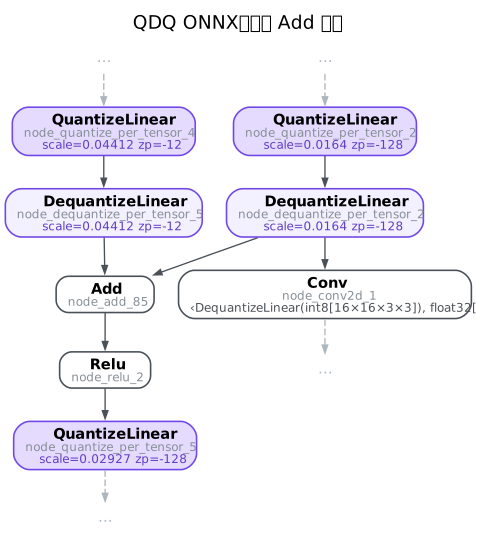
只有一個數字對不上:DequantizeLinear 比 Q/DQ 圖的兩種 dq 加起來少。看殘差的 Add 附近:
= lambda n: n.op_type == "Add" , hops= 2 , title= "QDQ ONNX:殘差 Add 附近" )
= pc["dequantize_per_tensor" ] + pc["dequantize_per_channel" ]print (f"Q/DQ 圖的 dq: { n_dq} 個;QDQ ONNX 的 DequantizeLinear: { oc['DequantizeLinear' ]} 個" )assert oc["DequantizeLinear" ] < n_dq
Q/DQ 圖的 dq:17 個;QDQ ONNX 的 DequantizeLinear:16 個
右邊那個 DequantizeLinear 同時給 Add 和下一個 Conv 用。convert_pt2e 原本替每個使用者各複製一個 dq(DuplicateDQPass,M02-3),torch.onnx.export 預設的圖最佳化又把兩個相同的 dq 合併回一個。M09-2 會看到 ORT 建 session 時再把它拆開。
B. 檔案裡存了什麼
ONNX 把常數存成 initializer 。依用途分組:
def role(op_type, idx):"""initializer 是某個 op 的第 idx 個輸入 → 它的用途。""" if op_type == "DequantizeLinear" :return ["weight(int8)" , "weight 的 per-channel scale" , "weight 的 zero_point" ][idx]if op_type in ("Conv" , "Gemm" ) and idx == 2 :return "conv/linear 的 bias" return {"ReduceMean" : "ReduceMean 的 axes" , "Reshape" : "Reshape 的目標 shape" }.get(op_type, f" { op_type} 的參數" )= {}for n in onnx_model.graph.node:for idx, name in enumerate (n.input ):= {}, 0 for init in onnx_model.graph.initializer:= numpy_helper.to_array(init)if arr.size == 1 :+= 1 continue = groups.setdefault(roles[init.name], [str (arr.dtype), 0 , []])1 ] += 1 2 ].append("×" .join(map (str , arr.shape)))= [[r, dt, cnt, "、" .join(shapes[:3 ]) + ("…" if len (shapes) > 3 else "" )] for r, (dt, cnt, shapes) in groups.items()]"activation 的 scale/zero_point" , "float32/int8" , n_scalar, "純量" ])"用途" , "dtype" , "個數" , "shape" ])
conv/linear 的 bias
float32
5
16、16、16…
weight(int8)
int8
5
16×3×3×3、16×16×3×3、16×16×3×3…
weight 的 per-channel scale
float32
5
16、16、16…
weight 的 zero_point
int8
3
16、32、4
ReduceMean 的 axes
int64
1
2
Reshape 的目標 shape
int64
1
2
activation 的 scale/zero_point
float32/int8
11
純量
assert groups["weight(int8)" ][0 ] == "int8" and groups["conv/linear 的 bias" ][0 ] == "float32"
int8 weight 是 convert_pt2e 已經量化好的常數(M02-3),匯出時原樣寫進檔案;每個輸出 channel 一個 scale。
weight 是對稱量化,zero point 全是 0;內容相同的 zero point 只存一份(同樣 channel 數的 weight 共用),所以個數比 weight 少。
bias 在 Q/DQ 圖上沒有量化,所以檔案裡仍是 float32。
檔案裡有 int8 weight,但這個檔案本身沒有任何 int8 kernel :Conv 仍是 fp32 的 op,要不要換成 int8 kernel,由執行它的 ORT 決定(M09-2)。
把 fp32 模型也匯出一份,拆開比較兩個檔案的大小:
def sizes(name, m):"""(.onnx 總大小, initializer, node, 其中 node 的 metadata_props),單位 bytes。""" = sum (len (i.SerializeToString()) for i in m.graph.initializer)= sum (len (n.SerializeToString()) for n in m.graph.node)= sum (len (p.SerializeToString()) + 2 for n in m.graph.node for p in n.metadata_props)return [name, len (m.SerializeToString()), init, nodes, meta]= [sizes("torch.onnx.export(fp32 模型)(to_onnx)" , to_onnx(model, x)), sizes("torch.onnx.export(Q/DQ 圖)" , onnx_model)]"" , "總計" , "initializer" , "node" , "node 裡的 metadata_props" ])
torch.onnx.export(fp32 模型)(to_onnx)
59195
39795
15693
13995
torch.onnx.export(Q/DQ 圖)
66019
11112
47638
42519
= rows[1 ][2 ] / rows[0 ][2 ], rows[1 ][1 ] / rows[0 ][1 ]print (f"initializer 變成 fp32 的 { init_ratio:.0%} ;檔案總大小是 fp32 的 { total_ratio:.0%} " )if total_ratio > 1 :print ("檔案反而變大:多出來的 QuantizeLinear/DequantizeLinear node,各帶一份 metadata_props。" )assert init_ratio < 0.5
initializer 變成 fp32 的 28%;檔案總大小是 fp32 的 112%
檔案反而變大:多出來的 QuantizeLinear/DequantizeLinear node,各帶一份 metadata_props。
weight 從 4 bytes 變 1 byte,initializer 大幅縮小。但 torch.onnx.export 在每個 node 的 metadata_props 寫了來源資訊(原本的 fx node、module 路徑),Q/DQ 又多出一大堆 node;這個小模型的 node 比 weight 還占空間。模型越大,weight 的占比越高(推論,沒有量更大的模型)。
C. 動態 batch
Q/DQ 圖的第一步是 torch.export.export(..., dynamic_shapes=({0: Dim.AUTO},))(包在 export_module),batch 維度是動態的。同一張 Q/DQ 圖匯出兩次,差別只在有沒有傳 dynamic_shapes;各建一個 ort.InferenceSession(ort_session),餵兩種 batch:
= [], {}for dynamic in [False , True ]:= to_onnx(qdq, x, dynamic_batch= dynamic)= m.graph.input [0 ].type .tensor_type.shape.dim[0 ]= d.dim_param or d.dim_value= ort_session(m)= []for bs in [x[0 ].shape[0 ], 4 ]:try :3 , 16 , 16 ))f"batch { bs} OK" )except Exception as e: # ORT 的 shape 錯誤是 InvalidArgument f"batch { bs} { type (e). __name__ } " )'dynamic_shapes=({0: Dim("batch")},)' if dynamic else "不傳 dynamic_shapes" , dim0[dynamic], ";" .join(results)])"torch.onnx.export(Q/DQ 圖, x, dynamo=True, …)" , "輸入的第 0 維" , "ORT 執行" ])
不傳 dynamic_shapes
2
batch 2 OK;batch 4 InvalidArgument
dynamic_shapes=({0: Dim("batch")},)
batch
batch 2 OK;batch 4 OK
assert dim0[False ] == x[0 ].shape[0 ] and isinstance (dim0[True ], str )
torch.onnx.export(dynamo=True) 會拿 x 重新 torch.export 一次,所以不傳 dynamic_shapes 時,第 0 維被寫死成 x 的 batch,GraphModule 原本的動態 batch 沒有帶過來。傳了 dynamic_shapes,第 0 維變成符號,ORT 接受任何 batch。本章之後都這樣匯出(to_onnx 預設 dynamic_batch=True)。
小結
Q/DQ 圖匯出成 ONNX 後結構不變:q/dq 變成 QuantizeLinear/DequantizeLinear,其他 op 換成 ONNX 的標準 op。這就是 QDQ format。
檔案裡 weight 是 int8 + per-channel scale,bias 仍是 fp32;這個檔案還沒有任何 int8 kernel。
動態 batch 要在 torch.onnx.export 再講一次。
要不要把「DequantizeLinear → Conv → QuantizeLinear」換成 int8 kernel,由執行它的 ORT 決定(M09-2)。