import copy

import torch

from common.data import calibration_batches
from common.graph_utils import observer_nodes, qdq_nodes
from common.models import example_inputs, get_model
from common.pt2e import (
    ANNOTATION_KEY,
    Quantizer,
    annotate_input_qspec_map,
    annotate_output_qspec,
    convert_pt2e,
    export_module,
    get_xnnpack_quantizer,
    prepare_pt2e,
    quiet,
)
from common.qspecs import act_spec, weight_spec
from common.viz import annotation_notes, draw, table

quiet()
_ = torch.manual_seed(0)
CONV2D = torch.ops.aten.conv2d.defaultM03-3 | 從零寫一個規則式 Quantizer:只量化 conv2d

M03-1 的 LabelQuantizer 是點名:我們告訴它「在 relu 的輸出貼標籤」。換一個模型,node 的名字就不一樣了,點名沒辦法推廣。 真實的 Quantizer 靠規則找 node:
\[ \text{Quantizer} = \text{找 node 的規則} + \text{每個位置用哪一份 spec} \]
這本 notebook 寫一個 ConvOnlyQuantizer:
- 規則:
node.target是aten.conv2d的 node。 - 規格:activation 用 int8 per-tensor affine、weight 用 int8 per-channel symmetric(
common/qspecs.py的act_spec()、weight_spec())。
段落:
- A. 寫出來:
annotate的三個動作。 - B. 和 XNNPACKQuantizer 比:conv 和 relu 之間的 observer。
- C.
validate:不支援的圖在 prepare 就報錯。 - D. 這個 Quantizer 還缺什麼。
A. 寫出來:annotate 的三個動作
annotate 對每個 node 做三件事:
- 找 node:用
node.target比對 op,不看名字。 - 貼標籤:torchao 提供兩個公開的輔助函式,
annotate_input_qspec_map(node, 上游, spec)標一條輸入邊、annotate_output_qspec(node, spec)標輸出。它們會在需要時建立QuantizationAnnotation,不必自己 new。 - 標記已處理:設
_annotated = True。開頭也要檢查它,已經被標過的 node 就跳過。多個 Quantizer 組合時,這是「不搶別人的 node」的約定(M03-6)。
class ConvOnlyQuantizer(Quantizer):
    def annotate(self, model):
        for node in model.graph.nodes:
            if node.op != "call_function" or node.target != CONV2D:  # (1) 找 node
                continue
            ann = node.meta.get(ANNOTATION_KEY)
            if ann is not None and ann._annotated:  # (3) 已經被標過就不動
                continue
            activation, weight = node.args[0], node.args[1]
            annotate_input_qspec_map(node, activation, act_spec())  # (2) 貼標籤
            annotate_input_qspec_map(node, weight, weight_spec())
            annotate_output_qspec(node, act_spec())
            node.meta[ANNOTATION_KEY]._annotated = True  # (3)
        return model

    def validate(self, model):
        """weight 必須是模型常數(get_attr),否則無法預先量化。"""
        for node in model.graph.nodes:
            if node.op == "call_function" and node.target == CONV2D and node.args[1].op != "get_attr":
                raise ValueError(f"{node.name} 的 weight 來自 {node.args[1].op} node「{node.args[1].name}」,"
"ConvOnlyQuantizer 只支援常數 weight")bias(node.args[2])沒有放進 input_qspec_map,所以不量化。直接呼叫 annotate 看標籤:
gm = export_module(get_model("conv_relu").eval(), example_inputs(4))
q = ConvOnlyQuantizer()
q.annotate(gm)
draw(gm, notes=annotation_notes(gm, unlabeled=True), title="ConvOnlyQuantizer 在 conv → relu 上貼的標籤")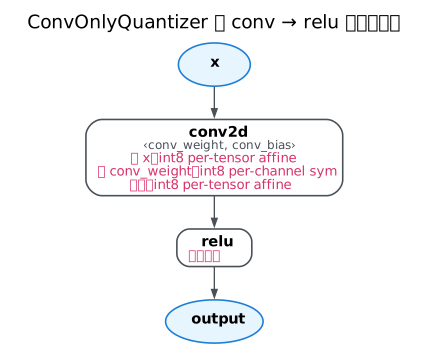
和 M03-2 A 段的 XNNPACKQuantizer 比,差在兩處:bias 這條邊根本不在標籤裡(XNNPACK 是列出來、規格寫 None,結果一樣不量化); 而 conv2d 自己有輸出標籤、relu 沒有標籤。
再呼叫一次 annotate,標籤物件不會被換掉,因為開頭的 _annotated 檢查擋住了:
before = {n.name: id(n.meta[ANNOTATION_KEY]) for n in gm.graph.nodes if ANNOTATION_KEY in n.meta}
q.annotate(gm)
after = {n.name: id(n.meta[ANNOTATION_KEY]) for n in gm.graph.nodes if ANNOTATION_KEY in n.meta}
print("再呼叫一次 annotate,標籤物件相同?", before == after)
assert before == after
再呼叫一次 annotate,標籤物件相同? TrueB. 和 XNNPACKQuantizer 比:conv 和 relu 之間的 observer
同一個 conv_bn_relu 模型,分別交給兩個 Quantizer 做 prepare_pt2e(BN 會先折進 conv),只畫 conv 與 relu 附近:
gm = export_module(get_model("conv_bn_relu").eval(), example_inputs(8))
mine = prepare_pt2e(copy.deepcopy(gm), ConvOnlyQuantizer())
draw(mine, focus=["conv2d", "relu"], title="ConvOnlyQuantizer:prepare 之後")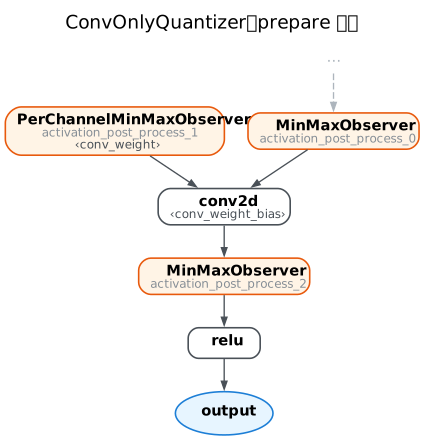
xnnpack, _ = get_xnnpack_quantizer(is_per_channel=True)
theirs = prepare_pt2e(copy.deepcopy(gm), xnnpack)
draw(theirs, focus=["conv2d", "relu"], title="XNNPACKQuantizer:prepare 之後")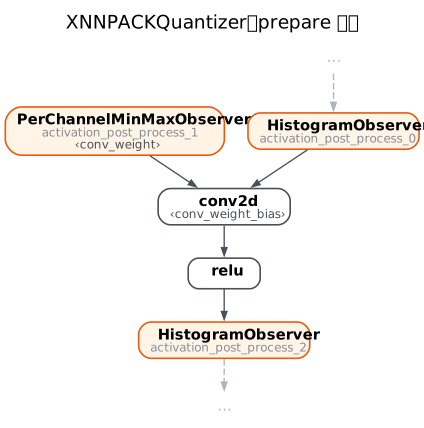
def observer_before_relu(gm):
    """relu 的輸入是不是 observer:是的話,conv 與 relu 之間有量化點。"""
    relu = next(n for n in gm.graph.nodes if n.target == torch.ops.aten.relu.default)
    return relu.args[0].op == "call_module"


print("ConvOnlyQuantizer:conv 與 relu 之間有 observer?", observer_before_relu(mine))
print("XNNPACKQuantizer: conv 與 relu 之間有 observer?", observer_before_relu(theirs))
assert observer_before_relu(mine) and not observer_before_relu(theirs)
ConvOnlyQuantizer:conv 與 relu 之間有 observer? True
XNNPACKQuantizer: conv 與 relu 之間有 observer? FalseConvOnlyQuantizer 只認得 conv,不知道後面接了 relu,所以照規則在 conv 的輸出貼標籤,conv 與 relu 之間多了一個量化點。 XNNPACKQuantizer 認得 conv + relu 這個 pattern,輸出標籤貼在 relu,後端就能把兩個 op 當成一個 kernel 執行。 兩種圖都能跑,差別在後端能不能融合。
換成較大的 tiny 模型(conv、maxpool、add、pool、linear…),兩個 Quantizer 各自量化了多少:
def count(model_name, quantizer):
    prepared = prepare_pt2e(export_module(get_model(model_name).eval(), example_inputs(8)), quantizer)
    n_obs = len(observer_nodes(prepared))
    with torch.no_grad():
        for batch in calibration_batches(n=64, batch_size=16):
            prepared(*batch)
    return n_obs, len(qdq_nodes(convert_pt2e(prepared)))


rows = []
for name, quantizer in [("ConvOnlyQuantizer", ConvOnlyQuantizer()),
                        ("XNNPACKQuantizer", get_xnnpack_quantizer(is_per_channel=True)[0])]:
    rows.append([name, *count("tiny", quantizer)])
table(rows, ["Quantizer", "observer 數", "q/dq 數"])| Quantizer | observer 數 | q/dq 數 |
|---|---|---|
| ConvOnlyQuantizer | 12 | 20 |
| XNNPACKQuantizer | 16 | 28 |
assert rows[0][1] < rows[1][1] and rows[0][2] < rows[1][2]ConvOnlyQuantizer 只替 conv 貼標籤,maxpool、add、pool、linear 都沒有標籤、留在 fp32,所以 observer 與 q/dq 都比較少。 XNNPACKQuantizer 替更多種 op 貼了標籤。
C. validate:不支援的圖在 prepare 就報錯
annotate 只管貼標籤;「這張圖我能不能處理」交給 validate。prepare_pt2e 在 annotate 之後、插 observer 之前呼叫它(M03-1), 所以使用者在校準之前就會知道。
下面的模型把 weight 當成輸入傳進來,而不是模型的參數。weight 不是常數,就無法預先量化成 int8:
class DynamicWeightConv(torch.nn.Module):
    def forward(self, x, w):
        return torch.nn.functional.conv2d(x, w, padding=1)


bad = export_module(DynamicWeightConv(), (torch.randn(1, 3, 8, 8), torch.randn(4, 3, 3, 3)), dynamic_batch=False)
try:
    prepare_pt2e(copy.deepcopy(bad), ConvOnlyQuantizer())
    raised = None
except ValueError as e:
    raised = e
print("ValueError:", raised)
assert raised is not None
ValueError: conv2d 的 weight 來自 placeholder node「w」,ConvOnlyQuantizer 只支援常數 weight後端有硬體限制時,validate 就是檢查限制的地方(M10-1 用它擋下動態 batch)。
D. 這個 Quantizer 還缺什麼
| 缺的東西 | 後果 | 在哪裡處理 |
|---|---|---|
| pattern | 不知道 conv 後面接 relu 可以融,量化點變多 | M03-6 標註順序、M04 fusion |
| 共用 qparams | add、cat 的輸入與輸出 scale 各自不同,整數運算前要先 rescale | M03-4 |
| bias 量化 | 後端常要求 int32 bias,scale 由 activation × weight 推導 | M03-5 |
| 設定介面 | 使用者無法指定「哪一部分用什麼規格、哪一部分不量化」 | M03-6、M03-7 |
小結
- 規則式 Quantizer 用
node.target找 op,模型換了照樣適用。 annotate的三個動作:找 node、貼標籤(annotate_input_qspec_map、annotate_output_qspec)、標記_annotated。- 只認單一 op 的規則,會在 pattern 中間留下量化點;
validate讓不支援的圖在 prepare 時就報錯。