import torch
import torch.nn as nn
import torch.nn.functional as F
from torch.export import export

from common.graph_utils import node_rows, short
from common.models import example_inputs, get_model
from common.pt2e import quiet
from common.viz import draw_stages, table

quiet()
_ = torch.manual_seed(0)M00-1 | What the Graph from torch.export Looks Like, and What ATen Is

Every step of PT2E works on the graph produced by torch.export. This notebook has two parts:
- A. The graph after export: what
torch.export.export()returns, whatep.module()is, and what information each node carries. - B. What ATen is: how to read a name like
aten.conv2d.default, and why different Python styles become the same sequence of ops after export.
A. The Graph After Export
The model is ConvBnReLU (conv → bn → relu). We call .eval() first (why we must decide eval/train up front is covered in M00-2).
A1. torch.export.export() Returns an ExportedProgram
An ExportedProgram (called ep below) holds three things: the graph ep.graph, the ep.graph_signature that says what each input on the graph is, and the values of the parameters and buffers, ep.state_dict. In ep.graph, the parameters, the buffers, and the user input x are all placeholders (inputs of the graph). graph_signature records which placeholders are model state and which field of the original model they correspond to:
model = get_model("conv_bn_relu").eval()
ex = example_inputs()
ep = export(model, ex)

table([[spec.arg.name, spec.kind.name, spec.target] for spec in ep.graph_signature.input_specs],
["placeholder", "kind", "target (field of the original model)"])| placeholder | kind | target (field of the original model) |
|---|---|---|
| p_conv_weight | PARAMETER | conv.weight |
| p_bn_weight | PARAMETER | bn.weight |
| p_bn_bias | PARAMETER | bn.bias |
| b_bn_running_mean | BUFFER | bn.running_mean |
| b_bn_running_var | BUFFER | bn.running_var |
| b_bn_num_batches_tracked | BUFFER | bn.num_batches_tracked |
| x | USER_INPUT |
The name prefixes p_ (parameter) and b_ (buffer) are only a convention for readability; the reliable classification is kind. Only x has kind USER_INPUT; everything else is model state.
A2. ep.module() Returns a GraphModule
PT2E’s prepare_pt2e takes ep.module(): it binds the state_dict back according to graph_signature and gives a directly callable GraphModule. In the figure below, the top is ep.graph and the bottom is the graph of ep.module(); this time the parameters are also drawn as separate nodes (show_params=True).
gm = ep.module()
draw_stages([(ep.graph_module, "ep.graph (ExportedProgram)"), (gm, "ep.module() (GraphModule)")],
            show_params=True, per_row=1, title="Parameters change from placeholder to get_attr")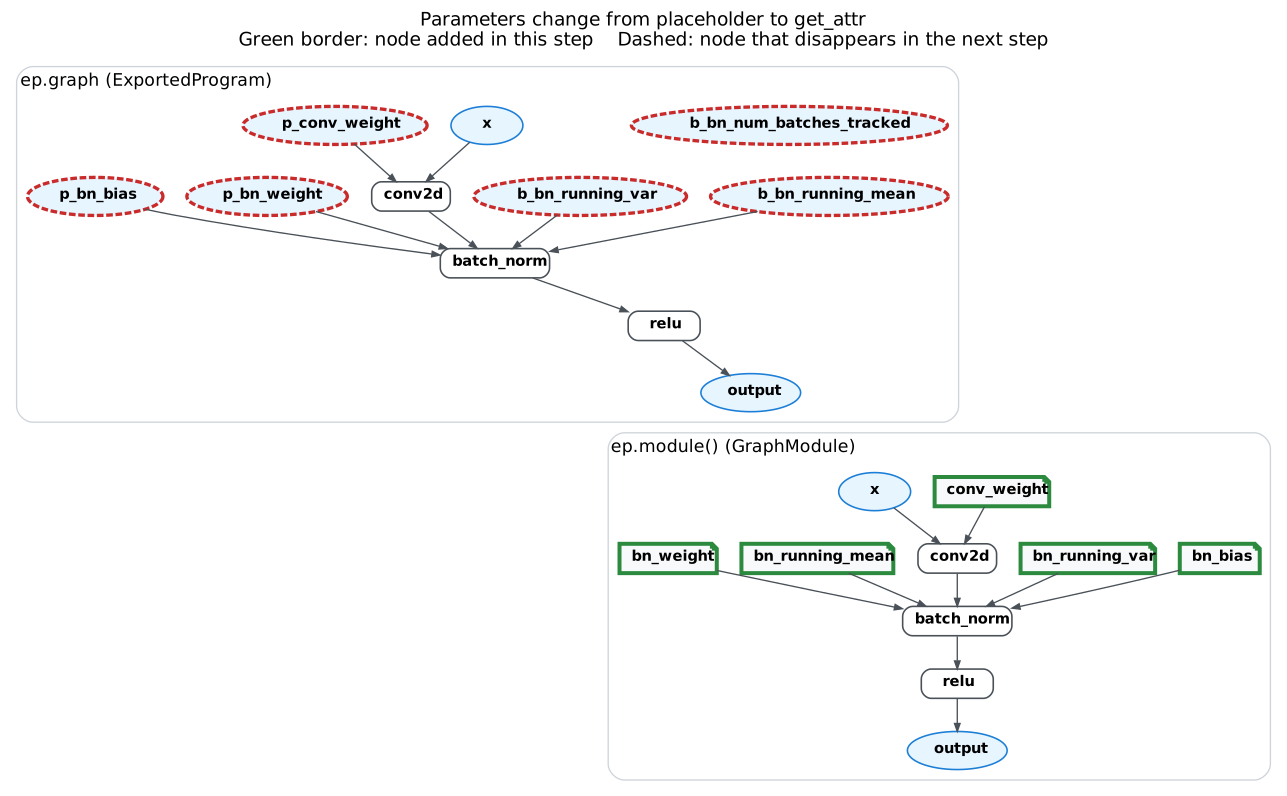
Look at three things:
- At the top,
p_conv_weight,b_bn_running_mean, … are placeholders (ovals, which disappear in the next step); at the bottom they becomeget_attr(folded-corner boxes, green border), which read attributes off the GraphModule itself. - Modules such as
nn.Conv2dandnn.BatchNorm2dare gone; only the three operationsconv2d,batch_norm, andreluremain. The whole graph is flat: no module hierarchy, just a sequence of ops. So for PT2E to find “a conv followed by a relu” it can only match op patterns on the graph; it cannot rely on “swapping out a module”. b_bn_num_batches_trackedis unused in eval mode (M00-2 shows who uses it in train mode).
Listing node by node. The op column is the kind of fx node:
table([row[:4] for row in node_rows(gm, show_args=False)], ["#", "op", "name", "target"])| # | op | name | target |
|---|---|---|---|
| 0 | get_attr | conv_weight | conv.weight |
| 1 | get_attr | bn_weight | bn.weight |
| 2 | get_attr | bn_bias | bn.bias |
| 3 | get_attr | bn_running_mean | bn.running_mean |
| 4 | get_attr | bn_running_var | bn.running_var |
| 5 | get_attr | bn_num_batches_tracked | bn.num_batches_tracked |
| 6 | placeholder | x | x |
| 7 | call_module | _guards_fn | _guards_fn |
| 8 | call_function | conv2d | conv2d |
| 9 | call_function | batch_norm | batch_norm |
| 10 | call_function | relu | relu |
| 11 | output | output | output |
placeholder: an input of the graph;get_attr: reads a parameter or buffer on the GraphModule;call_function: calls a function (here, all ATen ops);output: the output of the graph.- The
call_module_guards_fnis a check thatep.module()inserts by default: on each call it verifies that the input matches the assumptions made at export time (for example, the shape). It has nothing to do with quantization. The earlier figure does not draw it.
The target of a get_attr is exactly the target in graph_signature, and the output of ep.module() is also identical to the original model:
targets = {spec.target for spec in ep.graph_signature.input_specs if spec.target is not None}
assert {n.target for n in gm.graph.nodes if n.op == "get_attr"} == targets
with torch.no_grad():
    err = (model(*ex) - gm(*ex)).abs().max().item()
print(f"max error between model(x) and ep.module()(x) = {err}")
assert err == 0
max error between model(x) and ep.module()(x) = 0.0A3. The meta of Each Node
Each node has a meta dict that records information collected at export time. The most commonly used entry is meta["val"]: export runs the model once with “fake tensors” (FakeTensor, which have only shape, dtype, and device, but no values) and records what this node would produce.
rows = []
for n in gm.graph.nodes:
    if n.op == "call_function":
        val = n.meta["val"]
        rows.append([n.name, type(val).__name__, str(list(val.shape)), ", ".join(sorted(n.meta))])
table(rows, ["node", "type of meta['val']", "shape", "meta keys"])| node | type of meta['val'] | shape | meta keys |
|---|---|---|---|
| conv2d | FakeTensor | [2, 8, 16, 16] | from_node, nn_module_stack, stack_trace, tensor_meta, torch_fn, val |
| batch_norm | FakeTensor | [2, 8, 16, 16] | from_node, nn_module_stack, stack_trace, tensor_meta, torch_fn, val |
| relu | FakeTensor | [2, 8, 16, 16] | from_node, nn_module_stack, stack_trace, tensor_meta, torch_fn, val |
Dimension 0 of the shape is 2 because the batch of the example input is 2; export hard-codes shapes by default (common.pt2e.export_module() makes the batch dynamic, and M01 onward uses it).
There is nothing quantization-related in meta yet. The quantizer’s annotations will later be written into the same meta, under the key quantization_annotation (M01-2, M03).
Question to think about: which node does the weight of conv2d on this graph come from?
conv = next(n for n in gm.graph.nodes if n.name == "conv2d")
weight_node = conv.args[1]
print(f"conv2d.args[1] = {weight_node.name} (op={weight_node.op}, target={weight_node.target})")
assert weight_node.op == "get_attr"
conv2d.args[1] = conv_weight (op=get_attr, target=conv.weight)Answer: from the get_attr node conv_weight (target conv.weight); it is argument 1 of conv2d. Later, the annotation for quantizing the weight hangs on the conv2d node that uses it: “what spec applies to the weight input edge of conv2d”?
B. What Is ATen?
B1. How to Read aten.conv2d.default
The target of the conv2d node on the graph is torch.ops.aten.conv2d.default. It has three parts:
conv_op = torch.ops.aten.conv2d
print(f"torch.ops.aten.conv2d             {type(conv_op).__name__}: all overloads of an op")
print(f"torch.ops.aten.conv2d.overloads() {conv_op.overloads()}")
print(f"torch.ops.aten.conv2d.default     {type(conv_op.default).__name__}: one of the overloads")
print(f"  schema: {conv_op.default._schema}")
print(f"compare torch.ops.aten.add.Tensor")
print(f"  schema: {torch.ops.aten.add.Tensor._schema}")
assert conv.target is torch.ops.aten.conv2d.default
torch.ops.aten.conv2d OpOverloadPacket: all overloads of an op
torch.ops.aten.conv2d.overloads() ['default', 'padding']
torch.ops.aten.conv2d.default OpOverload: one of the overloads
schema: aten::conv2d(Tensor input, Tensor weight, Tensor? bias=None, SymInt[2] stride=[1, 1], SymInt[2] padding=[0, 0], SymInt[2] dilation=[1, 1], SymInt groups=1) -> Tensor
compare torch.ops.aten.add.Tensor
schema: aten::add.Tensor(Tensor self, Tensor other, *, Scalar alpha=1) -> Tensoraten (namespace) .conv2d (op) .default (overload). The same op can have several versions depending on argument types; for example add has add.Tensor (add two tensors), add.Scalar (add a number to a tensor), and so on.
ATen is PyTorch’s core tensor library, and almost all other Python/C++ interfaces are built on top of it (official C++ documentation); torch.ops.aten.* are its op names on the Python side.
B2. Three Styles, the Same Sequence of Ops After Export
The same model (conv → relu → mean → linear) written in three Python styles:
class FunctionalStyle(nn.Module):
    """Written entirely with torch.nn.functional; the parameters are declared by hand."""

    def __init__(self):
        super().__init__()
        self.w = nn.Parameter(torch.randn(8, 3, 3, 3))
        self.fc_w = nn.Parameter(torch.randn(4, 8))

    def forward(self, x):
        return F.linear(F.relu(F.conv2d(x, self.w, padding=1)).mean((2, 3)), self.fc_w)


class Inner(nn.Module):
    def __init__(self):
        super().__init__()
        self.conv = nn.Conv2d(3, 8, 3, padding=1, bias=False)
        self.act = nn.ReLU()

    def forward(self, x):
        return self.act(self.conv(x))


class WrappedStyle(nn.Module):
    """A custom Module wrapping nn.Conv2d / nn.ReLU / nn.Linear, one extra layer of Python class."""

    def __init__(self):
        super().__init__()
        self.inner = Inner()
        self.fc = nn.Linear(8, 4, bias=False)

    def forward(self, x):
        return self.fc(self.inner(x).mean((2, 3)))


class SequentialStyle(nn.Module):
    """Written with nn.Sequential."""

    def __init__(self):
        super().__init__()
        self.body = nn.Sequential(nn.Conv2d(3, 8, 3, padding=1, bias=False), nn.ReLU())
        self.fc = nn.Linear(8, 4, bias=False)

    def forward(self, x):
        return self.fc(self.body(x).mean((2, 3)))
Each style is captured in two ways, and we list the operation nodes on the graph:
torch.fx.symbolic_trace(model): fx’s original way of capturing (FX graph mode quantization before PT2E used it).torch.export.export(model, (x,)).module(): the way PT2E uses.
def fx_ops(gm):
    """symbolic_trace graph: call_module prints the module class (and its path in the model), call_function prints the function name, call_method prints the method name."""
    out = []
    for n in gm.graph.nodes:
        if n.op == "call_module":
            out.append(f"module {type(gm.get_submodule(n.target)).__name__}({n.target})")
        elif n.op == "call_function":
            out.append(f"function {n.target.__name__}")
        elif n.op == "call_method":
            out.append(f"method {n.target}")
    return out


def export_ops(gm):
    return [n.target for n in gm.graph.nodes if n.op == "call_function"]


ex_small = (torch.randn(2, 3, 8, 8),)
styles = [FunctionalStyle, WrappedStyle, SequentialStyle]
fx_lists = [fx_ops(torch.fx.symbolic_trace(cls())) for cls in styles]
export_lists = [export_ops(export(cls().eval(), ex_small).module()) for cls in styles]
table([[cls.__name__, " → ".join(f), " → ".join(short(t) for t in e)]
       for cls, f, e in zip(styles, fx_lists, export_lists)],
["Style", "symbolic_trace nodes", "export nodes (aten.*)"])| Style | symbolic_trace nodes | export nodes (aten.*) |
|---|---|---|
| FunctionalStyle | function conv2d → function relu → method mean → function linear | conv2d → relu → mean → linear |
| WrappedStyle | module Conv2d(inner.conv) → module ReLU(inner.act) → method mean → module Linear(fc) | conv2d → relu → mean → linear |
| SequentialStyle | module Conv2d(body.0) → module ReLU(body.1) → method mean → module Linear(fc) | conv2d → relu → mean → linear |
assert all(e == export_lists[0] for e in export_lists)  # export: the node.target is identical for all three styles
assert len({tuple(f) for f in fx_lists}) == 3  # symbolic_trace: all three styles differ
print("export node.target:", [str(t) for t in export_lists[0]])
export node.target: ['aten.conv2d.default', 'aten.relu.default', 'aten.mean.dim', 'aten.linear.default']- The symbolic_trace graph follows the way the model is written:
nn.Conv2dstays acall_module(at the module level; even its paths in the model,inner.convandbody.0, are kept),F.conv2dis a Python function, and.mean()is a method. The same conv comes in several shapes, and whoever receives this graph has to recognize every Module class and every Python style. - The export graph is the same sequence of
aten.*ops no matter how the model is written; the module hierarchy is also flattened.
This matters for backends: given a graph, a backend has to decide node by node, “do I have a kernel for this operation?” With the graph’s vocabulary unified to ATen ops, the backend only has to compare against its own list of supported ops. The PyTorch documentation positions the Core ATen op set the same way: it is “designed to serve as the functional IR to interface with backends” (IRs). The PT2E quantizer finds convs with node.target == torch.ops.aten.conv2d.default, which also relies on this (M03). The chapter overview explains this in more detail.
B3. The Layers, Top to Bottom
| Layer | What it is | In the exported graph |
|---|---|---|
nn.Conv2d, custom Module |
Python class | gone after export |
F.conv2d |
Python function | gone after export |
torch.ops.aten.conv2d.default |
the name of an op | this is the node.target |
| C++ implementations on each device (kernels) | the code that does the actual computation | not on the graph; chosen at run time (B4) |
An ATen op can also be decomposed into lower-level ops (for example conv2d → convolution); see M00-3.
B4. How an Op Finds Its Kernel at Run Time
Export leaves only the op’s name on the graph. At run time (eager mode, taking z = x + y with x and y both CPU tensors as the example):
- Python’s
x + ycallstorch.add, which enters ATen’saten::add.Tensor. - The dispatcher looks at the tensors’ dispatch keys and decides which layer of implementation to use: backend (CPU/CUDA/MPS…), autograd, quantized, and so on. When gradients are needed, the call first passes through the autograd layer.
- The backend’s kernel runs: ATen itself ships CPU, CUDA, and MPS implementations; some ops further call libraries such as cuBLAS and cuDNN.
- The dtype (float32, etc.) is usually switched inside the kernel, not decided at the dispatcher layer.
- The result is wrapped as a Tensor and returned to Python.
After dispatch, a kernel may still pick an implementation based on the inputs (M07-1 uses the profiler to see conv switching implementations by batch size). The above is a general description; the order of the steps was not traced line by line through the source code.
Summary
torch.export.export()returns an ExportedProgram: parameters are placeholders andgraph_signaturerecords the correspondence;ep.module()binds the parameters back asget_attr, and PT2E uses this GraphModule.- The graph is flat and contains only ATen ops; each node’s
meta["val"]records the output’s shape/dtype, and quantization annotations are later written inmetatoo. - Different Python styles export to the same sequence of ATen ops, so backends and quantizers only need to recognize this set of ops.