import copy

import torch
from torch.fx import Node

from common.graph_utils import observer_nodes
from common.models import example_inputs, get_model
from common.pt2e import (
    ANNOTATION_KEY,
    MovingAverageMinMaxObserver,
    QuantizationSpec,
    Quantizer,
    SharedQuantizationSpec,
    annotate_input_qspec_map,
    annotate_output_qspec,
    convert_pt2e,
    export_module,
    prepare_pt2e,
    quiet,
)
from common.qspecs import act_spec
from common.viz import draw, table

quiet()
_ = torch.manual_seed(0)
ADD = torch.ops.aten.add.TensorM03-4 | Shared qparams: SharedQuantizationSpec and Implicit Sharing

To do integer addition (or concat) on two int8 tensors, they must be on the same scale: integers with different scales can’t be added directly, and the hardware would have to rescale one of them first. So some backends require all inputs and outputs of add and cat to share one set of (scale, zero point).
In PT2E, “sharing qparams” means making several positions share the same observer instance: this observer sees the values at all the positions, computes one scale, and everyone uses it. Sharing comes from two sources:
- Explicit: the annotation’s spec is
SharedQuantizationSpec(some position), meaning “use the same observer as that position”. - Implicit: when two annotations on the same tensor have identical attributes,
prepare_pt2emerges them into one observer automatically. Mentioned in M03-1 section C.
Sections:
- A. Explicit sharing: make the inputs and output of add share one set of qparams.
- B. Implicit sharing: when the same tensor has both an output annotation and an edge annotation, when they merge and when they chain.
A. Explicit Sharing: SharedQuantizationSpec
AddQuantizer finds all adds by node.target. The first input edge uses an ordinary spec; when share=True, the remaining input edges and the output all get SharedQuantizationSpec((first input, add)): the argument is a position, an edge written as (producer, consumer), and a node’s output given as the node itself.
Only activations need annotations, so two kinds of input must be excluded: the Python scalar in add(x, 1.0) (not a Node, so it can’t be a key of input_qspec_map), and the model constant in add(x, self.b) (get_attr). In add(x, x) both inputs are the same node and need de-duplication.
class AddQuantizer(Quantizer):
    def __init__(self, share: bool):
        self.share = share

    def annotate(self, model):
        for node in model.graph.nodes:
            if node.op != "call_function" or node.target != ADD:
                continue
            ann = node.meta.get(ANNOTATION_KEY)
            if ann is not None and ann._annotated:
                continue
            inputs = list(dict.fromkeys(a for a in node.args[:2] if isinstance(a, Node) and a.op != "get_attr"))
            if not inputs:
                continue
            spec = act_spec()
            annotate_input_qspec_map(node, inputs[0], spec)
            rest = SharedQuantizationSpec((inputs[0], node)) if self.share else spec  # shares with "first input → add"
            for other in inputs[1:]:
                annotate_input_qspec_map(node, other, rest)
            annotate_output_qspec(node, rest)
            node.meta[ANNOTATION_KEY]._annotated = True
        return model

    def validate(self, model):
        pass
The first model has a single add, with the ranges of the two inputs deliberately very different (b is 5 times a). Prepare once with sharing and once without, calibrate, and the observers in the graph will show the computed scales:
class AddOnly(torch.nn.Module):
    def forward(self, a, b):
        return a + b


def make_inputs():
    return torch.randn(4, 8), torch.randn(4, 8) * 5


def prepare_add(gm, share, make_inputs):
    prepared = prepare_pt2e(copy.deepcopy(gm), AddQuantizer(share))
    with torch.no_grad():
        for _ in range(8):
            prepared(*make_inputs())
    return prepared


def instance_notes(prepared):
    """Label each observer node with which observer instance it uses."""
    number: dict[int, int] = {}
    return {n.name: f"instance #{number.setdefault(id(mod), len(number))}" for n, mod in observer_nodes(prepared)}


gm_add = export_module(AddOnly(), make_inputs())
separate = prepare_add(gm_add, False, make_inputs)
draw(separate, notes=instance_notes(separate), title="Not shared: each position has its own observer")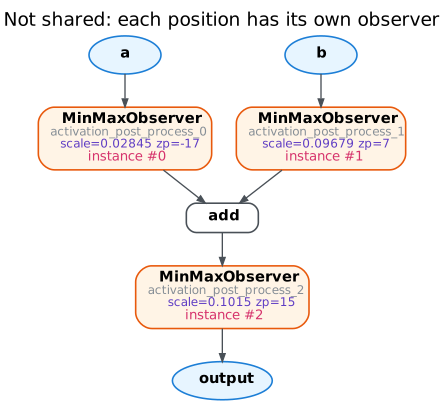
shared = prepare_add(gm_add, True, make_inputs)
draw(shared, notes=instance_notes(shared), title="Shared: three observer nodes point to the same instance")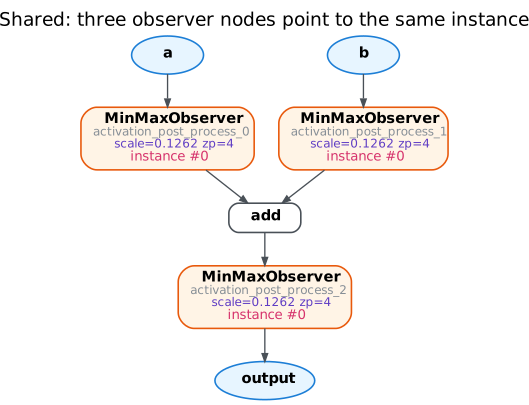
def summary(prepared):
    mods = [mod for _, mod in observer_nodes(prepared)]
    scales = sorted({round(float(m.calculate_qparams()[0]), 6) for m in mods})
    return len(mods), len({id(m) for m in mods}), scales


for title, p in [("Not shared", separate), ("Shared", shared)]:
    n_nodes, n_instances, scales = summary(p)
    print(f"{title}: {n_nodes} observer nodes, {n_instances} instances, scale {scales}")
assert summary(separate)[1] == 3 and summary(shared)[1] == 1
Not shared: 3 observer nodes, 3 instances, scale [0.028452, 0.09679, 0.101465]
Shared: 3 observer nodes, 1 instances, scale [0.126223]- Without sharing: the three positions compute their own scales;
bhas a large range, so its scale is large too. - With sharing: the graph still has three observer nodes (every position must be observed), but they are the same observer instance. This instance sees all the values of
a,band the output, and computes one scale covering all of them.
The same AddQuantizer doesn’t need to know what the model looks like. Switch to the residual model (the inputs of add are the conv’s output and the skip connection’s x) and draw only the area around add:
gm_res = export_module(get_model("residual").eval(), example_inputs(4))
res_shared = prepare_add(gm_res, True, lambda: (torch.randn(4, 3, 16, 16),))
draw(res_shared, focus="add", hops=2, notes=instance_notes(res_shared), title="add in residual: shared")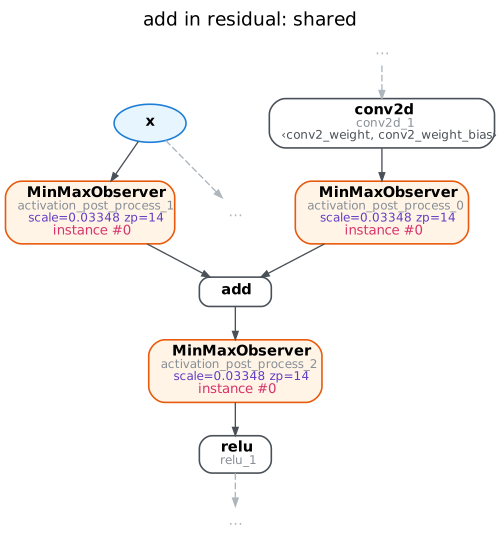
n_nodes, n_instances, _ = summary(res_shared)
print(f"{n_nodes} observer nodes, {n_instances} instances")
assert n_instances == 1 and n_nodes == 3
3 observer nodes, 1 instancesB. Implicit Sharing: Output Annotation + Edge Annotation
M03-1 section C showed that one tensor can have an output annotation (affecting all consumers) and also an edge annotation (affecting only one consumer). What happens when both are attached?
Use the cat_pool model (the input x feeds both conv2d and conv2d_1). TwoLabelQuantizer attaches spec A to the output of x, and spec B to the edge x → conv2d_1. It is written for this experiment by naming nodes, so the node names only fit cat_pool. allow_implicit_sharing is a field of QuantizationAnnotation (default True); setting it to False turns merging off.
class TwoLabelQuantizer(Quantizer):
    def __init__(self, spec_a, spec_b, implicit=True):
        self.spec_a, self.spec_b, self.implicit = spec_a, spec_b, implicit

    def annotate(self, model):
        nodes = {n.name: n for n in model.graph.nodes}
        annotate_output_qspec(nodes["x"], self.spec_a)
        annotate_input_qspec_map(nodes["conv2d_1"], nodes["x"], self.spec_b)
        nodes["conv2d_1"].meta[ANNOTATION_KEY].allow_implicit_sharing = self.implicit
        return model

    def validate(self, model):
        pass
Spec B in the four cases:
a = act_spec()  # int8 per-tensor affine [-128, 127], MinMaxObserver
different = QuantizationSpec(  # qscheme and integer range both differ from A
    dtype=torch.int8, quant_min=-127, quant_max=127, qscheme=torch.per_tensor_symmetric,
    observer_or_fake_quant_ctr=a.observer_or_fake_quant_ctr,
)
other_observer = QuantizationSpec(  # quantization attributes identical to A; only the observer class differs
    dtype=a.dtype, quant_min=a.quant_min, quant_max=a.quant_max, qscheme=a.qscheme,
    observer_or_fake_quant_ctr=MovingAverageMinMaxObserver,
)
cases = [
    ("B differs from A in attributes", TwoLabelQuantizer(a, different)),
    ("B has the same attributes as A", TwoLabelQuantizer(a, a)),
    ("same attributes, but allow_implicit_sharing=False", TwoLabelQuantizer(a, a, implicit=False)),
    ("B differs from A only in observer class", TwoLabelQuantizer(a, other_observer)),
]
For each case, prepare, calibrate and convert, then print what x passes through on its way to conv2d_1 (obs = observer, q/dq = quantize/dequantize):
def path_to(gm, consumer):
    """The nodes x passes through, in order, on its way to the consumer."""
    steps, src = [], next(n for n in gm.graph.nodes if n.name == consumer).args[0]
    while src.op != "placeholder":
        target = str(src.target)
        steps.append("obs" if src.op == "call_module" else "dq" if "dequantize" in target else "q")
        src = src.args[0]
    return " → ".join(["x", *reversed(steps), consumer])


gm_cat = export_module(get_model("cat_pool").eval(), example_inputs(4))
rows = []
for title, quantizer in cases:
    prepared = prepare_pt2e(copy.deepcopy(gm_cat), quantizer)
    obs = observer_nodes(prepared)
    kinds = ", ".join(sorted({type(m).__name__ for _, m in obs}))
    before = path_to(prepared, "conv2d_1")
    with torch.no_grad():
        for _ in range(4):
            prepared(torch.randn(4, 3, 16, 16))
    rows.append([title, len(obs), kinds, before, path_to(convert_pt2e(prepared), "conv2d_1")])
table(rows, ["case", "# observers", "observer classes", "after prepare", "after convert"])| case | # observers | observer classes | after prepare | after convert |
|---|---|---|---|---|
| B differs from A in attributes | 2 | MinMaxObserver | x → obs → obs → conv2d_1 | x → q → dq → q → dq → conv2d_1 |
| B has the same attributes as A | 1 | MinMaxObserver | x → obs → conv2d_1 | x → q → dq → conv2d_1 |
| same attributes, but allow_implicit_sharing=False | 2 | MinMaxObserver | x → obs → obs → conv2d_1 | x → q → dq → q → dq → conv2d_1 |
| B differs from A only in observer class | 1 | MinMaxObserver | x → obs → conv2d_1 | x → q → dq → conv2d_1 |
assert [r[1] for r in rows] == [2, 1, 2, 1]
assert rows[0][4] == "x → q → dq → q → dq → conv2d_1" and rows[1][4] == "x → q → dq → conv2d_1"
assert rows[3][2] == "MinMaxObserver"- Different attributes: the two annotations chain.
xis first quantized by A, then quantized again by B; after convert there are two layers of q/dq, rounding twice. Neither overrides the other, and no error is raised. - Identical attributes: automatically merged into one observer, quantized only once. They are the same tensor anyway, so there is no need to quantize twice; this is implicit sharing.
allow_implicit_sharing=False: no merging, back to two chained observers. Once it is off, you are responsible for not quantizing the same tensor twice.- What is compared is the quantization attributes (dtype, integer range, qscheme, …), not the observer class. When only the observer class differs, they also merge, and what remains is A’s
MinMaxObserver; theMovingAverageMinMaxObserverspecified by B is silently ignored (in this graph A’s annotation comes first in graph order).
To make the same tensor quantized only once: make the attributes of all annotations consistent, or explicitly point to the same position with SharedQuantizationSpec.
Summary
- Sharing qparams = several positions share the same observer instance; the graph still has several observer nodes.
- Explicit:
SharedQuantizationSpec(position), where the position is an edge(producer, consumer)or a node’s output. - Implicit: annotations with identical attributes on the same tensor merge automatically; with different attributes they chain into two quantizations, without an error.