import copy

import torch

from common.graph_utils import qspec_summary, unannotated_ops
from common.models import example_inputs, get_model
from common.pt2e import ANNOTATION_KEY, Quantizer, export_module, get_xnnpack_quantizer, prepare_pt2e, quiet
from common.viz import annotation_notes, draw

quiet()
_ = torch.manual_seed(0)M03-2 | Reading the Annotations XNNPACKQuantizer Attaches

The annotations in M03-1 were attached by hand: we chose the positions and we chose the specs. Before writing our own Quantizer, let’s read what a real Quantizer attaches. We use the test-version XNNPACKQuantizer from torchao (torchao.testing.pt2e._xnnpack_quantizer, an XNNPACK backend Quantizer torchao keeps for its own unit tests), with the per-channel weight config.
To read each annotation, just answer three questions:
- Position: which input edge (
input_qspec_map), or the output of which node (output_qspec). - Spec: which
QuantizationSpec(dtype, integer range, scheme, observer). - Present or not: a position with no annotation, or whose spec is
None, is not quantized.
This notebook reads three models:
- A. conv → relu: why there is no quantization point between conv and relu.
- B. residual: the two input edges of add, and when a conv has its own output annotation.
- C. cat_pool: which ops are left unannotated.
Getting the Graph the Quantizer Really Annotated
The most direct way is to call quantizer.annotate(gm) on the exported graph, but the graph you see that way differs from what the Quantizer actually annotated: M03-1 listed the steps of prepare_pt2e, and BN is folded into conv before annotate. Also, as soon as annotate finishes, prepare_pt2e goes on to insert observers, which makes the annotations hard to read.
So we add a wrapper: CaptureLabels forwards every method to the inner Quantizer, and copies the graph only at the moment annotate finishes.
class CaptureLabels(Quantizer):
    def __init__(self, inner: Quantizer):
        self.inner = inner
        self.annotated: torch.fx.GraphModule | None = None

    def transform_for_annotation(self, model):
        return self.inner.transform_for_annotation(model)

    def annotate(self, model):
        self.inner.annotate(model)
        self.annotated = copy.deepcopy(model)  # the graph after annotation, before observers are inserted
        return model

    def validate(self, model):
        self.inner.validate(model)


def read_labels(model_name):
    """Run prepare_pt2e once on the given model and return the graph XNNPACKQuantizer annotated."""
    gm = export_module(get_model(model_name).eval(), example_inputs(4))
    xnnpack, _ = get_xnnpack_quantizer(is_per_channel=True)
    capture = CaptureLabels(xnnpack)
    prepare_pt2e(gm, capture)
    assert capture.annotated is not None
    return capture.annotated
In each of the three sections below, the annotations the Quantizer attached are written directly under each node in the graph: one line “edge upstream: spec” per input edge, and one line “output: spec” for the output. Specs are abbreviated to dtype + granularity + scheme, e.g. int8 per-tensor affine; not quantized means the spec of that edge is None.
annotation_notes(graph) in the code is a small drawing helper of this project (common/viz.py), not a torchao API: it reads each node’s node.meta["quantization_annotation"], turns it into the text above, and hands it to the notes parameter of draw to be drawn under the node. To read the annotations, just look at the text in the graph.
A. conv → relu: No Quantization Point Between conv and relu
labeled = read_labels("conv_relu")
draw(labeled, notes=annotation_notes(labeled), title="Annotations XNNPACKQuantizer attaches on conv → relu")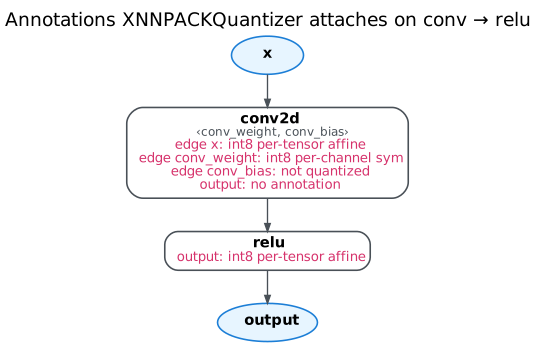
Look at the four lines under conv2d:
- Three input edges: the activation
x, the weight, and the bias. The activation is per-tensor affine, the weight is per-channel symmetric, and the bias spec isNone(this config doesn’t quantize the bias; it stays fp32). - The output of conv2d has no annotation; the output annotation is on relu. So no observer is inserted between conv and relu, and the backend can treat conv + relu as one kernel. This is fusion in PT2E: it doesn’t edit the graph, it just “doesn’t annotate in the middle”.
The full contents of the two specs (common.graph_utils.qspec_summary):
conv = next(n for n in labeled.graph.nodes if n.name == "conv2d")
ann = conv.meta[ANNOTATION_KEY]
# in the copied graph, the annotation keys are still node objects of the original graph, so look up by name
specs = {producer.name: spec for producer, spec in ann.input_qspec_map.items()}
x, weight, bias = (a.name for a in conv.args[:3])
print("activation:", qspec_summary(specs[x]).replace("\n", ", "))
print("weight:     ", qspec_summary(specs[weight]).replace("\n", ", "))
activation: int8 per-tensor affine [-128,127], HistogramObserver
weight: int8 per-channel symmetric [-127,127], PerChannelMinMaxObserver, ch_axis=0relu = next(n for n in labeled.graph.nodes if n.name == "relu")
assert ann.output_qspec is None and specs[bias] is None
assert relu.meta[ANNOTATION_KEY].output_qspec is not NoneThe activation uses HistogramObserver, and the weight uses PerChannelMinMaxObserver computing one scale per output channel (ch_axis=0); this is a choice made by this XNNPACKQuantizer default config (M02-1 compared the various observers).
B. residual: The Two Input Edges of add
labeled = read_labels("residual")
draw(labeled, notes=annotation_notes(labeled), title="Annotations XNNPACKQuantizer attaches on residual (BN folded into conv)")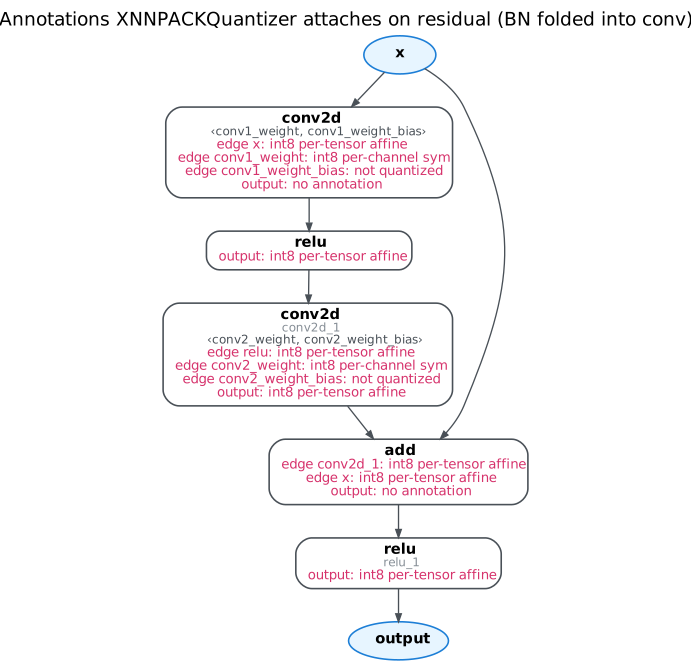
- There is no
batch_normin the graph anymore: the Quantizer sees the graph with BN already folded. The conv’s weight has been replaced by the folded value, and the bias is the new constant computed while folding BN (conv1_weight_bias). - Both input edges of
add(conv2d_1 → add,x → add) have annotations, and the output annotation is on the followingrelu_1: add + relu is also treated as one pattern. - The first conv is followed by a relu, so it has no output annotation; the second conv (
conv2d_1) is followed by an add, with no relu to fuse with, so it has its own output annotation.
Same Quantizer, same op, yet different annotations: the Quantizer decides by looking at the op’s context, not by mapping one op to one annotation.
anns = {n.name: n.meta.get(ANNOTATION_KEY) for n in labeled.graph.nodes}
assert "batch_norm" not in anns
assert anns["conv2d"].output_qspec is None and anns["conv2d_1"].output_qspec is not None
assert len(anns["add"].input_qspec_map) == 2 and anns["add"].output_qspec is None
assert anns["relu_1"].output_qspec is not None
C. cat_pool: Which Ops Are Left Unannotated
An unannotated op doesn’t raise an error; it just stays in fp32. Use unannotated_ops (common.graph_utils) to list ops with no annotation, and also mark them in the graph as “no annotation” (annotation_notes with unlabeled=True):
labeled = read_labels("cat_pool")
left = [n.name for n in unannotated_ops(labeled)]
print("Ops without annotations:", left)
draw(labeled, focus=["cat", "max_pool2d"], hops=1, notes=annotation_notes(labeled, unlabeled=True),
     title="The cat → max_pool2d segment of cat_pool")
Ops without annotations: ['cat', 'max_pool2d']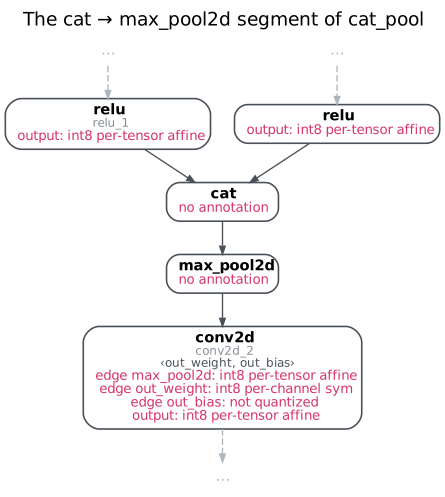
assert {"cat", "max_pool2d"} <= set(left)cat and max_pool2d are ops XNNPACK can quantize, yet they have no annotation. The cause was found in M01-2:
- The
catannotator in this torchao test version relies onnode.meta["source_fn_stack"]to find the pattern. torch 2.14’s export no longer fills this field, so it fails silently. - The
max_pool2dannotator itself isn’t broken: its rule is “share qparams with the input”, and since its inputcathas no annotation, it goes unannotated too.
The executorch version of XNNPACKQuantizer doesn’t have this problem (compared in M08-1).
Lesson: before using any Quantizer, draw its annotations and confirm that the ops you expect to be quantized really have annotations. When writing your own Quantizer, finding ops by node.target is more stable than depending on metadata such as source_fn_stack; this is the approach of M03-3.
Summary
- Each annotation answers only three things: position (edge or output), spec (
QuantizationSpec), present or not. - What fusion looks like in annotations: the nodes in the middle of a pattern get no output annotation, and the output annotation goes on the last op of the pattern (conv + relu on relu, add + relu on relu).
- The Quantizer sees the graph with BN folded and decides annotations from op context; unannotated ops raise no error, so you have to check yourself.