import copy
from collections import Counter

import torch

from common.data import calibration_batches, trained_tiny_net
from common.env import cpu_profile, env_summary
from common.graph_utils import QDQ_PREFIXES, diff_ops, op_counts, qdq_nodes, short
from common.models import example_inputs, get_model
from common.pt2e import convert_pt2e, export_module, get_xnnpack_quantizer, lower_pt2e_quantized_to_x86, prepare_pt2e, quiet
from common.viz import draw, table

quiet()
_ = torch.manual_seed(0)
QD = torch.ops.quantized_decomposedM07-2 | The Same Q/DQ Graph: What Each of Three Treatments Turns It Into

Up to M06, the result of convert_pt2e has always been a Q/DQ graph: the operations are still fp32 (conv2d, linear, …), wrapped in quantize / dequantize, and it does not get faster by itself (M02-3). To turn it into integer arithmetic, something has to “rewrite” the graph. This notebook takes one Q/DQ graph and looks at what each of three treatments does. The definitions of the three terms and how they relate are in the M07 overview.
- A. The starting point: the “dq → op → q” units on the Q/DQ graph, which are exactly what a backend must recognize and replace with int8 kernels.
- B. Reference representation:
convert_pt2e(..., use_reference_representation=True). - C. Lowering:
lower_pt2e_quantized_to_x86. - D. Inductor: what
torch.compiledoes to a Q/DQ graph (using the profiler to see the kernels actually run).
At the end, one summary table compares what the conv unit becomes under the three treatments.
The results depend on the platform: A and B are pure graph rewrites and only change with the torch / torchao versions; C and D depend on the machine (whether mkldnn is available, which kernel conv uses). The outputs stored below were produced in this environment; the notes under the tables are printed according to the measured results:
print(env_summary())Linux x86_64 | torch 2.14.0+cu130 | threads=1 | mkldnn=True | nnpack=TrueThe model is M05’s TinyConvNet, quantized with PTQ using XNNPACKQuantizer (per-channel weight) to get the Q/DQ graph:
def calibrated(model, per_channel=True):
    """export → prepare (XNNPACKQuantizer) → calibrate; returns the prepared graph, not yet converted."""
    prepared = prepare_pt2e(export_module(model, example_inputs()), get_xnnpack_quantizer(is_per_channel=per_channel)[0])
    with torch.no_grad():
        for batch in calibration_batches(128):
            prepared(*batch)
    return prepared


model = trained_tiny_net()
qdq = convert_pt2e(calibrated(model))
(x,) = next(calibration_batches(16, seed=9))
A. The starting point: “dq → op → q” units on the Q/DQ graph
Walk back from each activation’s quantize until reaching a dequantize; the ops passed through in between form one unit. The qdq_units below only recognizes the per-tensor activation q/dq produced by XNNPACKQuantizer; it is not a general pattern detector:
def qdq_units(gm):
    """Return {unit op: (count, whether the input and output (scale, zp) are all the same)}."""
    units, same = Counter(), {}
    for q in gm.graph.nodes:
        if q.target != QD.quantize_per_tensor.default:
            continue
        ops, in_qparams, frontier = [], set(), [q.args[0]]
        while frontier:
            n = frontier.pop()
            if n.target == QD.dequantize_per_tensor.default:
                in_qparams.add(tuple(n.args[1:3]))  # the input (scale, zp)
            if n.op != "call_function" or str(n.target).startswith(QDQ_PREFIXES):
                continue  # stop at dequantize / quantize / placeholder / get_attr
            ops.append(short(n.target))
            frontier += n.all_input_nodes
        if ops:
            key = " + ".join(reversed(ops))
            units[key] += 1
            same[key] = same.get(key, True) and in_qparams == {tuple(q.args[1:3])}
    return {k: (v, same[k]) for k, v in units.items()}


units = dict(sorted(qdq_units(qdq).items(), key=lambda kv: -kv[1][0]))
table([[k, n, "yes" if s else "no"] for k, (n, s) in units.items()], ["ops in dq → [op] → q", "count", "same qparams in/out?"])| ops in dq → [op] → q | count | same qparams in/out? |
|---|---|---|
| conv2d + relu | 3 | no |
| max_pool2d | 2 | yes |
| conv2d | 1 | no |
| add + relu | 1 | no |
| adaptive_avg_pool2d | 1 | yes |
| flatten | 1 | yes |
| linear | 1 | no |
assert units["conv2d + relu"][0] >= 1 and not units["conv2d + relu"][1]
assert units["max_pool2d"][1]  # max_pool2d shares qparams between input and output (M03-4)
Take the add + relu unit of a residual block as an example: two dequantizes go in and one quantize comes out, and the add and relu in between are fp32:
draw(qdq, focus=["add", "relu_2"], hops=1, title="add + relu unit: int8 in, int8 out, fp32 in the middle")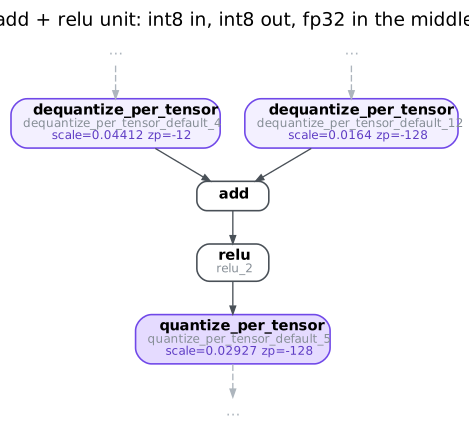
- Every unit has the same semantics: “int8 in, int8 out, computed in fp32 in the middle”. What a backend does is recognize these units and replace them with its own int8 kernels (for example, conv2d + relu becomes one int8 conv-relu).
- The Q/DQ graph is not tied to any backend: the same graph can be handed to Inductor (C and D of this notebook), XNNPACK (M08), or ONNX Runtime (M09), each recognizing it with its own patterns. This is what “Q/DQ is a backend-neutral interchange format” means.
- Units whose input and output share qparams (the ones marked “yes” in the table above, the Shared case of M03-4): an integer kernel does not need to change scale, and max / flatten just move int8 values.
- Units whose output scale differs from the input: the integer kernel has to requantize at the end, converting the accumulated result to the output scale.
B. Reference representation
convert_pt2e(..., use_reference_representation=True) writes Q/DQ as visible arithmetic, and rewrites the units that match a torchao pattern into integer arithmetic. Start with the smallest conv_relu. The two graphs below show the segment before conv’s input x enters conv2d, with the constant parameters (scale, zp, dtype) under each node:
small = convert_pt2e(calibrated(get_model("conv_relu").eval()), use_reference_representation=True)


def literal(node):
    args = [a for a in node.args[1:] if not hasattr(a, "op")]
    if args:
        return ", ".join(f"{a:.4g}" if isinstance(a, float) else str(a).replace("torch.", "") for a in args)
    return str(node.kwargs.get("dtype", "")).replace("torch.", "")


chain, n = [], next(n for n in small.graph.nodes if n.name == "conv2d").args[0]
while n.op == "call_function":
    chain.append(n)
    n = n.args[0]
chain.reverse()  # from the first op after x up to just before conv2d
split = next(i for i, c in enumerate(chain) if torch.int8 in c.args) + 1  # everything up to the cast to int8 (to(int8)) is quantize
quant_part, dequant_part = chain[:split], chain[split:]
notes = {c.name: literal(c) for c in chain}
draw(small, focus=["x"] + [c.name for c in quant_part], hops=0, notes=notes, rankdir="LR",
     title="quantize as arithmetic: ÷ scale → round → int32 → + zp → clamp → int8")
draw(small, focus=[c.name for c in dequant_part] + ["conv2d"], hops=0, notes=notes, rankdir="LR",
     title="dequantize as arithmetic: clamp → fp32 → − zp → × scale, then into the fp32 conv2d")
assert [short(c.target) for c in quant_part][:2] == ["div", "round"] and short(dequant_part[-2].target) == "mul"Both quantize and dequantize become ordinary ATen arithmetic, in which ÷ scale, round, and × scale are still floating-point operations: this step is “writing the formula out”, not switching to an int8 kernel. conv2d itself is unchanged.
Now switch to TinyConvNet and compare the per-channel and per-tensor weight settings. torchao wraps the ops rewritten to int32 arithmetic in out_dtype, so counting those tells which units were rewritten:
def integer_ops(gm):
    """Ops wrapped by out_dtype (computed in int32); the first argument of out_dtype is the wrapped op."""
    return Counter(short(n.args[0]) for n in gm.graph.nodes if short(n.target) == "out_dtype")


b = {}
for label, per_channel in (("per-channel weight (default)", True), ("per-tensor weight", False)):
    ref = convert_pt2e(calibrated(model, per_channel), use_reference_representation=True)
    c = op_counts(ref)
    b[label] = (sum(v for k, v in c.items() if k.startswith(("quantize", "dequantize"))), c["conv2d"], c["linear"],
                integer_ops(ref))
table([[k, q, cv, ln, ", ".join(f"{op}×{m}" for op, m in ints.items()) or "—"] for k, (q, cv, ln, ints) in b.items()],
["TinyConvNet", "remaining q/dq", "fp32 conv2d", "fp32 linear", "ops computed in int32 (out_dtype)"])| TinyConvNet | remaining q/dq | fp32 conv2d | fp32 linear | ops computed in int32 (out_dtype) |
|---|---|---|---|---|
| per-channel weight (default) | 0 | 4 | 1 | mul×2 |
| per-tensor weight | 0 | 4 | 0 | mul×3, linear×1, div×1 |
q_left, n_conv, _, _ = b["per-channel weight (default)"]
assert q_left == 0 and n_conv == 4  # torchao 0.18: q/dq all become arithmetic, conv is not rewritten
assert b["per-tensor weight"][2] == 0 and b["per-tensor weight"][3]["linear"] == 1 # per-tensor linear becomes integer- q/dq all become arithmetic, with none left.
- conv2d is still there, consuming the fp32 produced by dequantize: the conv unit was not rewritten into integer arithmetic. The reason (from reading torchao 0.18’s
reference_representation_rewrite.py): the conv pattern is written withaten.convolution, whiletorch.exportproducesaten.conv2d, so they do not match; the pattern is only written for per-tensor weight, and the conv output must feed directly into quantize (no relu in between). For what the whole unit becomes when all three conditions hold, see the M07 overview, “Reference representation: writing Q/DQ as explicit arithmetic” (the part about whether the whole unit matches a pattern). - What is rewritten into integer arithmetic: the two inputs of add + relu each use an int32 mul to move to the output scale; with per-tensor weight, linear uses int32 accumulation, the bias is quantized with div, and a final mul does the requantize. For how this integer arithmetic is derived from the affine quantization formula, see the section “Pure Integer Arithmetic” in the blog post “All About Quantization” (in Chinese).
So reference representation is a “partial” rewrite: q/dq always become arithmetic, and whether an operation becomes integer depends on whether a pattern matches.
C. Lowering: lower_pt2e_quantized_to_x86
This function does three things: re-export and decompose (for example, conv2d → convolution), run Inductor’s freezing pass, and constant folding. The x86 int8 patterns (for example, dq → conv → q replaced by onednn.qconv_pointwise) are only registered when mkldnn is available (overview, “How the three relate”). The table below shows the op changes before and after lowering:
lowered = lower_pt2e_quantized_to_x86(copy.deepcopy(qdq), (x,))
table(diff_ops(qdq, lowered, "Q/DQ graph", "after lowering", tablefmt="html"))| op | Q/DQ graph | after lowering | delta |
|---|---|---|---|
| adaptive_avg_pool2d | 1 | 0 | -1 |
| conv2d | 4 | 0 | -4 |
| dequantize_per_channel | 5 | 0 | -5 |
| dequantize_per_tensor | 12 | 7 | -5 |
| flatten | 1 | 0 | -1 |
| getitem | 0 | 2 | 2 |
| linear | 1 | 0 | -1 |
| max_pool2d | 2 | 0 | -2 |
| max_pool2d_with_indices | 0 | 2 | 2 |
| mean | 0 | 1 | 1 |
| qconv_pointwise.default | 0 | 4 | 4 |
| qlinear_pointwise.default | 0 | 1 | 1 |
| quantize_per_tensor | 11 | 6 | -5 |
| relu | 4 | 1 | -3 |
| view | 0 | 1 | 1 |
| add | 1 | 1 | 0 |
onednn = Counter(short(n.target) for n in lowered.graph.nodes if "onednn" in str(n.target))
n_before, n_after = len(qdq_nodes(qdq)), len(qdq_nodes(lowered))
mkldnn = torch.backends.mkldnn.is_available()
print(f"onednn ops: {dict(onednn) or 'none'}; q/dq: {n_before} → {n_after}; mkldnn available: {mkldnn}")
if onednn:
    print(f"The patterns matched: q/dq went from {n_before} to {n_after}, and these units were replaced with oneDNN int8 ops.")
elif not mkldnn:
    print("No mkldnn: the patterns are not registered, so the result is just a decomposed Q/DQ graph, with no q/dq removed.")
else:
    print("mkldnn is available but there are no onednn ops: the patterns are registered but did not match; see the op-change table above (not investigated here).")
if not mkldnn:
    assert not onednn and n_after == n_before
onednn ops: {'qconv_pointwise.default': 4, 'qlinear_pointwise.default': 1}; q/dq: 28 → 13; mkldnn available: True
The patterns matched: q/dq went from 28 to 13, and these units were replaced with oneDNN int8 ops.Most of the changes in the table above are decompose (conv2d → convolution, linear → addmm, etc.). In an environment without mkldnn, this is the only step lowering has; which ops are actually present after lowering on x86 is not verified here.
D. Inductor: what torch.compile does to a Q/DQ graph
The kernels generated by torch.compile do not show up under ATen op names in the profiler, so we compare two things: whether q/dq are still called as separate kernels, and which kernel conv actually runs. The profiler uses cpu_profile() introduced in M07-1:
CONV_WRAPPERS = ("aten::conv2d", "aten::convolution", "aten::_convolution", "aten::_nnpack_available")
INT8_HINTS = ("qconv", "onednn::q", "quantized::")  # a name containing these is treated as an int8 conv (inference, based on the op names in x86.py)


def kernel_calls(fn, x):
    """Return (number of q/dq kernel calls, kernels conv actually runs, total op calls)."""
    with torch.no_grad():
        fn(x)  # run once first: compile happens here
        with cpu_profile() as prof:
            fn(x)
    names = [e.name for e in prof.events() or []]
    convs = sorted({s for s in names if "conv" in s and s not in CONV_WRAPPERS})
    return sum(s.startswith("quantized_decomposed::") for s in names), convs, sum("::" in s for s in names)


eager = kernel_calls(qdq, x)
try:
    compiled, compile_error = kernel_calls(torch.compile(copy.deepcopy(qdq)), x), None
except Exception as e:  # e.g. on x86 with mkldnn, Inductor rewrites max_pool2d into an op that fails at run time
    compiled, compile_error = None, f"{type(e).__name__}: {str(e).splitlines()[0][:150]}"
table([[name, n, ", ".join(k), total] for name, r in (("Q/DQ graph (eager)", eager), ("torch.compile(Q/DQ graph)", compiled)) if r for n, k, total in [r]],
["", "q/dq kernel calls", "kernel conv actually runs", "total op calls"])| q/dq kernel calls | kernel conv actually runs | total op calls | |
|---|---|---|---|
| Q/DQ graph (eager) | 28 | aten::mkldnn_convolution | 534 |
if compiled is None:
    is_int8 = False
    print(f"torch.compile failed on this machine, so there is nothing to compare: {compile_error}")
else:
    is_int8 = any(h in k for k in compiled[1] for h in INT8_HINTS)
    print(f"q/dq kernel calls: {eager[0]} → {compiled[0]}; op calls: {eager[2]} → {compiled[2]}")
    print("conv: " + ("int8 kernel" if is_int8 else "still fp32, no int8 conv"))
    assert compiled[0] < eager[0]
torch.compile failed on this machine, so there is nothing to compare: NotImplementedError: Could not run 'aten::quantized_max_pool2d' with arguments from the 'CPU' backend. This could be because the operator doesn't exist for this backend, o- Inductor fuses the elementwise operations dequantize, relu, and quantize into the kernel it generates, so q/dq are no longer separate calls and the number of op calls drops sharply.
- Whether conv becomes int8 depends on the result printed above. Inductor’s freezing setting is off by default (overview, “How the three relate”); the conv rewrite with the int8 patterns from section C only runs when it is on.
- Platform difference: on x86 with mkldnn (torch 2.14, Linux x86_64), Inductor’s x86 quantization passes act whether or not freezing is on, and they fail: by default max_pool2d is rewritten into
aten::quantized_max_pool2d, which has no CPU implementation (aNotImplementedErrorat run time); with freezing on, packing the weight of the quantized conv raises a dtype error. The outputs stored in the Chinese notebook come from macOS arm64, where the compile works (these x86 quantization passes do not apply to arm); thetry/exceptabove lets the notebook run to the end on x86 too.
Summary table: what the conv unit becomes under the three treatments
rows = [
    ["reference representation", "became arithmetic" if q_left == 0 else f"{q_left} left",
     f"fp32 conv2d ({n_conv})" if n_conv else "integer conv", "no" if n_conv else "yes"],
    ["lower_pt2e_quantized_to_x86", "kept" if n_after == n_before else f"{n_before} → {n_after}",
     ", ".join(onednn) if onednn else "fp32 convolution", "yes" if onednn else "no"],
    ["torch.compile", "compile failed" if compiled is None else "fused into the generated kernel" if compiled[0] == 0 else "partly kept",
     "—" if compiled is None else ", ".join(compiled[1]) or "—",
     "yes" if is_int8 else "no"],
]
table(rows, ["treatment", "q/dq", "conv", "conv is integer arithmetic?"])| treatment | q/dq | conv | conv is integer arithmetic? |
|---|---|---|---|
| reference representation | became arithmetic | fp32 conv2d (4) | no |
| lower_pt2e_quantized_to_x86 | 28 → 13 | qconv_pointwise.default, qlinear_pointwise.default | yes |
| torch.compile | compile failed | — | no |
n_int = sum(r[3] == "yes" for r in rows)
print(f"{n_int} treatment(s) turned conv into integer arithmetic." if n_int else "None of the three treatments turned conv into an int8 kernel.")
1 treatment(s) turned conv into integer arithmetic.The Q/DQ graph is only a spec of “where to quantize and with which qparams”; a real integer kernel needs the backend’s patterns to recognize the units and replace them. x86 needs oneDNN; the path on arm is XNNPACK (M08). How far the backend’s real int8 kernel is from the Q/DQ graph numerically is measured in M08 and M09.
Summary
- The Q/DQ graph is made of “dq → op → q” units and is a backend-neutral interchange format.
- Reference representation writes q/dq as arithmetic; an operation only becomes integer if it matches a torchao pattern (torchao 0.18’s conv does not match).
- Lowering and
torch.compileneed the backend’s int8 patterns to swap in kernels; without them, lowering is left with only decompose, andtorch.compileonly fuses elementwise operations (on x86 with mkldnn, Inductor’s quantization passes can instead make the compile fail; see section D).