import copy

import torch

from common.models import ConvBnReLU, ConvReLU, example_inputs
from common.pt2e import convert_pt2e, export_module, prepare_qat_pt2e, quiet
from common.qat import freeze_for_eval, qat_quantizer
from common.viz import draw, draw_stages, table
from common.weight_norm import add_weight_norm, strip_weight_norm

quiet()
_ = torch.manual_seed(0)


def make(cls):
    """Small model: warm BN up with a few batches, then apply weight_norm to conv.weight."""
    torch.manual_seed(0)
    m = cls(3, 8).train()
    with torch.no_grad():
        for _ in range(3):
            m(torch.randn(16, 3, 16, 16))
    add_weight_norm(m.eval())
    return m


def prepare(model):
    return prepare_qat_pt2e(export_module(model, example_inputs(), train=True), qat_quantizer(bits=8))


def short_train(prepared, steps=5):
    """A few SGD steps, only to confirm that g and v get updated; the loss is arbitrary."""
    opt = torch.optim.SGD(prepared.parameters(), lr=1e-2)
    for _ in range(steps):
        opt.zero_grad()
        prepared(torch.randn(16, 3, 16, 16)).pow(2).mean().backward()
opt.step()M06-6 (Optional) | weight_norm in QAT: Keep g, v During Training and Strip It From the Graph Only Before convert

What weight_norm is, what it looks like after export, and how PTQ handles it: see M05-5. PTQ does not train, so removing weight_norm costs nothing; QAT does train, and remove_parametrizations before export amounts to giving up training \(g\) and \(v\). This notebook looks at how to “keep it until training ends”:
- A. No BN: \(g\) and \(v\) both get gradients and both get updated; convert folds
_weight_norminto a constant, and no extra handling is needed. - B. With BN:
prepare_qat_pt2esucceeds, andconvert_pt2eraisesValueErrorwhen folding BN. - C. Fix: after training and before convert, use
strip_weight_normto turn the weight back into aget_attr.
For the basic graph-editing moves see M00-4; for the QAT conv + BN subgraph see M04-2.
add_weight_norm and strip_weight_norm are this project’s tools (common/weight_norm.py), introduced in M05-5; for qat_quantizer and freeze_for_eval see M06-1 and M06-2.
A. No BN: Both g and v Are Trained
Apply weight_norm to conv + relu, then run prepare_qat_pt2e:
p = prepare(make(ConvReLU))
NOTES = {"_weight_norm": "W = g·v/‖v‖", "activation_post_process_1": "fake quant of weight"}
draw(p, title="After prepare_qat_pt2e: the weight's fake quant attaches to the output of _weight_norm", notes=NOTES)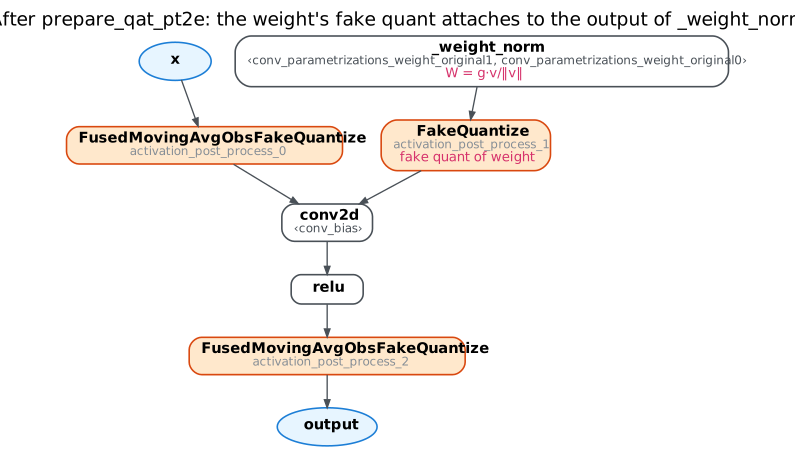
The weight’s fake quant attaches to the output of _weight_norm, so it quantizes the computed \(W\), at the same position as the observer in PTQ (M05-5). Train a few steps and see which parameters get gradients and updates:
params = dict(p.named_parameters())
before = {k: v.detach().clone() for k, v in params.items()}
short_train(p)
updated = {k: (v.grad is not None and bool(v.grad.abs().sum() > 0), not torch.equal(v, before[k])) for k, v in params.items()}
table([[k, g, u] for k, (g, u) in updated.items()], ["Parameter", "Has gradient", "Updated"])| Parameter | Has gradient | Updated |
|---|---|---|
| conv.bias | True | True |
| conv.parametrizations.weight.original0 | True | True |
| conv.parametrizations.weight.original1 | True | True |
assert all(g and u for g, u in updated.values())
assert any("original0" in k for k in updated) and any("original1" in k for k in updated)
original0 is \(g\) and original1 is \(v\). The STE gradient passes through the fake quant and then flows back to \(g\) and \(v\) through _weight_norm, so what QAT trains is \(g\) and \(v\), and the re-parametrization stays in effect. How the gradients of \(g\) and \(v\) are derived, and what this split buys for optimization, is in the blog post “Notes on Weight Normalization” (in Chinese).
Without BN, convert needs no extra handling:
freeze_for_eval(p)
c = convert_pt2e(copy.deepcopy(p))
draw_stages([(p, "Fake quant graph after training"), (c, "convert_pt2e")],
            focus=["_weight_norm", "activation_post_process_0", "activation_post_process_1", "conv2d"], hops=0,
            notes=[{"activation_post_process_0": "fake quant of input", "activation_post_process_1": "fake quant of weight"}, {}],
            title="No BN: convert folds _weight_norm together with quantize into a constant")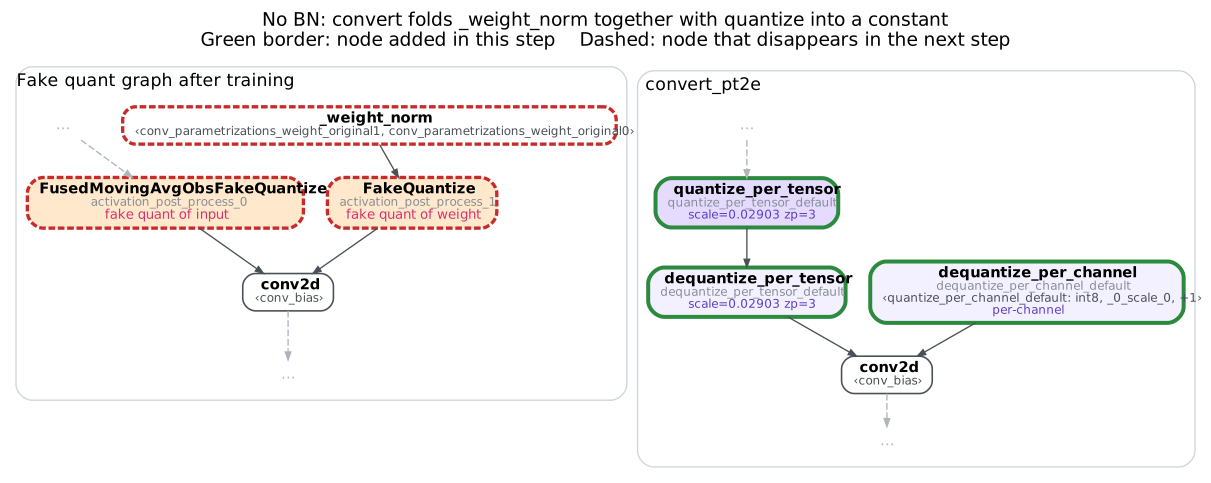
assert "_weight_norm" not in {n.name for n in c.graph.nodes}The two fake quants in the left graph are replaced by different things after convert:
- The input’s fake quant →
quantize_per_tensor+dequantize_per_tensor: the input values are only known at run time, so the q/dq stays in the graph (the two green boxes at the top of the right graph). - The weight’s fake quant together with
_weight_norm→ an int8 constant +dequantize_per_channel: all inputs of_weight_normare constants, and convert defaults tofold_quantize=True, so it precomputes this together with the weight’s quantize into an int8 constant (the same as M05-5 B), leaving only the dequantize in the right graph.
B. With BN: prepare Succeeds, convert Fails
p_bn = prepare(make(ConvBnReLU))
FOCUS = ["_weight_norm", "mul", "activation_post_process_1", "conv2d_1"]
draw(p_bn, focus=FOCUS, hops=1, notes={"_weight_norm": "weight source of the conv + BN subgraph"},
     title="With BN: the QAT subgraph is built as usual, and the weight still comes from _weight_norm")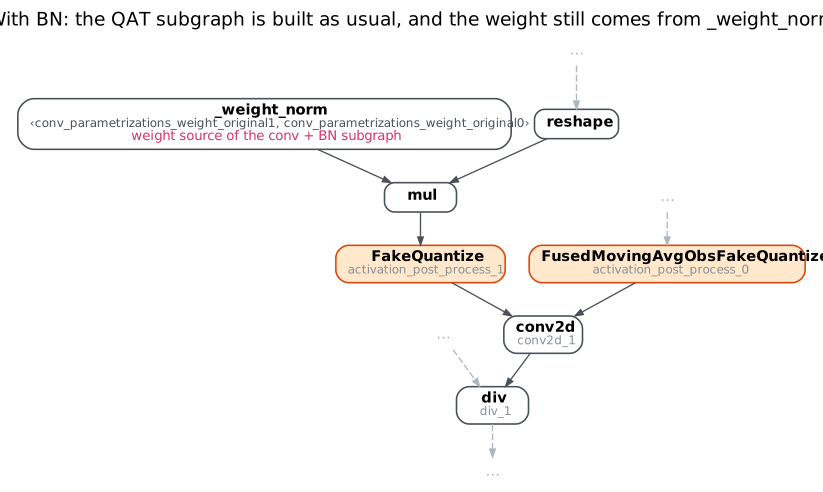
prepare_qat_pt2e does not fold BN; it replaces conv + BN with the QAT subgraph (M04-2): the weight is first multiplied by BN’s coefficient (mul) and then goes into the fake quant. The pattern match that builds the subgraph does not care where the weight comes from, so it can be built with _weight_norm attached and training runs as usual. The problem is at the last step:
short_train(p_bn)
freeze_for_eval(p_bn)
try:
    convert_pt2e(copy.deepcopy(p_bn))
    error = None
except ValueError as e:
    error = e
print("convert_pt2e →", f"{type(error).__name__}: {error}")
assert error is not None
convert_pt2e → ValueError: Expected get_attr node, got call_functionconvert_pt2e has to actually fold BN into conv (_fold_conv_bn_qat, one of the five steps in M02-3), which requires reading the weight out as a constant and rewriting it. The torchao internal function that reads constants accepts only get_attr (from reading the torchao 0.18 source), so it fails when the weight is the call_function _weight_norm. The difference from PTQ is when it fails: PTQ fails right at the start of prepare_pt2e (M05-5), while QAT fails only at convert, after all the training is done.
C. Fix: After Training and Before convert, Turn the Weight Back Into get_attr
strip_weight_norm(gm) computes the weight with the same _weight_norm and the same \(g\), \(v\) in the graph, stores it as a parameter, inserts a get_attr node, uses replace_all_uses_with to rewire downstream consumers to it, and then deletes _weight_norm (the graph-editing moves of M00-4):
fixed = copy.deepcopy(p_bn)
x = torch.randn(32, 3, 16, 16)
with torch.no_grad():
    y_before = fixed(x)
print("Weight stripped:", strip_weight_norm(fixed))
print("Parameters after strip:", [n for n, _ in fixed.named_parameters()])
draw_stages([(p_bn, "Fake quant graph after training"), (fixed, "After strip_weight_norm")], focus=FOCUS, hops=1,
            title="_weight_norm replaced by get_attr (‹conv_weight›)")
Weight stripped: ['conv.weight']
Parameters after strip: ['conv.weight', 'bn.weight', 'bn.bias']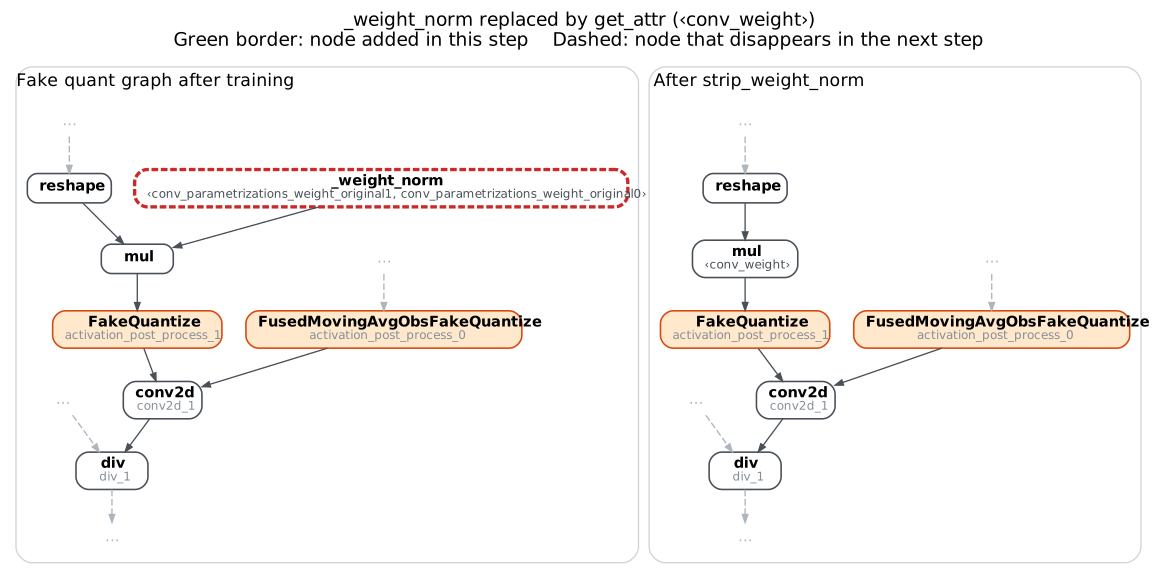
The weight input of mul in the graph is now ‹conv_weight›. Now convert works, and BN is folded into conv too:
converted = convert_pt2e(copy.deepcopy(fixed))
draw(converted, focus=lambda n: n.name.startswith("conv2d"), hops=2, title="After convert_pt2e: batch_norm has been folded into conv")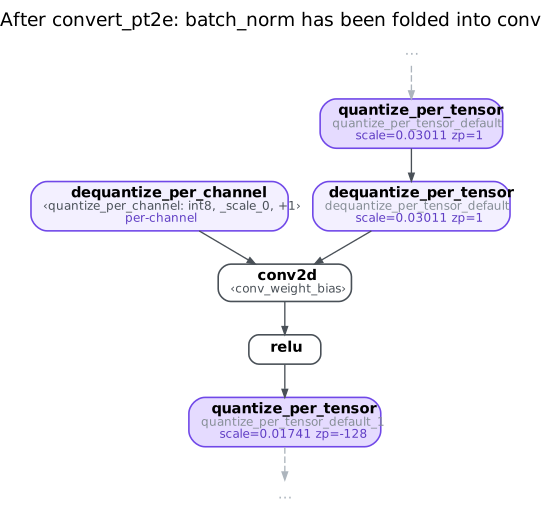
with torch.no_grad():
    y_after, y_conv = fixed(x), converted(x)
checks = {"Fake quant graph before vs after strip (torch.equal)": torch.equal(y_before, y_after),
          "Fake quant graph after strip vs convert graph (torch.allclose)": torch.allclose(y_after, y_conv)}
table([[k, v] for k, v in checks.items()], ["Output on the same 32 inputs", "Result"])| Output on the same 32 inputs | Result |
|---|---|
| Fake quant graph before vs after strip (torch.equal) | True |
| Fake quant graph after strip vs convert graph (torch.allclose) | True |
assert all(checks.values())
assert not any("batch_norm" in str(n.target) for n in converted.graph.nodes)
The two checks each test one thing:
- Bitwise identical before and after strip: checks that the graph edit was wired correctly. The weight is computed by the same op with the same \(g\), \(v\), so the values are necessarily identical; what can go wrong is which parameter the new
get_attrpoints to, and whether all downstream consumers were rewired. - The convert graph matches the fake quant graph: section B failed at this step; here it runs through, and the outputs agree, which shows that folding BN read the correct weight.
Why strip only after training: once it is stripped, the graph holds only the constant \(W\), so calling it before training is equivalent to remove_parametrizations, giving up training \(g\) and \(v\).
Summary
- In QAT the fake quant attaches to the output of
_weight_norm, and gradients flow back through it to \(g\) and \(v\). - Without BN there is nothing to handle; with BN,
prepare_qat_pt2epasses and onlyconvert_pt2efails when folding BN. - Flow:
export(train=True)→prepare_qat_pt2e→ training →freeze_for_eval→strip_weight_norm→convert_pt2e. - This notebook does not compare the effect of weight_norm on QAT accuracy.