import copy

import torch
from torch.fx import Graph
from torch.fx.passes.infra.pass_manager import PassManager
from torch.fx.passes.utils.matcher_utils import SubgraphMatcher

from common.data import calibration_batches
from common.graph_utils import diff_ops, observer_nodes, op_counts
from common.models import example_inputs, get_model
from common.pt2e import DuplicateDQPass, convert_pt2e, export_module, get_xnnpack_quantizer, prepare_pt2e, quiet
from common.viz import draw_stages, table

quiet()
_ = torch.manual_seed(0)

QD = torch.ops.quantized_decomposed # the q/dq ops produced by convert_pt2e all live in this namespaceM02-3 | Redo convert_pt2e by Hand: observer → quantize/dequantize

M02-2 did prepare_pt2e by hand. This notebook does convert_pt2e by hand and finally compares the result with it item by item.
First, what convert_pt2e does in order (torchao 0.18 quantize_pt2e.py):
| Order | Step | What it does | In this notebook |
|---|---|---|---|
| 1 | observer → q/dq | Replace each observer with a quantize/dequantize pair, writing scale and zero point into the graph | Part B |
| 2 | _fold_conv_bn_qat |
Fold away the conv + bn subgraph left in place during QAT training | Skipped (PTQ already folded BN at prepare, M04) |
| 3 | DuplicateDQPass |
When one dequantize has multiple users, make a copy for each user | Part C |
| 4 | PortNodeMetaForQDQ |
Move metadata such as annotations onto the q/dq nodes | Skipped (does not affect graph structure or values) |
| 5 | constant_fold |
The weight’s quantize input is a constant; precompute it and store only int8 | Part D |
Before starting, part A first confirms the math of the quantize and dequantize ops.
A. The Math of quantize/dequantize
The two ops are just the M01 formulas: \(q = \text{clamp}(\text{round}(x/s) + z,\ q_{\min}, q_{\max})\), \(\hat{x} = (q - z)\cdot s\). Pick a smallish scale so that some elements fall outside the range and get clamped:
x = torch.randn(8) * 2
scale, zp, qmin, qmax = 0.02, 3, -128, 127

q_op = QD.quantize_per_tensor(x, scale, zp, qmin, qmax, torch.int8)
dq_op = QD.dequantize_per_tensor(q_op, scale, zp, qmin, qmax, torch.int8)
q_hand = (torch.round(x / scale) + zp).clamp(qmin, qmax).to(torch.int8)
dq_hand = (q_hand.to(torch.float32) - zp) * scale
clamped = ((torch.round(x / scale) + zp < qmin) | (torch.round(x / scale) + zp > qmax))

table([["x", *[f"{v:.3f}" for v in x.tolist()]],
       ["q (op)", *q_op.tolist()],
       ["q (by hand)", *q_hand.tolist()],
       ["dq (op)", *[f"{v:.3f}" for v in dq_op.tolist()]],
["clamped", *["✱" if c else "" for c in clamped.tolist()]]])| x | 3.082 | -0.587 | -4.358 | 1.137 | -2.169 | -2.797 | 0.807 | 1.676 |
| q (op) | 127 | -26 | -128 | 60 | -105 | -128 | 43 | 87 |
| q (by hand) | 127 | -26 | -128 | 60 | -105 | -128 | 43 | 87 |
| dq (op) | 2.480 | -0.580 | -2.620 | 1.140 | -2.160 | -2.620 | 0.800 | 1.680 |
| clamped | ✱ | ✱ | ✱ |
assert torch.equal(q_op, q_hand) and torch.equal(dq_op, dq_hand) and clamped.any()The ops are bit-for-bit identical to the hand-written formulas. Clamped elements come back stopped at the range boundary (\((q_{\max} - z)\cdot s\) or \((q_{\min} - z)\cdot s\)); this is the clipping error.
Setup: a Calibrated, Not-Yet-Converted Graph
TinyConvNet (conv-bn-relu, a residual block, linear), prepared with XNNPACKQuantizer (per-channel weights) and calibrated. official is the result of convert_pt2e, and every later step is compared against it.
model = get_model("tiny").eval()
quantizer, _ = get_xnnpack_quantizer(is_per_channel=True)
prepared = prepare_pt2e(export_module(model, example_inputs(8)), quantizer)
with torch.no_grad():
    for batch in calibration_batches(n=128, batch_size=16):
        prepared(*batch)

official = convert_pt2e(copy.deepcopy(prepared))  # convert_pt2e modifies in place, so call it on a copy
x_test = torch.randn(8, 3, 16, 16)


def max_diff(a, b):
    with torch.no_grad():
        return float((a(x_test) - b(x_test)).abs().max())


print(f"Number of observers in the prepared graph = {len(observer_nodes(prepared))}")
Number of observers in the prepared graph = 16B. Step 1: observer → q/dq
For each observer: take out the scale and zero point with calculate_qparams(), insert quantize and dequantize in front of it, make the downstream consume the dequantize, then delete the observer. The graph edit is Steps 4 to 5 of M00-4 (replace call_module with call_function, put constants into the graph). Where the scale and zero point go depends on the quantization mode:
- per-tensor: scale and zero point are Python numbers, written directly in the node’s arguments.
- per-channel: scale and zero point are tensors; register them as buffers first, then read them out with
get_attrnodes.
def replace_observers_with_qdq(gm):
    """Replace each observer (call_module) in the graph with quantize → dequantize call_functions."""
    graph = gm.graph
    for k, (node, obs) in enumerate(observer_nodes(gm)):
        scale, zp = obs.calculate_qparams()
        qmin, qmax, dtype = obs.quant_min, obs.quant_max, obs.dtype
        src = node.args[0]
        with graph.inserting_before(node):
            if scale.numel() > 1:  # per-channel: register tensors as buffers and read them with get_attr
                gm.register_buffer(f"_scale_{k}", scale.detach().clone())
                gm.register_buffer(f"_zero_point_{k}", zp.detach().clone())
                s_node, z_node = graph.get_attr(f"_scale_{k}"), graph.get_attr(f"_zero_point_{k}")
                axis = int(obs.ch_axis)
                q = graph.call_function(QD.quantize_per_channel.default, (src, s_node, z_node, axis, qmin, qmax, dtype))
                dq = graph.call_function(QD.dequantize_per_channel.default, (q, s_node, z_node, axis, qmin, qmax, dtype))
            else:                  # per-tensor: Python numbers go directly in the arguments
                s, z = float(scale), int(zp)
                q = graph.call_function(QD.quantize_per_tensor.default, (src, s, z, qmin, qmax, dtype))
                dq = graph.call_function(QD.dequantize_per_tensor.default, (q, s, z, qmin, qmax, dtype))
        node.replace_all_uses_with(dq)
        graph.erase_node(node)
        gm.delete_submodule(node.target)  # discard the observer module once used
    graph.lint()
    gm.recompile()
    return gm


manual = replace_observers_with_qdq(copy.deepcopy(prepared))
draw_stages([(prepared, "prepared after calibration"), (manual, "after step 1")], focus=["conv2d"], hops=2,
            title="stem conv2d: observers replaced by q/dq")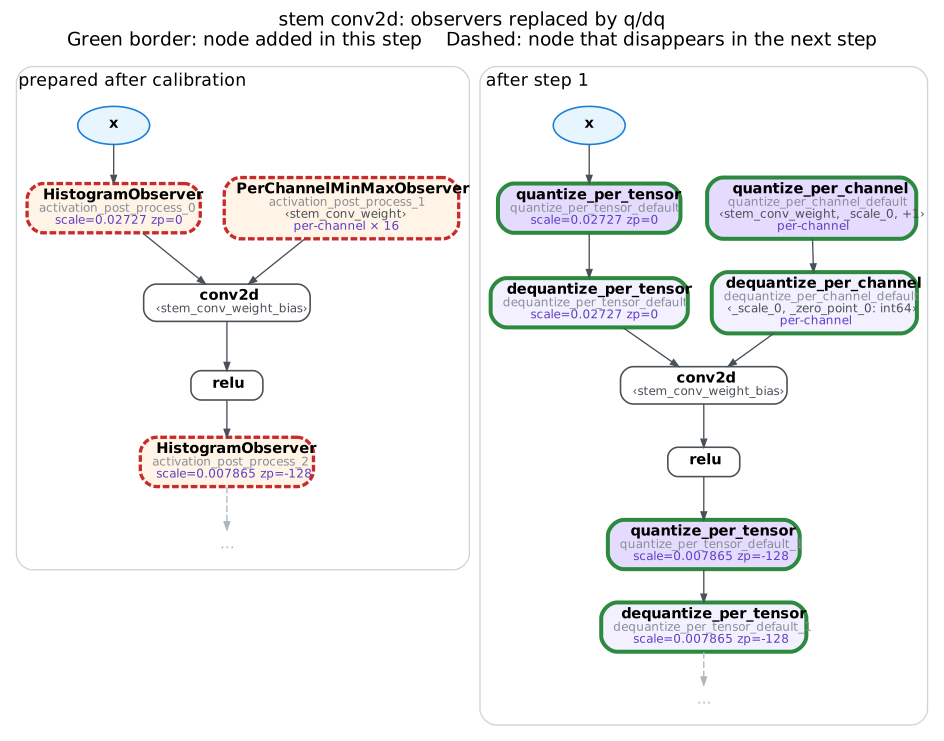
The three observers on the left (dashed, gone after the next step) each become a q/dq pair on the right (green boxes). The weight’s pair is per-channel, and _scale_0 in its arguments is the buffer just registered; the activation’s pair is per-tensor, with the scale written directly in the arguments.
Compare the output with convert_pt2e:
print(f"After step 1, max output difference vs. convert_pt2e = {max_diff(official, manual):.3e}")
assert max_diff(official, manual) == 0
After step 1, max output difference vs. convert_pt2e = 0.000e+00The numbers are already exactly the same. But the graph’s op composition still differs in two places (official = convert_pt2e, manual = step 1 only):
table(diff_ops(official, manual, "official", "manual", tablefmt="html"))| op | official | manual | delta |
|---|---|---|---|
| dequantize_per_tensor | 12 | 11 | -1 |
| quantize_per_channel | 0 | 5 | 5 |
| adaptive_avg_pool2d | 1 | 1 | 0 |
| add | 1 | 1 | 0 |
| conv2d | 4 | 4 | 0 |
| dequantize_per_channel | 5 | 5 | 0 |
| flatten | 1 | 1 | 0 |
| linear | 1 | 1 | 0 |
| max_pool2d | 2 | 2 | 0 |
| quantize_per_tensor | 11 | 11 | 0 |
| relu | 4 | 4 | 0 |
co, cm = op_counts(official), op_counts(manual)
assert co["quantize_per_channel"] == 0 and cm["quantize_per_channel"] == 5
assert co["dequantize_per_tensor"] == cm["dequantize_per_tensor"] + 1quantize_per_channel:officialhas none, because the weight’s quantize was precomputed (step 5, part D).dequantize_per_tensor:officialhas one more (step 3, part C).
C. Step 3: DuplicateDQPass
Find the dequantizes currently shared by multiple users:
def shared_dqs(gm):
    return [n.name for n in gm.graph.nodes
            if n.op == "call_function" and n.target == QD.dequantize_per_tensor.default and len(n.users) > 1]


before = copy.deepcopy(manual)
shared = shared_dqs(manual)
manual = PassManager([DuplicateDQPass()])(manual).graph_module
print(f"Before applying, dequantize shared by multiple users: {shared}")
print(f"After applying: {shared_dqs(manual)}")
assert len(shared) == 1 and shared_dqs(manual) == []
Before applying, dequantize shared by multiple users: ['dequantize_per_tensor_default_2']
After applying: []draw_stages([(before, "before"), (manual, "after DuplicateDQPass")], focus=shared,
title="residual block entrance: one dq feeds two ops")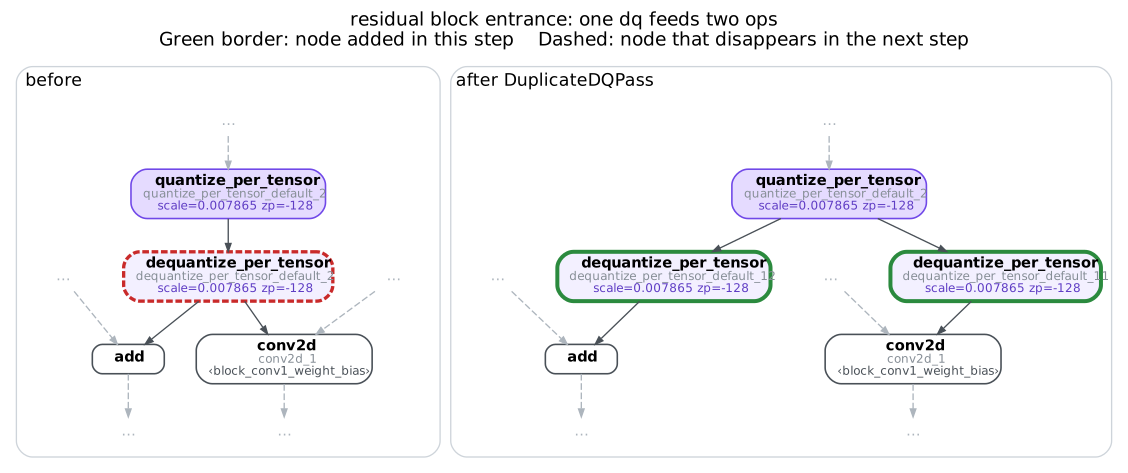
This is the entrance of the residual block: the same dequantize feeds both conv2d_1 and add. After the pass, each of the two users has its own dequantize.
What is the problem with sharing one dq? As the M01 overview mentioned, for a backend to make int8 actually faster, it looks for the “dq → op → q” pattern in the Q/DQ graph and replaces the whole segment with one int8 kernel. This act of “replacing the Q/DQ graph with backend kernels” is called lowering (done for real from M07 on).
When replacing, the dq inside the pattern disappears with it. But the dq on the left of the figure above must also feed add: if “dq → conv2d_1” is replaced with an int8 conv, add loses its input. So when matching a pattern, if a node inside the pattern still has users outside it, that segment cannot count as a successful match. This is how torch.fx’s SubgraphMatcher defines it (in the source’s _is_contained: a matched node may not have users outside the pattern, except for the pattern’s inputs and outputs).
Now use SubgraphMatcher to look for “dq → conv2d” in both graphs (matching only the first half of the pattern, without comparing argument values) and see which convs match:
def dq_conv_matcher(gm):
    """Pattern for "dequantize → conv2d"; argument count follows the conv2d in the graph, values are not compared (ignore_literals)."""
    conv = next(n for n in gm.graph.nodes if n.target == torch.ops.aten.conv2d.default)
    dq = conv.args[0]
    pattern = Graph()
    xq, w, b = pattern.placeholder("xq"), pattern.placeholder("w"), pattern.placeholder("b")
    x = pattern.call_function(dq.target, (xq, *dq.args[1:]))
    pattern.output(pattern.call_function(conv.target, (x, w, b, *conv.args[3:])))
    return SubgraphMatcher(pattern, ignore_literals=True)


matcher = dq_conv_matcher(manual)


def matched_convs(gm):
    return sorted(n.name for m in matcher.match(gm.graph) for n in m.nodes_map.values()
                  if n.target == torch.ops.aten.conv2d.default)


table([["before (dq shared)", ", ".join(matched_convs(before))],
       ["after DuplicateDQPass", ", ".join(matched_convs(manual))]],
["graph", "convs matching \"dq → conv2d\""])| graph | convs matching "dq → conv2d" |
|---|---|
| before (dq shared) | conv2d, conv2d_2, conv2d_3 |
| after DuplicateDQPass | conv2d, conv2d_1, conv2d_2, conv2d_3 |
assert "conv2d_1" not in matched_convs(before) and "conv2d_1" in matched_convs(manual)Before the pass, conv2d_1 does not match: the dq in front of it must also feed add. After the pass, conv2d_1 and add each have their own dq, “dq → conv2d_1” stands as its own segment, and the backend can replace it with an int8 conv while add keeps using its own dq, unaffected. This is the purpose of DuplicateDQPass, and its docstring says the same: users that share one dequantize cannot be annotated and lowered separately.
Copying just adds a node with identical arguments, so the values are exactly equivalent:
print(f"After applying, max output difference vs. convert_pt2e = {max_diff(official, manual):.3e}")
assert max_diff(official, manual) == 0
After applying, max output difference vs. convert_pt2e = 0.000e+00D. Step 5: Constant Folding
The weight’s quantize input is a constant (a parameter read by get_attr), so the result need not wait until run time. Precompute the int8 weight with the op, register it as a buffer, and have the graph read it with get_attr; the original quantize node then has no users.
def get_attr_value(gm, target):
    obj = gm
    for part in target.split("."):
        obj = getattr(obj, part)
    return obj


def fold_weight_quantize(gm):
    """The result of quantize_per_channel(get_attr weight) is a constant: precompute it and store as an int8 buffer."""
    graph = gm.graph
    folded = 0
    for node in list(graph.nodes):
        if node.op != "call_function" or node.target != QD.quantize_per_channel.default:
            continue
        if node.args[0].op != "get_attr":  # fold weights only; an activation input is not known until run time
            continue
        w, scale, zp = (get_attr_value(gm, a.target) for a in node.args[:3])
        w_int8 = QD.quantize_per_channel(w, scale, zp, *node.args[3:])  # call the op directly to get the int8 weight
        name = f"_frozen_param{folded}"
        gm.register_buffer(name, w_int8)
        with graph.inserting_before(node):
            new = graph.get_attr(name)
        node.replace_all_uses_with(new)
        graph.erase_node(node)
        folded += 1
    graph.eliminate_dead_code()  # the fp32 weight get_attr has no users now; clean it up too
    graph.lint()
    gm.recompile()
    return folded


before = copy.deepcopy(manual)
n_fold = fold_weight_quantize(manual)
draw_stages([(before, "before folding"), (manual, "after folding")],
            focus=["quantize_per_channel_default", "dequantize_per_channel_default", "conv2d"], hops=0,
            title="stem weight: quantize precomputed")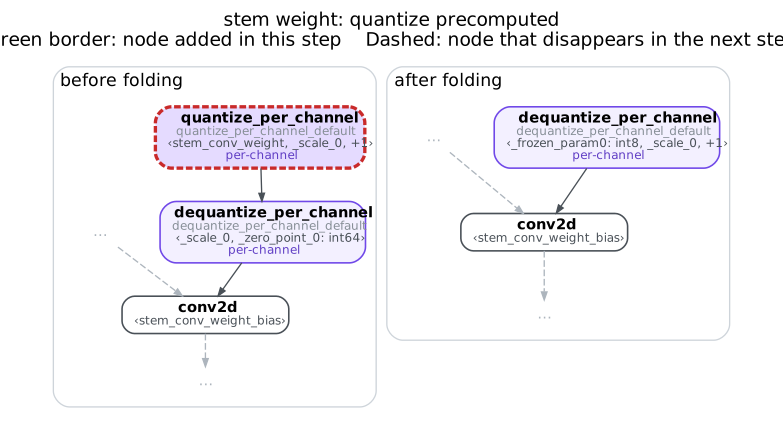
On the left, quantize_per_channel takes the fp32 stem_conv_weight; on the right it is gone, and dequantize reads the int8 _frozen_param0 directly. The weights the graph actually uses (read by get_attr, tensors with ≥ 2 dims; the 1-dim bias does not count) got smaller:
def graph_weight_bytes(gm):
    total = 0
    for n in gm.graph.nodes:
        if n.op == "get_attr":
            t = get_attr_value(gm, n.target)
            if isinstance(t, torch.Tensor) and t.dim() >= 2:
                total += t.numel() * t.element_size()
    return total


table([["before folding", f"{graph_weight_bytes(before):,}"],
       ["after folding", f"{graph_weight_bytes(manual):,}"],
       ["convert_pt2e", f"{graph_weight_bytes(official):,}"]],
["graph", "weight size (bytes)"])| graph | weight size (bytes) |
|---|---|
| before folding | 39,104 |
| after folding | 9,776 |
| convert_pt2e | 9,776 |
assert n_fold == 5
assert graph_weight_bytes(before) == 4 * graph_weight_bytes(manual) == 4 * graph_weight_bytes(official)
fp32 is 4 bytes and int8 is 1 byte, so the size shrinks by exactly 4x, the same as convert_pt2e. One last comparison of op composition and output:
table(diff_ops(official, manual, "official", "manual", tablefmt="html"))| op | official | manual | delta |
|---|---|---|---|
| adaptive_avg_pool2d | 1 | 1 | 0 |
| add | 1 | 1 | 0 |
| conv2d | 4 | 4 | 0 |
| dequantize_per_channel | 5 | 5 | 0 |
| dequantize_per_tensor | 12 | 12 | 0 |
| flatten | 1 | 1 | 0 |
| linear | 1 | 1 | 0 |
| max_pool2d | 2 | 2 | 0 |
| quantize_per_tensor | 11 | 11 | 0 |
| relu | 4 | 4 | 0 |
print(f"Max output difference vs. convert_pt2e = {max_diff(official, manual):.3e}")
assert op_counts(official) == op_counts(manual) and max_diff(official, manual) == 0
Max output difference vs. convert_pt2e = 0.000e+00After the three steps, the hand-written graph is identical to convert_pt2e in both op composition and output. The two skipped steps (_fold_conv_bn_qat, PortNodeMetaForQDQ) do not affect the result on this PTQ graph.
Summary
- observer → q/dq hard-codes the calibrated scale and zero point into the graph: before convert they live in the observer modules, afterwards they are constants or buffers in the graph.
- convert reads qparams only through
calculate_qparams()(torchaoconvert.py), andFakeQuantizehas this method too, so the QAT graph takes the same path. - The weight’s quantize input is a constant, so it can be precomputed and stored as int8 only; the activation’s q/dq has to wait for the input at run time and must stay in the graph.
- The result is still a Q/DQ graph: after dequantize it is still an fp32
conv2d, so it does not get faster. Switching to integer kernels is the backend’s job (M07 to M09).