M09-2 | How ORT Executes QDQ ONNX: Five Graph Optimization Levels and QDQ Node Fusion
Open In Colab
The QDQ ONNX of M09-1 contains no int8 kernel, only QuantizeLinear / DequantizeLinear wrapped around an fp32 Conv. What swaps in int8 kernels is ONNX Runtime (ORT): when creating an InferenceSession, ORT rewrites the graph according to the graph optimization level, then hands each node to an Execution Provider (EP) to run.
QDQ ONNX (M09-1)
  → ort.InferenceSession(…, sess_options, providers)   pick EPs, rewrite the graph per the optimization level
  → session.run                                         run the rewritten graph
A. Which EPs this ORT build has.
B. What each of the five levels rewrites TinyConvNet’s QDQ ONNX into.
Which rewrites each level registers in the ORT source, and how each kind of op is handled, are summarized in the M09 overview.
When creating sessions this chapter always specifies providers=["CPUExecutionProvider"]: every ORT build has this EP, and its kernels are ORT’s own MLAS, a different implementation from M08’s XNNPACK. What an EP is, and how the order of the list decides which one is used, is in the M07 overview, “One Library, Several Frameworks”.
B. The Five Graph Optimization Levels
ORT 1.30 has five levels, each including the previous one (details in the M09 overview):
Level
What this level adds
ORT_DISABLE_ALL
Runs only the required steps, e.g. making each DQ feed only one op
ORT_ENABLE_BASIC
EP-independent simplification; bias quantized to int32
ORT_ENABLE_EXTENDED
QDQ node fusion: DQ → op → Q becomes an int8 op
ORT_ENABLE_LAYOUT
CPU layout: int8 Conv becomes NHWC
ORT_ENABLE_ALL
fp16 constants to fp32; the default of InferenceSession
How do we see the graph ORT rewrote? Pass SessionOptions.optimized_model_filepath when creating the session, and ORT saves the rewritten graph as an .onnx:
so = ort.SessionOptions()so.graph_optimization_level = ort.GraphOptimizationLevel.ORT_ENABLE_EXTENDED# On x86, ORT's QDQ fusion skips int8 activations by default; enable it so x86 and arm fuse the same graphso.add_session_config_entry("session.qdqisint8allowed", "1")with tempfile.TemporaryDirectory() as d: so.optimized_model_filepath =str(Path(d) /"optimized.onnx") ort.InferenceSession(onnx_model.SerializeToString(), so, providers=["CPUExecutionProvider"]) extended = onnx.load(so.optimized_model_filepath)print("After EXTENDED rewrite:", dict(onnx_op_counts(extended)))
ORT makes the same rewrites whenever it creates a session, it just does not save them. This project wraps these lines as optimized_model(onnx_model, level) (common/onnx_utils.py). Run it once per level and compare the op counts:
graphs = {"Exported QDQ ONNX": onnx_model} | {lv: optimized_model(onnx_model, lv) for lv in LEVELS}counts = {name: onnx_op_counts(g) for name, g in graphs.items()}ops =sorted(set().union(*counts.values()), key=lambda o: (-counts["Exported QDQ ONNX"].get(o, 0), o))table([[op] + [counts[name].get(op, "") for name in graphs] for op in ops], ["op"] + [name.replace("ORT_", "") for name in graphs])
op
Exported QDQ ONNX
DISABLE_ALL
ENABLE_BASIC
ENABLE_EXTENDED
ENABLE_LAYOUT
ENABLE_ALL
DequantizeLinear
16
17
22
2
2
2
QuantizeLinear
11
11
11
2
2
2
Conv
4
4
4
Relu
4
4
4
MaxPool
2
2
2
2
Add
1
1
1
Gemm
1
1
1
ReduceMean
1
1
1
1
1
1
Reshape
1
1
1
1
1
1
QLinearConv
4
Transpose
2
2
com.microsoft.NhwcMaxPool
2
2
com.microsoft.QGemm
1
1
1
com.microsoft.QLinearAdd
1
1
1
com.microsoft.QLinearConv
4
4
Now one level at a time.
ORT_DISABLE_ALL: One More DequantizeLinear
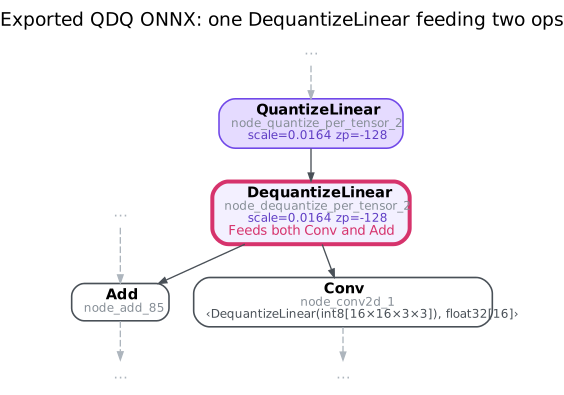
“Disabling optimization” also changes the graph. Take the merged DequantizeLinear from section A of M09-1, and first look at the exported QDQ ONNX:
dis = graphs["ORT_DISABLE_ALL"]dup =next(n.name for n in dis.graph.node if n.name.endswith("/duplicated")) # DQ copied by ORTshared = dup.removesuffix("/duplicated") # the originally shared DQdraw_onnx(onnx_model, focus=shared, hops=1, highlight=[shared], notes={shared: "Feeds both Conv and Add"}, title="Exported QDQ ONNX: one DequantizeLinear feeding two ops")
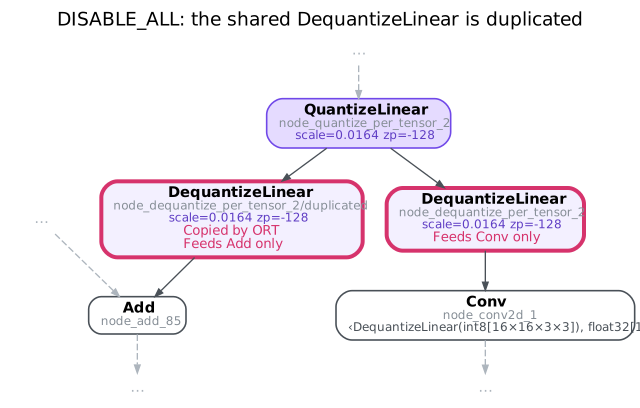
The same region after ORT_DISABLE_ALL rewrites it:
draw_onnx(dis, focus=[shared, dup], hops=1, highlight=[shared, dup],
          notes={shared: "Feeds Conv only", dup: "Copied by ORT\nFeeds Add only"},
          title="DISABLE_ALL: the shared DequantizeLinear is duplicated")
def users(model, name): out =next(n.output[0] for n in model.graph.node if n.name == name)returnsorted(n.op_type for n in model.graph.node if out in n.input)print(f"Exported QDQ ONNX: {shared} → {users(onnx_model, shared)}")print(f"DISABLE_ALL: {shared} → {users(dis, shared)}; {dup} → {users(dis, dup)}")assert users(onnx_model, shared) == ["Add", "Conv"] and users(dis, shared) == ["Conv"] and users(dis, dup) == ["Add"]
The one DequantizeLinear that fed both the Add and the next Conv now has a separate copy for the Add (…/duplicated). This is ORT’s EnsureUniqueDQForNodeUnit: the later fusions rewrite in units of “DQ → op → Q” (node units), and each unit needs its own DQ. The source lists it as a required step, so even DISABLE_ALL runs it.
ORT_ENABLE_BASIC: The Bias Becomes int32
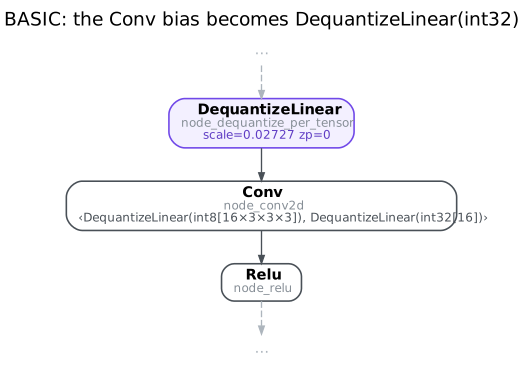
There are a few more DequantizeLinear. Look at the first conv:
The Conv’s third input used to be a float32 bias; now it is DequantizeLinear(int32[…]): ORT quantized the fp32 bias to int32 (WeightBiasQuantization in the source). Check whether the int32 bias is \(\operatorname{round}(b / (s_x \cdot s_w))\), where \(s_x\) is the scale of the Conv input and \(s_w\) is the weight’s per-channel scale:
def consts(model):return {i.name: numpy_helper.to_array(i) for i in model.graph.initializer}def conv_node(model):returnnext(n for n in model.graph.node if n.name =="node_conv2d")src, by_out = consts(onnx_model), {n.output[0]: n for n in onnx_model.graph.node}conv = conv_node(onnx_model)s_x =float(src[by_out[conv.input[0]].input[1]]) # scale of the input DequantizeLinears_w = src[by_out[conv.input[1]].input[1]] # per-channel scale of the weight DequantizeLinearb_fp32 = src[conv.input[2]]b_by_out = {n.output[0]: n for n in basic.graph.node}b_int32 = consts(basic)[b_by_out[conv_node(basic).input[2]].input[0]]same = np.array_equal(b_int32, np.round(b_fp32 / (s_x * s_w)).astype(np.int32))print(f"int32 bias == round(fp32 bias / (s_x · s_w)): {same}")assert b_int32.dtype == np.int32 and same
As with M08’s XNNPACK, the scale is \(s_x \cdot s_w\). The difference is the timing: XNNPACK does it when exporting the .pte, ORT does it when creating the session.
ORT_ENABLE_EXTENDED: QDQ Node Fusion
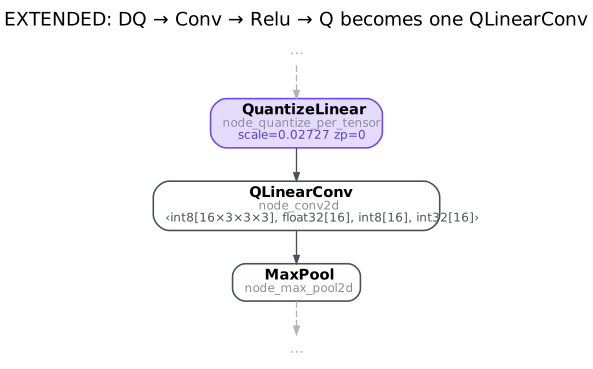
int8 kernels appear only from this level on. The first conv unit:
The original “DequantizeLinear → Conv → Relu → QuantizeLinear” becomes a single QLinearConv: its inputs and outputs are int8, and the ‹…› lists, in order, the int8 weight, the weight’s scale and zero point, and the int32 bias (done at BASIC). The scale and zero point of the input and output are also its parameters (scalars, not printed).
Where did the Relu go? Look at the zero point of the QuantizeLinear after the Relu:
nodes =list(onnx_model.graph.node)relu =next(n for n in nodes if n.op_type =="Relu")q =next(n for n in nodes if n.op_type =="QuantizeLinear"and n.input[0] == relu.output[0])zp = src[q.input[2]]print(f"QuantizeLinear after Relu: zero point = {int(zp)}, lower bound of {zp.dtype} = {np.iinfo(zp.dtype).min}")assertint(zp) == np.iinfo(zp.dtype).min
QuantizeLinear after Relu: zero point = -128, lower bound of int8 = -128
The zero point is exactly int8’s lower bound: real 0 maps to -128, and negative values would be clamped to -128 inside QuantizeLinear anyway. After quantization the Relu changes no value, so ORT removes it (ReluQuantFusion in the source, applied only when the zero point equals the lower bound). The zero point is the lower bound because the minimum the observer saw at the relu output is 0.
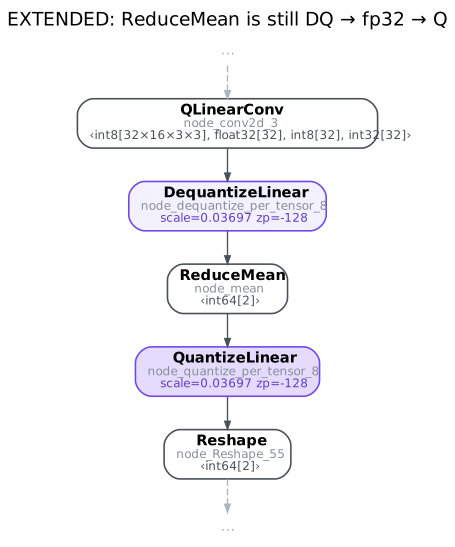
Not every unit can be swapped. Look near ReduceMean (the op AdaptiveAvgPool2d(1) exports to):
draw_onnx(ext, focus=lambda n: n.op_type =="ReduceMean", hops=2, title="EXTENDED: ReduceMean is still DQ → fp32 → Q")
dq_out = {n.output[0] for n in ext.graph.node if n.op_type =="DequantizeLinear"}fp32_ops =sorted({n.op_type for n in ext.graph.node if n.op_type !="QuantizeLinear"andset(n.input) & dq_out})print("Ops that still consume DequantizeLinear output after EXTENDED:", fp32_ops)assert fp32_ops == ["ReduceMean"]
Ops that still consume DequantizeLinear output after EXTENDED: ['ReduceMean']
ReduceMean is not on the QDQ fusion list, so it stays “DQ → fp32 compute → Q”, with one int8 ↔︎ fp32 conversion before and one after.
The Reshape below it, like the earlier MaxPool, has the surrounding Q/DQ removed and runs directly on int8: an op that only moves data or takes a maximum gives the same result on int8.
One QuantizeLinear remains at the graph input and one DequantizeLinear at the output; those are the true fp32 ↔︎ int8 conversions.
Which group the other ops belong to is summarized in the M09 overview, “The Three Groups of QDQ Node Fusion”.
ORT_ENABLE_LAYOUT: int8 Conv Becomes NHWC
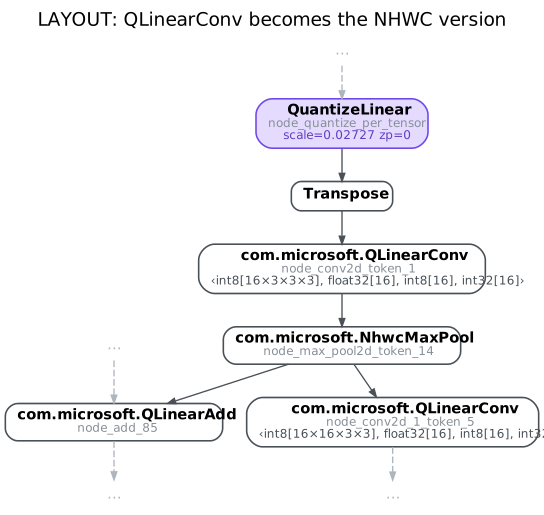
layout = graphs["ORT_ENABLE_LAYOUT"]first_conv =next(n.name for n in layout.graph.node if n.op_type =="QLinearConv") # the NHWC version renames the nodedraw_onnx(layout, focus=first_conv, hops=2, title="LAYOUT: QLinearConv becomes the NHWC version")
NhwcTransformer replaces QLinearConv with the NHWC version of com.microsoft.QLinearConv and inserts Transpose before and after the int8 segment; the MaxPool in between also becomes com.microsoft.NhwcMaxPool. com.microsoft.* ops are defined by ORT itself, are not in the ONNX standard, and only ORT understands them.
Why switch to NHWC? ORT CPU’s int8 conv kernel (QLinearConv) computes only in NHWC. Every run of an NCHW QLinearConv first converts each image to NHWC inside the kernel, then converts back to NCHW after computing (from reading ORT v1.30.0’s qlinearconv.cc). So no Transpose is visible in the EXTENDED graph, yet every QLinearConv transposes twice.
NhwcTransformer lifts the transposes into the graph, adjacent Transposes that cancel each other are then removed, and the whole int8 segment transposes only once at each end; MaxPool is also switched to the NHWC version so the layout is not interrupted midway. QLinearAdd is element-wise and independent of layout, so it stays in the middle. Count the Transposes in the graphs of the two levels:
def n_ops(model, op_type):returnsum(n.op_type == op_type for n in model.graph.node)for name, g in [("EXTENDED", ext), ("LAYOUT", layout)]:print(f"{name}: {n_ops(g, 'QLinearConv')} QLinearConv, {n_ops(g, 'Transpose')} Transpose in the graph")assert n_ops(ext, "Transpose") ==0and n_ops(layout, "Transpose") ==2and n_ops(layout, "QLinearConv") ==4
EXTENDED: 4 QLinearConv, 0 Transpose in the graph
LAYOUT: 4 QLinearConv, 2 Transpose in the graph
ORT_ENABLE_ALL
same = [n.op_type for n in graphs["ORT_ENABLE_ALL"].graph.node] == [n.op_type for n in graphs["ORT_ENABLE_LAYOUT"].graph.node]print("ALL and LAYOUT produce the same graph:", same)assert same
ALL and LAYOUT produce the same graph: True
ALL adds only “fp16 constants to fp32” over LAYOUT, and this model has no fp16 constants, so the two are the same.
Summary
QDQ ONNX is backend-neutral: the file contains only the standard QuantizeLinear / DequantizeLinear, and whether they become int8 kernels is decided at run time by the EP and the optimization level.
DISABLE_ALL also duplicates a shared DQ; BASIC quantizes the bias to int32; from EXTENDED on, Conv is int8 and Relu is folded into Q; LAYOUT switches to NHWC, lifting the kernel-internal transposes to the two ends of the int8 segment; ALL adds only fp16 handling.
Ops not on the fusion list (here ReduceMean) stay in fp32.
The same .onnx is rewritten differently on x86 (M09 overview, “Platform-Dependent”).