import copy

import torch
from torch.fx import Node

from common.data import calibration_batches
from common.graph_utils import observer_nodes, qdq_nodes
from common.models import example_inputs, get_model
from common.pt2e import (
    ANNOTATION_KEY,
    ComposableQuantizer,
    QuantizationAnnotation,
    Quantizer,
    annotate_input_qspec_map,
    annotate_output_qspec,
    convert_pt2e,
    export_module,
    get_module_name_filter,
    prepare_pt2e,
    quiet,
)
from common.qspecs import act_spec, weight_spec
from common.viz import draw, draw_stages, table

quiet()
_ = torch.manual_seed(0)
CONV2D = torch.ops.aten.conv2d.default
RELU = torch.ops.aten.relu.default
ADD = torch.ops.aten.add.TensorM03-6 | Quantizing Only Part of a Model, Composing Quantizers, Annotation Order

Real backends rarely quantize a whole model in one go:
- Some layers are sensitive to quantization and must stay in fp32 (mixed precision in M05).
- Some ops aren’t supported by the hardware and can only fall back to CPU (M10).
- Different kinds of ops are handled by different Quantizers.
The three sections of this notebook:
- A. Partial quantization: use module names to decide which convs to quantize, and see what grows at the fp32/int8 boundary.
- B.
ComposableQuantizer: one Quantizer per kind of op, and what it forbids. - C. Annotation order: the big pattern (conv + relu) must be annotated first, or the small pattern (conv) grabs the node.
The rule-based Quantizers shared by all three sections. They all follow the style of M03-3: find ops by node.target, and leave nodes that are already annotated (_annotated) alone.
def find(gm, target):
    return [n for n in gm.graph.nodes if n.op == "call_function" and n.target == target]


def done(*nodes):
    """Whether any of these nodes has already been annotated."""
    return any((a := n.meta.get(ANNOTATION_KEY)) is not None and a._annotated for n in nodes)


def label_conv(conv, out):
    """The activation and weight input edges of conv, plus an output annotation (attached to out: the conv itself, or the relu after it)."""
    annotate_input_qspec_map(conv, conv.args[0], act_spec())
    annotate_input_qspec_map(conv, conv.args[1], weight_spec())
    annotate_output_qspec(out, act_spec())
    for node in (conv, out):
        node.meta[ANNOTATION_KEY]._annotated = True


class RuleQuantizer(Quantizer):
    def validate(self, model):
        pass


class ConvQuantizer(RuleQuantizer):
    """Quantize conv2d. include is a node -> bool function deciding which convs to quantize (all by default)."""

    def __init__(self, include=None):
        self.include = include

    def annotate(self, model):
        for conv in find(model, CONV2D):
            if not done(conv) and (self.include is None or self.include(conv)):
                label_conv(conv, conv)
        return model


class ConvReluQuantizer(RuleQuantizer):
    """Quantize conv + relu: the output annotation goes on relu, and nothing is quantized between conv and relu."""

    def annotate(self, model):
        for relu in find(model, RELU):
            conv = relu.args[0]
            # if the conv output has other users, conv + relu is not a self-contained pattern
            if conv.op == "call_function" and conv.target == CONV2D and len(conv.users) == 1 and not done(conv, relu):
                label_conv(conv, relu)
        return model


class AddQuantizer(RuleQuantizer):
    """Quantize the activation inputs and output of add (excluding scalars and model constants)."""

    def annotate(self, model):
        for add in find(model, ADD):
            inputs = [a for a in add.args[:2] if isinstance(a, Node) and a.op != "get_attr"]
            if inputs and not done(add):
                for a in inputs:
                    annotate_input_qspec_map(add, a, act_spec())
                annotate_output_qspec(add, act_spec())
                add.meta[ANNOTATION_KEY]._annotated = True
        return model
A. Partial Quantization: Use Module Names to Decide Which Convs to Quantize
The tiny model has three segments: stem, block, head_conv. torchao’s get_module_name_filter("stem") returns a node -> bool function: whether this node comes from the submodule named stem (it looks at node.meta["nn_module_stack"]). Pass it to ConvQuantizer as include, and convs not on the list get no annotation.
def calibrate(prepared):
    with torch.no_grad():
        for batch in calibration_batches(n=64, batch_size=16):
            prepared(*batch)


model = get_model("tiny").eval()
gm_tiny = export_module(model, example_inputs(8))
configs = [("all convs", None)] + [(f"only {name}", get_module_name_filter(name)) for name in ("stem", "block", "head_conv")]
rows, converted = [], {}
for title, include in configs:
    prepared = prepare_pt2e(copy.deepcopy(gm_tiny), ConvQuantizer(include))
    n_obs = len(observer_nodes(prepared))
    calibrate(prepared)
    converted[title] = convert_pt2e(prepared)
    rows.append([title, n_obs, len(qdq_nodes(converted[title]))])
table(rows, ["setting", "# observers", "# q/dq"])| setting | # observers | # q/dq |
|---|---|---|
| all convs | 12 | 20 |
| only stem | 3 | 5 |
| only block | 6 | 10 |
| only head_conv | 3 | 5 |
A conv not on the list has no annotation; prepare_pt2e inserts no observer for it, and it and the ops after it stay in fp32. Lay out the ops of “only stem” after convert in one line (q = quantize, dq = dequantize) and look at the boundary between int8 and fp32:
def sequence(gm):
    def short(n):
        t = str(n.target)
        return "dq" if "dequantize" in t else "q" if "quantize" in t else n.name.rstrip("_0123456789")
    return " ".join(short(n) for n in gm.graph.nodes if n.op == "call_function")


chain = sequence(converted["only stem"])
print(chain)
dq q dq conv2d q dq relu max_pool2d conv2d relu conv2d add relu max_pool2d conv2d relu adaptive_avg_pool2d flatten linearassert chain.startswith("dq q dq conv2d q dq relu")
assert "q" not in chain.split("relu", 1)[1].split() # no more q/dq after stem- The lone
dqat the very front is stem’s weight: it has already been pre-quantized into an int8 constant, leaving only a dequantize at run time. - Then
q dq conv2d q dq: one q/dq pair each on the input and output of stem’s conv. Everything after that is fp32.
q/dq appear only around the quantized conv; this is the boundary between fp32 and int8. The more boundaries, the larger the q/dq overhead, so backends prefer to quantize long contiguous stretches. Backends wrap this in config APIs such as set_module_name, which M03-7 will show.
B. ComposableQuantizer: One Quantizer per Kind of Op
ComposableQuantizer([q1, q2, ...]) calls each Quantizer’s annotate in order. Each Quantizer focuses only on its own kind of op, and together they cover the whole model. On the residual model, first use only ConvQuantizer, then add AddQuantizer:
gm_res = export_module(get_model("residual").eval(), example_inputs(4))
only_conv = prepare_pt2e(copy.deepcopy(gm_res), ConvQuantizer())
composed = prepare_pt2e(copy.deepcopy(gm_res), ComposableQuantizer([ConvQuantizer(), AddQuantizer()]))
print("ConvQuantizer only: observers", len(observer_nodes(only_conv)))
print("ConvQuantizer + AddQuantizer: observers", len(observer_nodes(composed)))
assert len(observer_nodes(composed)) == len(observer_nodes(only_conv)) + 1
ConvQuantizer only: observers 6
ConvQuantizer + AddQuantizer: observers 7Which one is the extra? Draw only the area around add: on the left only ConvQuantizer, on the right AddQuantizer added; the green boxes are the newly grown observers:
add = next(n for n in composed.graph.nodes if n.target == ADD)
from_conv, from_x = add.args[0], add.args[1]  # the two inputs of add, now both observers
draw_stages([(only_conv, "ConvQuantizer only"), (composed, "ConvQuantizer + AddQuantizer")], focus="add", hops=2,
            notes=[{}, {from_conv.name: "also takes the conv2d_1 → add annotation", from_x.name: "also takes the x → add annotation",
                        next(iter(add.users)).name: "output of add: the only new one"}],
            title="Around add in residual")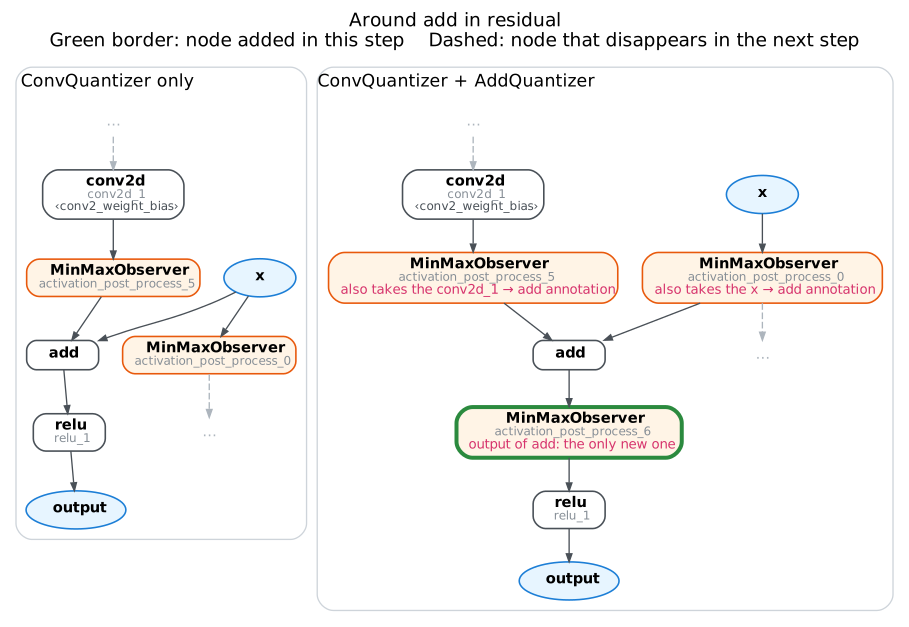
conv = next(n for n in composed.graph.nodes if n.target == CONV2D)
assert from_x is conv.args[0]  # the x that add takes is the same observer the first conv takes
assert from_conv.args[0].name == "conv2d_1"  # the conv output that add takes is the existing output observer of conv2d_1
Only one is added, the output of add. The two input edges of add were also annotated, but they didn’t each grow an observer; they merged into the existing observers:
conv2d_1 → add:ConvQuantizeralready annotated the output ofconv2d_1; the two annotations have identical attributes and share one observer.x → add: in the left graph add takes the originalxdirectly (not quantized); in the right graph it takesx‘s existing observer, the one the first conv uses. The two edges’ annotations have identical attributes and merge into one.
This is the implicit sharing of M03-4: annotations with identical attributes on the same tensor quantize only once.
What ComposableQuantizer forbids: after each Quantizer’s annotate, it checks whether annotations already attached earlier have been replaced or deleted, and raises an error if so. The MeddlingQuantizer below replaces the conv’s annotation entirely with an empty one, and is placed after ConvQuantizer:
class MeddlingQuantizer(RuleQuantizer):
    def annotate(self, model):
        for conv in find(model, CONV2D):
            conv.meta[ANNOTATION_KEY] = QuantizationAnnotation()
        return model


try:
    prepare_pt2e(copy.deepcopy(gm_res), ComposableQuantizer([ConvQuantizer(), MeddlingQuantizer()]))
    raised = None
except RuntimeError as e:
    raised = e
print("RuntimeError:", raised)
assert raised is not None
RuntimeError: Quantizer MeddlingQuantizer has changed annotations on node conv2dSo later Quantizers can only fill in nodes that have no annotation yet, and can’t change anyone else’s. Checking _annotated at the start of every annotate (done() here) is to honor this convention.
C. Annotation Order: Big Pattern First
ConvReluQuantizer (big pattern) and ConvQuantizer (small pattern) both want to annotate the same conv. Whoever goes first takes it. For the same conv → relu, prepare once with each order:
gm_cr = export_module(get_model("conv_relu").eval(), example_inputs(4))
big_first = prepare_pt2e(copy.deepcopy(gm_cr), ComposableQuantizer([ConvReluQuantizer(), ConvQuantizer()]))
draw(big_first, focus=["conv2d", "relu"], title="ConvReluQuantizer first, then ConvQuantizer")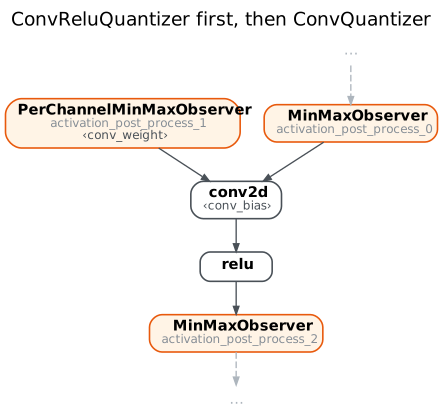
small_first = prepare_pt2e(copy.deepcopy(gm_cr), ComposableQuantizer([ConvQuantizer(), ConvReluQuantizer()]))
draw(small_first, focus=["conv2d", "relu"], title="ConvQuantizer first, then ConvReluQuantizer")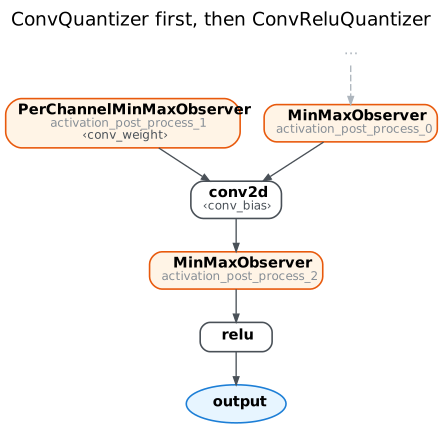
def observer_before_relu(gm):
    relu = next(n for n in gm.graph.nodes if n.target == RELU)
    return relu.args[0].op == "call_module"


print("Big pattern first: observer between conv and relu?", observer_before_relu(big_first))
print("Small pattern first: observer between conv and relu?", observer_before_relu(small_first))
assert not observer_before_relu(big_first) and observer_before_relu(small_first)
Big pattern first: observer between conv and relu? False
Small pattern first: observer between conv and relu? True- Big pattern first:
ConvReluQuantizerannotates the conv and relu and sets_annotated;ConvQuantizersees that the conv is already annotated and skips it. The quantization point is after relu, with no observer between conv and relu. - Small pattern first:
ConvQuantizertakes the conv first (annotating its output too), andConvReluQuantizerfinds the conv already annotated and gives up. There is an extra quantization point between conv and relu, so the backend can’t fuse the two into one kernel.
Both orders are legal and both run; only the results differ. The order is the Quantizer author’s responsibility: the STATIC_OPS of the torchao test-version XNNPACKQuantizer is linear_relu, linear, conv_relu, conv… in that order, again with the bigger ones first.
Summary
- Partial quantization: ops without annotations stay in fp32, and q/dq grow at the boundary. Use
get_module_name_filterto pick nodes by module name. ComposableQuantizercalls several Quantizers in order; later ones can only fill in, not change annotations attached earlier.- Annotation order decides the result: big patterns must come before small patterns.