import torch
from torch.export import export

from common.graph_utils import diff_ops, short
from common.models import example_inputs, get_model
from common.pt2e import quiet
from common.viz import draw_stages, table

quiet()
_ = torch.manual_seed(0)M00-3 | Decomposition: Why PT2E Annotates on the Not-Yet-Decomposed Graph

An ATen op can be decomposed into lower-level, smaller ops; this is called decomposition. The graph that torch.export gives by default is not yet decomposed: conv2d is a single aten.conv2d.default, and batch_norm is a single aten.batch_norm.default. After calling ep.run_decompositions(table), big ops are broken up according to the decomposition table passed in. How deep it goes depends on the table:
| Call | With conv + bn as the example |
|---|---|
ep.run_decompositions({}) (empty table; this notebook uses it) |
batch_norm → _native_batch_norm_legit_no_training + getitem; conv2d unchanged |
ep.run_decompositions() (default table, Core ATen) |
conv2d also becomes convolution |
What this means for quantization: the quantizer looks for “semantic-level” patterns like conv-bn-relu, and once the graph is decomposed they are hard to recognize. So PT2E annotates before decomposing; after convert, when the graph is handed to a backend, the backend decides how deep to decompose.
- A. The same ExportedProgram, the graph before and after decomposition.
- B. How the ops of the whole graph change, and “how many nodes need to be matched”.
A. The Stem Before and After Decomposition
The model is TinyConvNet (4 conv-bn-relu groups in total across stem, block, and head_conv); call .eval() first.
ep = export(get_model("tiny").eval(), example_inputs())
gm_pre = ep.module()                          # PT2E annotates at this level
gm_post = ep.run_decompositions({}).module()  # pass an empty decomposition table
draw_stages([(gm_pre, "ep.module()"), (gm_post, "ep.run_decompositions({}).module()")],
            focus=["conv2d", "batch_norm", "relu"], hops=0, title="conv → bn → relu in the stem")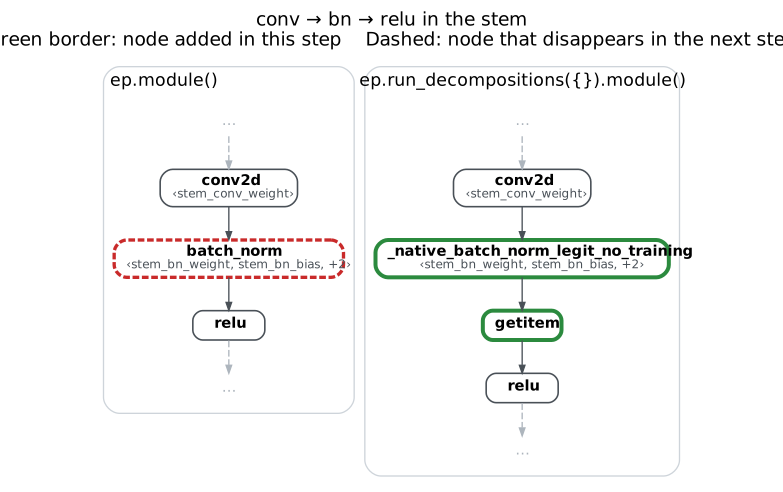
batch_norm (dashed, disappears in the next step) becomes two nodes (green border): _native_batch_norm_legit_no_training returns several tensors, and getitem picks out the main output. conv2d and relu stay as they were.
Note that run_decompositions does not modify ep; it returns a new ExportedProgram, so gm_pre is unaffected.
B. How the Ops of the Whole Graph Change
print(f"number of nodes (including get_attr, placeholder, output): gm_pre {len(gm_pre.graph.nodes)} → gm_post {len(gm_post.graph.nodes)}")
table(diff_ops(gm_pre, gm_post, "gm_pre", "gm_post", tablefmt="html"))
number of nodes (including get_attr, placeholder, output): gm_pre 47 → gm_post 51| op | gm_pre | gm_post | delta |
|---|---|---|---|
| _native_batch_norm_legit_no_training | 0 | 4 | 4 |
| batch_norm | 4 | 0 | -4 |
| flatten | 1 | 0 | -1 |
| getitem | 0 | 4 | 4 |
| view | 0 | 1 | 1 |
| adaptive_avg_pool2d | 1 | 1 | 0 |
| add | 1 | 1 | 0 |
| conv2d | 4 | 4 | 0 |
| linear | 1 | 1 | 0 |
| max_pool2d | 2 | 2 | 0 |
| relu | 4 | 4 | 0 |
def count(gm, op):
    return sum(1 for n in gm.graph.nodes if n.op == "call_function" and short(n.target) == op)


assert count(gm_pre, "batch_norm") == 4 and count(gm_post, "batch_norm") == 0
assert count(gm_post, "_native_batch_norm_legit_no_training") == 4 and count(gm_post, "getitem") == 4
assert count(gm_post, "conv2d") == count(gm_pre, "conv2d")
assert count(gm_pre, "flatten") == 1 and count(gm_post, "view") == 1- All 4
batch_normbecome_native_batch_norm_legit_no_training+getitem. - The
.flatten(1)in forward is also replaced byview. conv2d,relu,max_pool2d, andlinearstay as they were (the empty table only does the most basic conversions; only the default table breaks conv2d into convolution).
Question to think about: to find the conv + bn + relu pattern on gm_post, how many nodes need to be matched?
def chain_after(gm, start):
    """Walk down from start along the "only user" and return the op names passed."""
    node, ops = next(n for n in gm.graph.nodes if n.name == start), []
    while node.op == "call_function":
        ops.append(short(node.target))
        if short(node.target) == "relu" or len(node.users) != 1:
            break
        node = next(iter(node.users))
    return ops


pre_chain, post_chain = chain_after(gm_pre, "conv2d"), chain_after(gm_post, "conv2d")
print("gm_pre :", " → ".join(pre_chain))
print("gm_post:", " → ".join(post_chain))
assert len(pre_chain) == 3 and len(post_chain) == 4
gm_pre : conv2d → batch_norm → relu
gm_post: conv2d → _native_batch_norm_legit_no_training → getitem → reluBefore decomposition, 3 nodes are matched; after, it takes 4, with a getitem in between that merely “extracts a value”. If a backend uses a deeper decomposition, batch norm is further broken into more arithmetic nodes, and the pattern is even harder to recognize. So annotation should be done while the semantics of conv + bn + relu are still clear: what the PT2E quantizer receives is the graph at the ep.module() level.
Summary
run_decompositions(table)breaks big ops into small ops, and the table determines how deep; it returns a new ExportedProgram.- PT2E annotates before decomposition because semantic-level patterns (conv-bn-relu) are easiest to recognize at this level.
- How deep to decompose is the backend’s business: for example, the Core ATen set of about 180 ops is for backends that “want to minimize the number of ops they implement”.