import copy

import matplotlib.pyplot as plt
import torch
from matplotlib_inline.backend_inline import set_matplotlib_formats

from common.data import calibration_batches, evaluate, make_loader, trained_tiny_net
from common.graph_utils import qdq_nodes, sqnr
from common.models import example_inputs
from common.pt2e import (
    ANNOTATION_KEY,
    QuantizationAnnotation,
    Quantizer,
    convert_pt2e,
    export_module,
    get_xnnpack_quantizer,
    prepare_pt2e,
    quiet,
)
from common.viz import table

quiet()
_ = torch.manual_seed(0)
set_matplotlib_formats("svg")
BLUE, MUTED = "#2a78d6", "#52514e"M05-4 | Mixed Precision: Keep Sensitive Layers in fp32 and See How Much Accuracy Recovers

The layerwise SQNR in M05-3 gave clues. This notebook tests the clues by experiment: actually exclude a module from quantization and measure how much the overall output SQNR recovers.
- A. Write a Quantizer that “excludes some modules”, wrapping XNNPACKQuantizer.
- B. Exclude each module one at a time and compare the overall SQNR.
- C. Remove only
fc’s output quantization, to verify where B’s result comes from. - D. Error accumulates: quantize only the first k modules, and the larger k is, the lower the overall SQNR.
A. A Quantizer That Excludes Some Modules
SkipQuantizer first lets the inner XNNPACKQuantizer annotate as usual, then clears the annotations of nodes inside the specified modules, so those nodes stay in fp32 (the partial quantization of M03-6). To tell which module a node belongs to, look at its node.meta["nn_module_stack"].
Clearing annotations has a catch: another node’s annotation may be a SharedQuantizationSpec pointing to a node that was cleared (M03-4). If not handled, prepare_pt2e raises a KeyError. And once the pointed-to annotation is cleared, the annotations pointing to it become invalid too, so clearing has to repeat until nothing changes.
no_output is used in section C: it removes only the output quantization of those modules, while inputs and weights are still quantized.
def in_module(node, name):
    """Whether node belongs to module `name` (including submodules)."""
    stack = node.meta.get("nn_module_stack") or {}
    return any(path == name or path.startswith(name + ".") for path, _ in stack.values())


def shares_with(spec, dead):
    """Whether spec shares with a node whose annotation has been cleared."""
    if type(spec).__name__ != "SharedQuantizationSpec":
        return False
    target = spec.edge_or_node
    return (target[0] if isinstance(target, tuple) else target) in dead


class SkipQuantizer(Quantizer):
    def __init__(self, inner, skip=(), no_output=()):
        self.inner, self.skip, self.no_output = inner, tuple(skip), tuple(no_output)

    def annotate(self, model):
        self.inner.annotate(model)
        dead = set()  # nodes whose output is no longer quantized
        for n in model.graph.nodes:
            ann = n.meta.get(ANNOTATION_KEY)
            if n.op != "call_function" or ann is None:
                continue
            if any(in_module(n, m) for m in self.skip):
                n.meta[ANNOTATION_KEY] = QuantizationAnnotation(_annotated=True)  # clear everything but still mark as processed
                dead.add(n)
            elif any(in_module(n, m) for m in self.no_output):
                ann.output_qspec = None
                dead.add(n)
        changed = True
        while changed:  # invalidated sharing cascades: keep clearing until nothing changes
            changed = False
            for n in model.graph.nodes:
                ann = n.meta.get(ANNOTATION_KEY)
                if ann is None:
                    continue
                for edge in [e for e, spec in ann.input_qspec_map.items() if shares_with(spec, dead)]:
                    del ann.input_qspec_map[edge]
                    changed = True
                if n not in dead and shares_with(ann.output_qspec, dead):
                    ann.output_qspec = None
                    dead.add(n)
                    changed = True
        return model

    def validate(self, model):
        pass
Model, calibration data, and evaluation data are all the same as in M05-1:
model = trained_tiny_net()
gm = export_module(model, example_inputs())
test_loader = make_loader(n=1024, seed=2, shuffle=False)
(x,) = next(calibration_batches(64, seed=9))
with torch.no_grad():
    y_ref = model(x)


def quantize(**skip_kwargs):
    prepared = prepare_pt2e(copy.deepcopy(gm), SkipQuantizer(get_xnnpack_quantizer(is_per_channel=True)[0], **skip_kwargs))
    with torch.no_grad():
        for batch in calibration_batches(128):
            prepared(*batch)
    return convert_pt2e(prepared)


def measure(converted):
    with torch.no_grad():
        return sqnr(y_ref, converted(x)), evaluate(converted, test_loader), len(qdq_nodes(converted))


def show(results):
    return table([[k, f"{s:.2f}", f"{a:.4f}", q] for k, (s, a, q) in results.items()],
                 ["setting", "output SQNR (dB)", "accuracy", "# q/dq"])
B. Exclude Each Module One at a Time
The four submodules of TinyConvNet are, in order, stem, block, head_conv, and fc. Each time, keep just one of them in fp32 and quantize the rest to int8 as usual:
MODULES = ("stem", "block", "head_conv", "fc")
b = {"all int8": measure(quantize())}
for name in MODULES:
    b[f"{name} in fp32"] = measure(quantize(skip=[name]))
show(b)| setting | output SQNR (dB) | accuracy | # q/dq |
|---|---|---|---|
| all int8 | 27.32 | 0.7051 | 28 |
| stem in fp32 | 27.68 | 0.7080 | 23 |
| block in fp32 | 26.84 | 0.7100 | 19 |
| head_conv in fp32 | 27.19 | 0.7051 | 23 |
| fc in fp32 | 33.17 | 0.7041 | 25 |
base = b["all int8"][0]
gain = {name: b[f"{name} in fp32"][0] - base for name in MODULES}
best = max(gain, key=lambda k: gain[k])
print("SQNR change after exclusion:", {k: f"{v:+.2f} dB" for k, v in gain.items()})
assert best == "fc" and abs(gain["head_conv"]) < 1.0
assert all(b[f"{n} in fp32"][2] < b["all int8"][2] for n in MODULES)
SQNR change after exclusion: {'stem': '+0.36 dB', 'block': '-0.48 dB', 'head_conv': '-0.13 dB', 'fc': '+5.85 dB'}- Excluding
fcrecovers the most;head_conv, which dropped the most in the M05-3 layerwise table, barely changes when excluded. The location where layerwise SQNR drops a lot is not necessarily the most useful one to exclude. - After excluding a module the q/dq count goes down (one less layer quantized means one less layer’s quantization points), but there are still q/dq at the boundary between fp32 and int8 (M03-6).
- Accuracy is insensitive on this task (M05-1); the differences are at the noise level, and only SQNR shows them.
C. Why Excluding fc Works
When fc is kept in fp32, its input, weight, and output are all unquantized. Try removing only its output quantization (input and weight stay int8):
c = {"all int8": b["all int8"], "fc in fp32 (input, weight, output all unquantized)": b["fc in fp32"],
     "fc output quantization removed (input, weight still int8)": measure(quantize(no_output=["fc"]))}
show(c)| setting | output SQNR (dB) | accuracy | # q/dq |
|---|---|---|---|
| all int8 | 27.32 | 0.7051 | 28 |
| fc in fp32 (input, weight, output all unquantized) | 33.17 | 0.7041 | 25 |
| fc output quantization removed (input, weight still int8) | 33.22 | 0.7041 | 26 |
only_output = c["fc output quantization removed (input, weight still int8)"][0]
print(f"output quantization removed only: {only_output:.2f} dB; whole fc in fp32: {b['fc in fp32'][0]:.2f} dB")
assert abs(only_output - b["fc in fp32"][0]) < 0.5
output quantization removed only: 33.22 dB; whole fc in fp32: 33.17 dBRemoving only fc‘s output quantization brings SQNR back to about the same as “the whole fc in fp32”: nearly all the benefit of excluding fc in section B comes from the final output (logits) no longer being quantized. Why this model’s logits are so sensitive to quantization is not investigated here (possibly related to the logits’ value range, an inference); whether other models behave the same is not verified.
This matches practical experience: it usually works best to keep the head and tail of a model at higher precision; the blog post “Learning Zero-Point and Scale in Quantization Parameters” (in Chinese) also mentions that LSQ keeping the first and last layers at 8 bit is already standard practice.
The mixed precision workflow is therefore: use the overall SQNR to tell whether there is a problem → narrow down with layerwise SQNR (M05-3) → confirm candidates by excluding them experimentally (this section) → among the fixes that solve the problem, pick the least invasive one. Here the least invasive is removing only fc’s output quantization. “Less invasive is cheaper” is an inference; execution cost is not measured here.
D. Error Accumulates: Quantize Only the First k Modules
Quantize the first k modules and keep the rest in fp32. k goes from 1 to 4:
d = []
for k in range(1, len(MODULES) + 1):
    d.append((" + ".join(MODULES[:k]), measure(quantize(skip=MODULES[k:]))[0]))
Plotting code
fig, ax = plt.subplots(figsize=(6.4, 3.2))
ax.plot(range(len(d)), [s for _, s in d], color=BLUE, lw=2, marker="o", ms=6)
for i, (_, s) in enumerate(d):
    below = i == len(d) - 1  # the last point is at the end of a descending segment; put its label below so it doesn't overlap the line
    ax.annotate(f"{s:.2f}", (i, s), xytext=(0, -16 if below else 8), textcoords="offset points", ha="center",
                color=MUTED, fontsize=9)
ax.set_xticks(range(len(d)), [f"k={k + 1}\n+ {name.split(' + ')[-1]}" for k, (name, _) in enumerate(d)], fontsize=9)
ax.set_xlim(-0.4, len(d) - 0.6)
ax.set_ylim(min(s for _, s in d) - 2, max(s for _, s in d) + 2)
ax.set_ylabel("output SQNR (dB)", color=MUTED)
ax.grid(axis="y", color="#e6e5e1", lw=0.8)
ax.spines[["top", "right"]].set_visible(False)
ax.tick_params(colors=MUTED)
plt.show()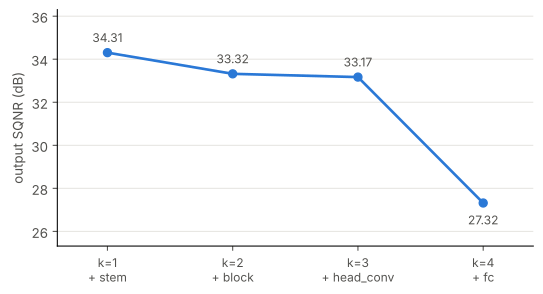
steps = [d[i][1] - d[i - 1][1] for i in range(1, len(d))]
table([[k + 1, name, f"{s:.2f}", "—" if k == 0 else f"{steps[k - 1]:+.2f}"] for k, (name, s) in enumerate(d)],
["k", "int8 modules", "output SQNR (dB)", "vs previous row"])| k | int8 modules | output SQNR (dB) | vs previous row |
|---|---|---|---|
| 1 | stem | 34.31 | — |
| 2 | stem + block | 33.32 | -0.98 |
| 3 | stem + block + head_conv | 33.17 | -0.15 |
| 4 | stem + block + head_conv + fc | 27.32 | -5.85 |
assert all(step < 0 for step in steps)  # monotonically decreasing
assert min(steps) == steps[-1]  # adding fc drops the most
The x axis of the plot labels the module newly quantized at step k.
- The more modules are quantized, the more the overall SQNR drops monotonically: quantization error accumulates along the network, which is why M05-3 saw “lower toward the output”.
- But the cost of adding each module is uneven: adding
fcdrops the most in one go (section C: nearly all from the output quantization of the logits). On this model it is not that every layer contributes a similar amount of error that then adds up, but that a few locations dominate.
Error does accumulate, but to find the problem you have to exclude candidates one by one experimentally; the trend of the layerwise scores alone isn’t enough.
Summary
- A Quantizer that excludes some modules has to handle shared annotations: clear repeatedly until nothing changes.
- The location with the largest layerwise SQNR drop is not necessarily useful to exclude; what this model is really sensitive to is the output quantization of the logits.
- Error accumulates along the network but is dominated by a few locations; narrow down first, then confirm by experiment.