import torch
from torch.fx import Node

from common.pt2e import convert_pt2e, export_module, get_xnnpack_quantizer, prepare_pt2e, quiet
from common.data import calibration_batches, trained_tiny_net
from common.models import example_inputs
from common.viz import draw, table
from vpu_quantizer import ADD, CAT, CONV2D, FLATTEN, LINEAR, MAX_POOL2D, RELU, fused_relu, vpu_ptq

quiet()
_ = torch.manual_seed(0)
QD = torch.ops.quantized_decomposed
Q_T, DQ_T, DQ_C = QD.quantize_per_tensor.default, QD.dequantize_per_tensor.default, QD.dequantize_per_channel.default
BATCH = 16M10-2 | The Backend Compiler’s View: Checking Whether a Q/DQ Graph Meets the Hardware Constraints

The MyVPUQuantizer of M10-1 promises to produce graphs that satisfy the VPU constraints. But all the backend compiler receives is the Q/DQ graph from convert_pt2e; it does not know which quantizer annotated it, and it should not trust it. So the compiler has to check the graph itself before consuming it.
This notebook writes a checker pass check_vpu that reads only the Q/DQ graph, with rules corresponding to constraints (2) to (8) of vpu_quantizer.py. Constraint (1) (the op list) is not a violation: ops outside the list fall back to CPU, which M10-3 handles.
- A. Seven rules: what each looks at on the Q/DQ graph.
- B. Two Q/DQ graphs through the check: the one from
MyVPUQuantizervs the one from the torchao test-version XNNPACKQuantizer. - C. What passing the check buys: the requant factor of every conv/linear is \(2^k\), so the hardware can do it with a shift.
A. Seven Rules
| Rule | What it checks on the Q/DQ graph | Constraint |
|---|---|---|
| R1 | every quantize_per_tensor (activation) is int8 with zero point = 0 |
(2) |
| R2 | the scale of every quantize_per_tensor and of the weight’s dequantize is \(2^k\) |
(4) |
| R3 | add/cat/max_pool2d/flatten: the input dq and the output q share one scale | (6) |
| R4 | the bias of conv/linear comes from an int32 dequantize_per_channel, with scale = \(s_{in} \cdot s_w\) |
(5) |
| R5 | the input of relu is not “conv/linear/add → q → dq” (no quantization point in between) | (7) |
| R6 | no SymInt in the placeholder shapes | (8) |
| R7 | the weight of conv/linear comes from dequantize_per_channel, with all-zero zero points and range [-127, 127] |
(3) |
The checker pass reads only the q/dq parameters and the connections, not the annotations (after convert the annotations no longer matter). First two small functions to read scales:
def scale_of(gm, n: Node) -> torch.Tensor:
    """The scale of a q/dq node: per-tensor is a float in args, per-channel is a buffer pointed to by get_attr."""
    s = n.args[1]
    if isinstance(s, Node):
        s = getattr(gm, str(s.target))
    return torch.as_tensor(s, dtype=torch.float64).flatten()


def is_pow2(s: torch.Tensor) -> bool:
    return bool(torch.all(torch.log2(s) == torch.round(torch.log2(s))))


def is_call(n, target) -> bool:
    return isinstance(n, Node) and n.op == "call_function" and n.target == target


def requant_inputs(gm, op: Node):
    """The (s_in, s_w, s_out) of a conv/linear; s_out is taken from the quantize_per_tensor after the output (or the fused relu)."""
    act, weight = op.args[0], op.args[1]
    assert isinstance(act, Node) and isinstance(weight, Node)
    out = fused_relu(op) or op
    q = next((u for u in out.users if is_call(u, Q_T)), None)
    return scale_of(gm, act), scale_of(gm, weight), (scale_of(gm, q) if q is not None else None)
The checker pass itself: walk the nodes of the graph one by one; each rule takes a few lines.
def check_vpu(gm):
    """Read only the Q/DQ graph and return the list of violations [(rule, node name, detail)]."""
    bad = []
    for n in gm.graph.nodes:
        if n.op == "placeholder":                                                     # R6
            val = n.meta.get("val")
            if isinstance(val, torch.Tensor) and not all(isinstance(d, int) for d in val.shape):
                bad.append(("R6", n.name, f"shape {tuple(val.shape)}"))
        if n.op != "call_function":
            continue
        if n.target == Q_T and (n.args[2] != 0 or n.args[5] != torch.int8):         # R1
            bad.append(("R1", n.name, f"zero point = {n.args[2]}"))
        if n.target in (Q_T, DQ_C) and not is_pow2(scale_of(gm, n)):                # R2
            bad.append(("R2", n.name, f"scale = {scale_of(gm, n)[0].item():.5g}"))
        if n.target in (ADD, CAT, MAX_POOL2D, FLATTEN):                               # R3
            ins = n.args[0] if n.target == CAT else (n.args[:2] if n.target == ADD else n.args[:1])
            assert isinstance(ins, (list, tuple))
            out = fused_relu(n) or n
            scales = {float(scale_of(gm, a)) for a in ins if is_call(a, DQ_T)}
            scales |= {float(scale_of(gm, q)) for q in out.users if is_call(q, Q_T)}
            if len(scales) > 1:
                bad.append(("R3", n.name, "scale = " + ", ".join(f"{s:.5g}" for s in sorted(scales))))
        if n.target in (CONV2D, LINEAR) and len(n.args) > 2 and isinstance(b := n.args[2], Node):   # R4
            if not (is_call(b, DQ_C) and b.args[-1] == torch.int32):
                bad.append(("R4", n.name, f"bias comes from {b.op} node {b.name} (fp32)"))
            else:
                s_in, s_w, _ = requant_inputs(gm, n)
                if not torch.equal(scale_of(gm, b), s_in * s_w):
                    bad.append(("R4", n.name, "bias scale != s_in x s_w"))
        if n.target in (CONV2D, LINEAR):
            w, zp = n.args[1], None
            assert isinstance(w, Node)
            if is_call(w, DQ_T) and not is_pow2(scale_of(gm, w)):                     # R2: per-tensor weight
                bad.append(("R2", w.name, f"scale = {scale_of(gm, w)[0].item():.5g}"))
            if is_call(w, DQ_C) and isinstance(z := w.args[2], Node):
                zp = getattr(gm, str(z.target))
            if zp is None:                                                            # R7
                bad.append(("R7", n.name, f"weight comes from {w.op} node {w.name}, not per-channel"))
            elif torch.any(zp != 0) or w.args[4:6] != (-127, 127):
                bad.append(("R7", n.name, f"range {w.args[4:6]}, or zero point is not 0"))
        if n.target == RELU:                                                          # R5
            src = n.args[0]
            if is_call(src, DQ_T) and is_call(q := src.args[0], Q_T) and isinstance(op := q.args[0], Node) \
                    and op.target in (CONV2D, LINEAR, ADD):
                bad.append(("R5", n.name, f"there is a q/dq between {op.name} and relu"))
    return bad
B. Two Q/DQ Graphs Through the Check
Both graphs come from the trained TinyConvNet and the same calibration data:
- The VPU graph:
vpu_ptq(vpu_quantizer.py) =torch.export.export(model, x)(static shape) →prepare_pt2e(…, MyVPUQuantizer())→ calibrate →convert_pt2e. - The XNNPACK graph: the default of
export_module(dynamic batch) →prepare_pt2e(…, torchao test-version XNNPACKQuantizer, per-channel)→ calibrate →convert_pt2e.
model, x = trained_tiny_net(), example_inputs(BATCH)
xnn_prepared = prepare_pt2e(export_module(model, x), get_xnnpack_quantizer(is_per_channel=True)[0])
with torch.no_grad():
    for b in calibration_batches(n=64, batch_size=BATCH):
        xnn_prepared(*b)
graphs = {"MyVPUQuantizer": vpu_ptq(model, x), "XNNPACKQuantizer": convert_pt2e(xnn_prepared)}
results = {name: check_vpu(g) for name, g in graphs.items()}
RULES = ["R1", "R2", "R3", "R4", "R5", "R6", "R7"]
table([[r] + [sum(v[0] == r for v in results[name]) for name in graphs] for r in RULES],
["Rule"] + [f"{name} graph: violations" for name in graphs])| Rule | MyVPUQuantizer graph: violations | XNNPACKQuantizer graph: violations |
|---|---|---|
| R1 | 0 | 10 |
| R2 | 0 | 16 |
| R3 | 0 | 1 |
| R4 | 0 | 5 |
| R5 | 0 | 0 |
| R6 | 0 | 1 |
| R7 | 0 | 0 |
assert results["MyVPUQuantizer"] == []The MyVPUQuantizer graph has 0 violations: every constraint of M10-1 really landed on the Q/DQ graph.
The first violation of each rule on the XNNPACK graph:
WHY = {
    "R1": "the activation spec is per_tensor_affine: zero point follows the value range, -128 after relu",
    "R2": "uses a regular observer, so the scale is an arbitrary float",
    "R3": "the two inputs of add are quantized separately, without SharedQuantizationSpec (M03-4)",
    "R4": "bias is not annotated: it stays on the graph as an fp32 constant and the backend quantizes it itself (the backends of M08 and M09 both do this)",
    "R5": "an extra q/dq pair between conv/add and relu",
    "R6": "this graph was exported with dynamic batch, and the validate() of XNNPACKQuantizer does not check shapes",
    "R7": "the weight spec is not per-channel symmetric",
}
first = {}
for v in results["XNNPACKQuantizer"]:
    first.setdefault(v[0], v)
table([[r, node, detail, WHY[r]] for r, (_, node, detail) in sorted(first.items())], ["Rule", "node", "Observed", "Reason"])| Rule | node | Observed | Reason |
|---|---|---|---|
| R1 | quantize_per_tensor_default_1 | zero point = -128 | the activation spec is per_tensor_affine: zero point follows the value range, -128 after relu |
| R2 | dequantize_per_channel_default | scale = 0.0038905 | uses a regular observer, so the scale is an arbitrary float |
| R3 | add | scale = 0.016419, 0.027519, 0.039895 | the two inputs of add are quantized separately, without SharedQuantizationSpec (M03-4) |
| R4 | conv2d | bias comes from get_attr node stem_conv_weight_bias (fp32) | bias is not annotated: it stays on the graph as an fp32 constant and the backend quantizes it itself (the backends of M08 and M09 both do this) |
| R6 | x | shape (s77, 3, 16, 16) | this graph was exported with dynamic batch, and the validate() of XNNPACKQuantizer does not check shapes |
Draw R3 to see it: the two inputs of add come from two dequantizes with different scales.
draw(graphs["XNNPACKQuantizer"], focus="add", hops=1, title="XNNPACK graph: the two inputs of add have different scales (R3)")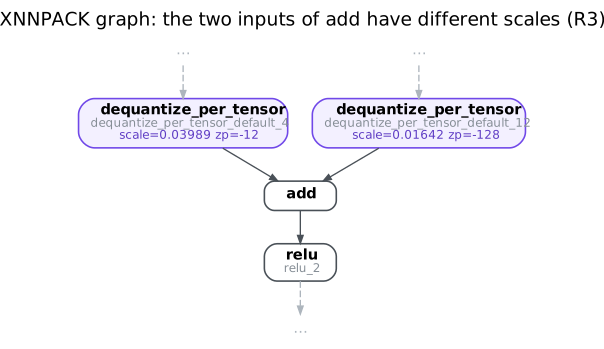
passed = [r for r in RULES if r not in first]
print("Rules the XNNPACK graph passes:", passed)
assert passed == ["R5", "R7"]
Rules the XNNPACK graph passes: ['R5', 'R7']- R5 passes: XNNPACKQuantizer also treats conv+relu and add+relu as one pattern (M04-1).
- R7 passes because
is_per_channel=Truewas passed here; without it the weight would be per-tensor and this rule would be violated.
The XNNPACK graph is perfectly reasonable on a CPU (M08’s XNNPACK consumes exactly this kind of graph); it just does not fit this VPU’s spec. Whether the same Q/DQ graph can be deployed depends on the backend; so the backend ships its own Quantizer, and the compiler also checks on its own.
C. What Passing the Check Buys: the Requant Factor
The accumulator of an integer conv is int32, with scale = \(s_{in} \cdot s_w\); to write it back to int8 (scale = \(s_{out}\)) it has to be multiplied by
\[ M = \frac{s_{in} \cdot s_w}{s_{out}} \tag{1} \]
Read the three scales of every conv/linear off the VPU graph (the weight is per-channel, so list min to max):
vpu = graphs["MyVPUQuantizer"]
rows, all_pow2 = [], True
for n in vpu.graph.nodes:
    if n.op != "call_function" or n.target not in (CONV2D, LINEAR):
        continue
    s_in, s_w, s_out = requant_inputs(vpu, n)
    assert s_out is not None
    m = s_in * s_w / s_out
    all_pow2 &= is_pow2(m)
    shift = (-torch.log2(m)).round().long()
    rows.append([n.name, f"2^{torch.log2(s_in).item():.0f}", f"2^{torch.log2(s_w).min():.0f} to 2^{torch.log2(s_w).max():.0f}",
                 f"2^{torch.log2(s_out).item():.0f}", f"{shift.min().item()} to {shift.max().item()}"])
table(rows, ["node", "s_in", "s_w", "s_out", "right shift (-log2 M)"])| node | s_in | s_w | s_out | right shift (-log2 M) |
|---|---|---|---|---|
| conv2d | 2^-5 | 2^-8 to 2^-7 | 2^-4 | 8 to 9 |
| conv2d_1 | 2^-4 | 2^-9 to 2^-8 | 2^-4 | 8 to 9 |
| conv2d_2 | 2^-4 | 2^-8 to 2^-7 | 2^-4 | 7 to 8 |
| conv2d_3 | 2^-4 | 2^-9 to 2^-7 | 2^-4 | 7 to 9 |
| linear | 2^-5 | 2^-7 to 2^-6 | 2^-3 | 8 to 9 |
print("VPU graph: all M are 2^k:", all_pow2)
assert all_pow2
xnn = graphs["XNNPACKQuantizer"]
conv = next(n for n in xnn.graph.nodes if n.op == "call_function" and n.target == CONV2D)
s_in, s_w, s_out = requant_inputs(xnn, conv)
assert s_out is not None
m0 = (s_in * s_w / s_out)[0]
print(f"For comparison, XNNPACK graph: M of channel 0 of {conv.name} = {m0.item():.6g} (log2 = {torch.log2(m0).item():.3f})")
VPU graph: all M are 2^k: True
For comparison, XNNPACK graph: M of channel 0 of conv2d = 0.00646425 (log2 = -7.273)All three scales on the VPU graph are decided by the Pow2 observers, so the exponent of \(M\) is just the three exponents added and subtracted: shifting the accumulator right by that many bits completes the requant. The \(M\) of the XNNPACK graph is not a power of 2; integer hardware generally has to do requant with a fixed-point multiply of “int32 multiplier + shift” (a common approach, not implemented in this project).
Summary
- The checker pass is the backend’s line of defense: reading only the q/dq parameters and connections on the Q/DQ graph is enough to decide whether the graph can run on this VPU.
- Every rule corresponds to a constraint in
vpu_quantizer.py; when the quantizer fails to meet one, the pass points directly at the node. - The benefit of power-of-2 scales becomes a concrete number: the requant of each conv is just a right-shift amount.