import copy

import torch

from common.graph_utils import annotation_table, diff_ops, observer_placement_table, unannotated_ops
from common.models import example_inputs, get_model
from common.pt2e import convert_pt2e, export_module, get_xnnpack_quantizer, prepare_pt2e, quiet
from common.viz import draw, draw_stages, table

quiet()
_ = torch.manual_seed(0)M01-2 | What Exactly prepare / convert Change in the Graph

M01-1 looked at the small stem section. This notebook switches to a complete small residual block and lays out every change prepare_pt2e and convert_pt2e make to the graph.
Predict first, then run on to see the answers:
- Is there an observer between conv2d and relu?
- Do the input and output of
max_pool2duse the same qparams? - What about the two inputs of
cat?
A. The Three Stages of a Residual Block
The model is conv → bn → relu → conv → bn, then added to the input x and passed through relu. How conv → bn → relu changes was already seen in M01-1; here we draw only the residual-specific part: the input x feeds both the first conv and the add.
model = get_model("residual", ch=8).eval()
ex = (torch.randn(4, 8, 16, 16),)
gm = export_module(model, ex)

quantizer, _ = get_xnnpack_quantizer(is_per_channel=True)
prepared = prepare_pt2e(copy.deepcopy(gm), quantizer)
with torch.no_grad():
    for _ in range(8):
        prepared(torch.randn(4, 8, 16, 16))
converted = convert_pt2e(copy.deepcopy(prepared))

draw_stages([(gm, "export"), (prepared, "prepare_pt2e"), (converted, "convert_pt2e")],
            focus=["x", "add"], hops=0, title="Skip connection: near x and add")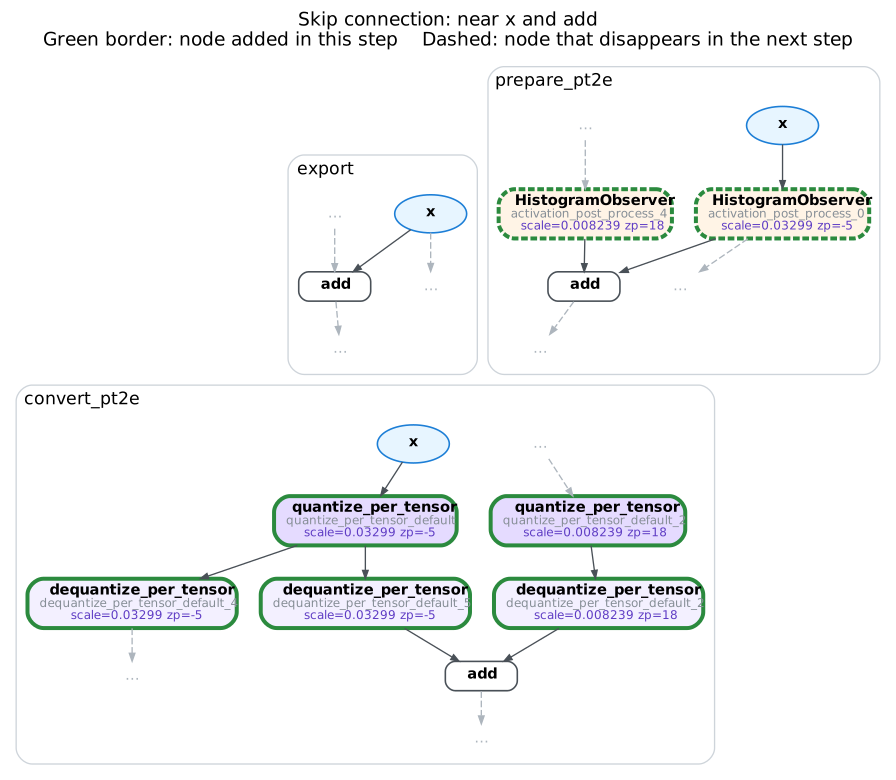
Read in the order export → prepare_pt2e (first row) → convert_pt2e (second row):
- prepare: only one observer is inserted after
x, serving both the conv and the add; the other input ofadd(the second conv’s output) has its own observer. - convert: observers are replaced by
quantize→dequantize. The quantize ofxis followed by two dequantizes, one per consumer. This is done byDuplicateDQPass, the last passconvert_pt2eruns (torchao 0.18 source:duplicate_dq_pass.py): each branch gets its own dq, so that when the backend replaces “dq → op → q” with an int8 kernel it can handle each branch separately (why a shared dq does not work is verified in M02-3).
Looking at the whole graph through the change in op counts: the two batch_norms disappear (folded into conv) and observers are added; after convert, all observers become q/dq. The weight’s observer leaves only a dequantize_per_channel, because the int8 weight is stored directly as a constant.
table(diff_ops(gm, prepared, "export", "prepare", tablefmt="html"))| op | export | prepare | delta |
|---|---|---|---|
| <module:HistogramObserver> | 0 | 4 | 4 |
| <module:PerChannelMinMaxObserver> | 0 | 2 | 2 |
| batch_norm | 2 | 0 | -2 |
| add | 1 | 1 | 0 |
| conv2d | 2 | 2 | 0 |
| relu | 2 | 2 | 0 |
table(diff_ops(prepared, converted, "prepare", "convert", tablefmt="html"))| op | prepare | convert | delta |
|---|---|---|---|
| <module:HistogramObserver> | 4 | 0 | -4 |
| <module:PerChannelMinMaxObserver> | 2 | 0 | -2 |
| dequantize_per_channel | 0 | 2 | 2 |
| dequantize_per_tensor | 0 | 5 | 5 |
| quantize_per_tensor | 0 | 4 | 4 |
| add | 1 | 1 | 0 |
| conv2d | 2 | 2 | 0 |
| relu | 2 | 2 | 0 |
Which edge each observer sits on, and the qparams computed after calibration:
table(observer_placement_table(prepared, tablefmt="html"))| observer | type | input from | output to | qparams |
|---|---|---|---|---|
| activation_post_process_1 | PerChannelMinMaxObserver | conv1_weight | conv2d | scale=0.0009225 zp=0 (per-channel, n=8) |
| activation_post_process_3 | PerChannelMinMaxObserver | conv2_weight | conv2d_1 | scale=0.0009054 zp=0 (per-channel, n=8) |
| activation_post_process_0 | HistogramObserver | x | conv2d, add | scale=0.03299 zp=-5 |
| activation_post_process_2 | HistogramObserver | relu | conv2d_1 | scale=0.008802 zp=-128 |
| activation_post_process_4 | HistogramObserver | conv2d_1 | add | scale=0.008239 zp=18 |
| activation_post_process_5 | HistogramObserver | relu_1 | output | scale=0.01745 zp=-128 |
Answer 1: conv2d’s output goes straight into relu, with no observer in between. The quantizer marks conv + relu as a group and quantizes only relu’s output; this lets the backend fuse the two into one kernel, and the value in between does not have to be stored as int8 first (M04 covers this in detail).
def users_of(gm, name):
    node = next(n for n in gm.graph.nodes if n.name == name)
    return [u.name for u in node.users]


print("Users of conv2d after prepare:", users_of(prepared, "conv2d"))
assert users_of(prepared, "conv2d") == ["relu"]
Users of conv2d after prepare: ['relu']B. Which Ops the Quantizer Actually Covers
For questions 2 and 3, switch to a model with cat, max_pool2d, and mean (CatPoolNet):
x ─┬─ conv a → relu ─┐
   └─ conv b → relu ─┴─ cat → max_pool2d → conv out ─┬──────── add → output
                                                     └─ mean ──┘
To answer “which ops are covered”, we first need to see what the quantizer leaves on the graph. First, a rough introduction to two terms:
- Quantizer: an object supplied by the backend that decides “which tensors get quantized, and with what spec”. The
XNNPACKQuantizerused throughout this chapter is the XNNPACK backend’s quantizer. quantizer.annotate(graph): the quantizer’s core method. It walks the whole graph and writes an annotation on each node to be quantized, stored innode.meta["quantization_annotation"]. An annotation has two fields:input_qspec_maprecords “which input edges are quantized, each with which spec”, andoutput_qspecrecords “whether this node’s output is quantized, and with which spec”. A spec (QuantizationSpec) states the dtype, integer range, symmetric or asymmetric, per-tensor or per-channel, and which kind of observer to use.
annotate only puts on annotations; it does not insert observers or change the graph’s structure. You normally never call it yourself: the first thing prepare_pt2e does is call it, then insert observers according to the annotations. We call it on its own here to see the annotations before any observer appears. annotate also modifies in place, so we call it on a copy.
Don’t worry about the details yet. All you need here is to see “which nodes have annotations and which do not”. The quantizer and
annotateare covered in detail in several later notebooks:
- M03-1: how
prepare_pt2edecides, from the annotations, which edge each observer goes on- M03-2: reading every annotation
XNNPACKQuantizerputs on, one by one- M03-3: writing a quantizer’s
annotatefrom scratch yourself- M03-4, M03-5: other specs such as
SharedQuantizationSpec(shared qparams) andDerivedQuantizationSpec(derived from other scales)- M10-1: writing hardware constraints into a complete quantizer
gm2 = export_module(get_model("cat_pool").eval(), example_inputs(4))
q2, _ = get_xnnpack_quantizer(is_per_channel=True)
annotated = q2.annotate(copy.deepcopy(gm2))
table(annotation_table(annotated, tablefmt="html"))| node | target | input_qspec_map | output_qspec |
|---|---|---|---|
| a_weight | a.weight | - | NoneType |
| a_bias | a.bias | - | NoneType |
| b_weight | b.weight | - | NoneType |
| b_bias | b.bias | - | NoneType |
| out_weight | out.weight | - | NoneType |
| out_bias | out.bias | - | NoneType |
| conv2d | conv2d | x:Spec, a_weight:Spec, a_bias:NoneType | NoneType |
| relu | relu | - | Spec |
| conv2d_1 | conv2d | x:Spec, b_weight:Spec, b_bias:NoneType | NoneType |
| relu_1 | relu | - | Spec |
| conv2d_2 | conv2d | max_pool2d:Spec, out_weight:Spec, out_bias:NoneType | Spec |
| mean | mean | conv2d_2:SharedSpec | SharedSpec |
| add | add | conv2d_2:Spec, mean:Spec | Spec |
How to read the table:
Specis an independent quantization spec,SharedSpecmeans “shares qparams with another place”, andNoneTypemeans this position is not quantized. For example,conv2d’s output isNoneTypebecause it forms a group with the following relu and only relu’s output is quantized (the reason for Answer 1).- The weight and bias rows have no spec: the quantizer only marks them as “handled”. The weight’s spec is written in the
input_qspec_mapof the row of the conv that uses it; there bias isNoneType, since this config does not quantize bias.
cat and max_pool2d are not in the table: they were not annotated at all and stay in fp32.
left_fp32 = [n.name for n in unannotated_ops(annotated)]
print("Ops without annotation:", left_fp32)
assert set(left_fp32) == {"cat", "max_pool2d"}
Ops without annotation: ['cat', 'max_pool2d']After inserting observers, look near cat: each of the two relu outputs has its own observer, and there is no observer between cat and max_pool2d.
prepared2 = prepare_pt2e(gm2, q2)
with torch.no_grad():
    for _ in range(8):
        prepared2(torch.randn(4, 3, 16, 16))
draw(prepared2, focus=["cat", "max_pool2d"], hops=2, title="Near cat after prepare_pt2e")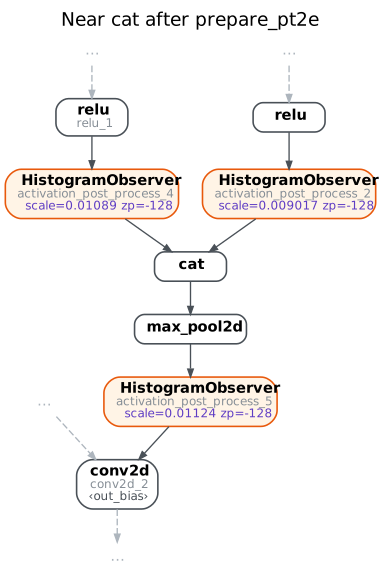
Answers 2 and 3: in this environment, the two inputs of cat each use their own qparams (the two observers in the figure above have different scales), and max_pool2d is not quantized either.
This is not by design but the quantizer silently failing. This project’s M01 to M07 use the torchao test version of XNNPACKQuantizer (torchao.testing.pt2e._xnnpack_quantizer, a copy torchao keeps for its own unit tests). Its way of finding cat depends on node.meta["source_fn_stack"], but nodes exported by torch 2.14 no longer have this field:
cat_node = next(n for n in gm2.graph.nodes if n.name == "cat")
print(sorted(cat_node.meta))
assert "source_fn_stack" not in cat_node.meta
['from_node', 'nn_module_stack', 'stack_trace', 'tensor_meta', 'torch_fn', 'val']max_pool2d has no annotator of its own; in the last step it “shares qparams with its input”. Its input cat is not annotated, so it is not annotated either. conv, linear, and add match node.target directly, so they work as usual. The XNNPACKQuantizer shipped with executorch does not have this problem; M08 compares the two.
Summary
- prepare does two things: fold BN and insert observers according to the annotations. convert replaces observers with q/dq and stores the weight as an int8 constant.
- There is no quantization point between conv + relu; this is how PT2E expresses “fusion”.
- Whether an op is quantized must be verified by dumping the annotations yourself; don’t rely only on docs or articles.