M08-2 | From Q/DQ Graph to .pte: Lowering, File Size, Runtime Execution
Open In Colab
All three treatments in M07 stay inside PyTorch and produce no int8 kernel. This notebook takes Route A (M07 overview): hand the Q/DQ graph to ExecuTorch’s XNNPACK backend, produce the deployment file .pte, and run it with the ExecuTorch runtime.
export (static shape) → PT2E                Q/DQ graph (executorch XNNPACKQuantizer, M08-1)
  → to_edge_transform_and_lower             XnnpackPartitioner carves out subgraphs, compiled into a delegate
  → to_executorch                           memory planning, serialize to .pte
  → ExecuTorch runtime                      load the .pte, run it
A. Graphs before and after lowering: where the ops on the Q/DQ graph went; inside the delegate, the nodes XNNPACK actually executes.
B..pte file size: fp32 vs int8.
C. Run the .pte with the ExecuTorch runtime; what happens with a different batch size.
The terms at each step (Edge dialect, partitioner, delegate, memory planning) are in the M08 overview. This notebook needs executorch (uv sync --group executorch).
The model is M05’s TinyConvNet (trained). xnnpack_ptq is this project’s wrapper (common/executorch_utils.py, not an executorch API); it does the PTQ familiar from M01 on, with only two differences:
export_module(..., dynamic_batch=False): turns off dynamic batch, so the graph accepts only the batch size of example_inputs (1 here). The reason is in section C.
The quantizer is the executorch XNNPACKQuantizer (per-channel weight).
Because the batch is fixed at 1, the calibration data is also fed one sample at a time.
model = trained_tiny_net().eval()x = example_inputs(1)qdq = xnnpack_ptq(model, x) # export (static) → prepare_pt2e → calibration → convert_pt2ecounts = op_counts(qdq)n_before =sum(counts.values())n_qdq =sum(v for k, v in counts.items() if"quantize"in k)print(f"Q/DQ graph: {n_before} call_function nodes, of which {n_qdq} are q/dq")
Q/DQ graph: 42 call_function nodes, of which 28 are q/dq
A. Lowering: Where the Ops on the Q/DQ Graph Went
Using only executorch’s raw API, in three steps:
ep = torch.export.export(qdq, x) # 1. export once more to get an ExportedProgramedge = to_edge_transform_and_lower(ep, partitioner=[XnnpackPartitioner()]) # 2. convert to Edge dialect, carve out the delegatepte = edge.to_executorch().buffer# 3. memory planning, serialize to the bytes of the .ptelowered = edge.exported_program().graph_module # the graph after step 2print(f"GraphModule after lowering: {len(lowered.graph.nodes)} nodes; .pte {len(pte)} bytes")
GraphModule after lowering: 5 nodes; .pte 20880 bytes
Step 1 exports once more because to_edge_transform_and_lower takes an ExportedProgram, while convert_pt2e returns a GraphModule. This step also fixes the shape to that of x. This project wraps the three steps as lower_to_xnnpack(gm, example_inputs), which returns (edge, pte), used by M08-3 and M08-4.
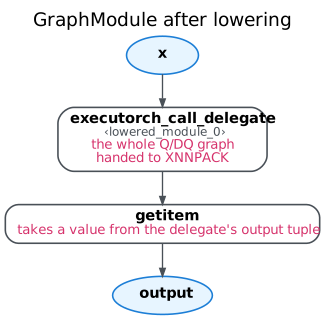
The graph after step 2 (the GraphModule after lowering):
draw(lowered, notes={"executorch_call_delegate": "the whole Q/DQ graph\nhanded to XNNPACK","getitem": "takes a value from the delegate's output tuple"}, title="GraphModule after lowering")
The conv, relu, and q/dq from the Q/DQ graph are gone, leaving only one executorch_call_delegate. ‹lowered_module_0› is its delegate: the subgraph compiled by XNNPACK.
Which ops went into the delegate? delegation_summary (this project’s wrapper) calls executorch’s get_delegation_info(lowered) and counts, op by op, whether it was handed to XNNPACK or stayed in ExecuTorch. The op names are in Edge dialect spelling:
n_sub, n_del, n_non, by_op = delegation_summary(edge)table([[op, d, nd] for op, (d, nd) insorted(by_op.items())], ["op (Edge dialect name)", "handed to XNNPACK", "stays in ExecuTorch"])
left =sorted(op for op, (_, nd) in by_op.items() if nd)print(f"delegates: {n_sub}; Edge nodes handed to the delegate: {n_del} ({n_before} before lowering); left behind: {left}")assert n_sub ==1and n_del == n_before and left == ["getitem"]
delegates: 1; Edge nodes handed to the delegate: 42 (42 before lowering); left behind: ['getitem']
All the ops before lowering went into the same delegate; the only thing left is getitem, which was added during lowering and is not a computation. At run time ExecuTorch calls XNNPACK just once.
The names changed: conv2d has been decomposed into convolution in the Edge dialect, adaptive_avg_pool2d became mean, and flatten became view_copy.
The above counts Edge nodes, q/dq included. What these nodes turn into once inside the delegate can only be seen by opening the delegate.
Inside the Delegate: the Nodes XNNPACK Actually Executes
After to_edge_transform_and_lower hands the subgraph to XNNPACK, the XNNPACK backend rebuilds it as its own graph and serializes that into the .pte. The runtime executes this graph, not the Edge nodes above.
xnnpack_nodes(qdq, x) is a tool of this project (common/executorch_utils.py, not an executorch API): it lowers once more, intercepts the graph before XNNPACK serializes it, and lists each node’s input and output dtypes, plus the output range fused into the node (clamp). It depends on executorch 1.5.0’s internals and may need changes for other versions; the reader only needs to understand the printed table. The dtypes use XNNPACK’s spelling: qint8 is per-tensor int8, and qcint8 and qcint32 are the per-channel int8 weight and int32 bias.
xnn = xnnpack_nodes(qdq, x)[0] # there is only one delegatetable(xnn, ["XNNPACK node", "input dtype", "output dtype", "output clamp"])
XNNPACK node
input dtype
output dtype
output clamp
XNNConvert
fp32
qint8
XNNStaticTranspose
qint8
qint8
XNNConv2d
qint8, qcint8, qcint32
qint8
[0, +inf]
XNNMaxPooling2d
qint8
qint8
XNNConv2d
qint8, qcint8, qcint32
qint8
[0, +inf]
XNNConv2d
qint8, qcint8, qcint32
qint8
XNNAdd
qint8, qint8
qint8
[0, +inf]
XNNMaxPooling2d
qint8
qint8
XNNConv2d
qint8, qcint8, qcint32
qint8
[0, +inf]
XNNGlobalAvgPooling2d
qint8
qint8
XNNStaticTranspose
qint8
qint8
XNNStaticReshape
qint8
qint8
XNNFullyConnected
qint8, qcint8, qcint32
qint8
XNNConvert
qint8
fp32
names = [r[0] for r in xnn]n_relu =sum(short(n.target) =="relu"for n in qdq.graph.nodes)n_clamp =sum(r[3] =="[0, +inf]"for r in xnn)print(f"Q/DQ graph: {n_before} call_function nodes ({n_qdq} q/dq) → {len(xnn)} XNNPACK nodes")print(f"XNNConvert: {names.count('XNNConvert')}; relu on the Q/DQ graph: {n_relu}; nodes with a fused clamp: {n_clamp}")
Q/DQ graph: 42 call_function nodes (28 q/dq) → 14 XNNPACK nodes
XNNConvert: 2; relu on the Q/DQ graph: 4; nodes with a fused clamp: 4
assert names[0] == names[-1] =="XNNConvert"and names.count("XNNConvert") ==2assert xnn[0][1] =="fp32"and xnn[-1][2] =="fp32"andall(r[2] =="qint8"for r in xnn[:-1])assert n_clamp == n_relu andnotany("Clamp"in n for n in names)
Each dq → op → q unit becomes one XNNPACK node, with qint8 for both input and output:
q/dq are gone: the q/dq sandwiched between two ops are not computations; only the scale and zero point on the tensor remain (which is why the dtype is qint8 rather than fp32).
fp32 ↔︎ int8 converts only twice: the two XNNConverts at the head and tail come from the q at the graph input and the dq at the output.
bias became int32: on the Q/DQ graph the bias is fp32; here it is qcint32.
relu is fused: relu has no node of its own; it became the output clamp [0, +inf] of the preceding conv or add.
Two extra transposes: XNNPACK’s conv and pooling use the NHWC layout, so the data is converted from NCHW before the first conv and back before flatten. These two ops are not on the Q/DQ graph.
This table is a worked example of “Where q/dq Go During Lowering” in the M08 overview.
B. .pte File Size: fp32 vs int8
As a reference, lower the fp32 model directly without quantizing:
_, pte_fp32 = lower_to_xnnpack(model, x)n_params =sum(p.numel() for p in model.parameters())table([["fp32 .pte", len(pte_fp32), n_params *4], ["int8 .pte", len(pte), n_params]], ["", ".pte bytes", "size if all parameters are stored as fp32 / int8"])
.pte bytes
size if all parameters are stored as fp32 / int8
fp32 .pte
45968
39760
int8 .pte
20880
9940
ratio =len(pte) /len(pte_fp32)print(f"The int8 .pte is {ratio:.0%} of the fp32 .pte (the model has {n_params} parameters)")assertlen(pte) <len(pte_fp32)
The int8 .pte is 45% of the fp32 .pte (the model has 9940 parameters)
A .pte is a self-contained deployment file: the graph, weights, delegate data, and memory plan are all inside.
In the int8 version the weights are stored as int8, with per-channel scales stored separately; the bias that is fp32 on the Q/DQ graph is quantized to int32 during lowering and stored (M08 overview). So the int8 estimate in the third column (1 byte per parameter) is slightly lower than the actual size.
The rest is graph structure, the description of the XNNPACK subgraph, and the memory plan. This part does not grow in proportion to the parameter count, so the larger the model, the closer the int8-to-fp32 ratio gets to 1/4 (inference; no larger model was measured).
C. Run with the ExecuTorch Runtime
What you hand over at deployment is the .pte file. Write it to a file first, then load it from the file. PteRunner is this project’s wrapper: executorch.runtime.Runtime.get().load_program(...) loads it, load_method("forward") gets the method, and execute([...]) runs it (the raw API is in the M08 overview). It keeps the Program returned by load_program alive: if you keep only the Method and let the Program be garbage collected, the Method reads freed memory when it runs.
with tempfile.TemporaryDirectory() as d: path = Path(d) /"tiny_int8.pte" path.write_bytes(pte) runner = PteRunner(path) y_pte = runner(x[0])with torch.no_grad(): y_qdq = qdq(x[0])out_scale = [n for n in qdq.graph.nodes if short(n.target) =="quantize_per_tensor"][-1].args[1]print(f"input {tuple(x[0].shape)} → output {tuple(y_pte.shape)}")print(f"Max difference from the Q/DQ graph: {(y_pte - y_qdq).abs().max():.3g} ({(y_pte - y_qdq).abs().max() / out_scale:.2f} output LSB)")
input (1, 3, 16, 16) → output (1, 4)
Max difference from the Q/DQ graph: 0.0643 (1.00 output LSB)
The output LSB is the scale of the last quantize: one step of int8. The .pte computes with XNNPACK’s integer kernels while the Q/DQ graph simulates in fp32, so the two are not guaranteed to be bit-identical (M08 overview, “Numerical Differences from the Q/DQ Graph”); section C of M08-3 measures the difference over many inputs.
Changing the Batch Size
The .pte was exported with batch 1. Try feeding batch 4. The ExecuTorch runtime’s C++ layer prints the reason to stderr; this project’s capture_stderr() (common/env.py) collects it so we can print it together:
with capture_stderr() as log:try: runner(torch.randn(4, 3, 16, 16)) error =NoneexceptRuntimeErroras e: error =str(e)print("Python side:", error)print("C++ log:")print(log.text.strip())
Python side: method->set_inputs() for method 'forward' failed with error 0x10
C++ log:
[tensor_impl.cpp:135] Attempted to resize a static tensor. Expected shape (1, 3, 16, 16), but received (4, 3, 16, 16).
[method.cpp:1243] Error resizing tensor at input 0
to_executorch() plans the memory of every intermediate tensor ahead of time from the shapes at export time (memory planning), and no memory is allocated at run time. The input tensor’s shape is therefore fixed, and feeding a different batch fails right at the set_inputs step.
This is why export_module() has dynamic batch on by default from M00 on (calibration feeds different batch sizes), yet it has to be turned off in M08. ExecuTorch also supports dynamic shapes with an upper bound given at export time (torch.export.Dim("batch", max=…)), which this project does not use.
Summary
to_edge_transform_and_lower hands off, as one block, the subgraph XNNPACK can handle; TinyConvNet’s whole graph went into a single delegate.
Inside the delegate, each dq → op → q unit is one int8 XNNPACK node and relu is fused into a clamp; fp32 ↔︎ int8 converts only at the input and output.
The .pte carries its own graph, int8 weights, and memory plan, and runs once loaded with the ExecuTorch runtime.
The memory plan is decided by the shapes at export time, so a .pte exported with static shapes accepts only that batch.
What happens with unsupported ops is in M08-3; whether it got faster is in M08-4.