M09-3 | ORT’s Own PTQ Tool vs PT2E: Same QDQ ONNX, Where the Two Paths Differ
Open In Colab
The QDQ ONNX in M09-1 and M09-2 were both “quantize in PyTorch with PT2E first, then export”. ORT also has its own PTQ tool, which takes an fp32 ONNX directly and inserts Q/DQ on the ONNX graph:
PT2E path: PyTorch model → PT2E → torch.onnx.export             QDQ ONNX
ORT path : PyTorch model → torch.onnx.export → quantize_static   QDQ ONNX
A. The default settings of quantize_static, and the graph it produces.
B. Accuracy: PT2E’s QDQ ONNX vs. two settings of the ORT tool.
C. Another output of the same tool: QOperator format.
A. The Default Settings of quantize_static, and the Graph It Produces
inspect.signature reads out the defaults of quantize_static, to compare with the PT2E side’s settings (torchao test-version XNNPACKQuantizer):
params = inspect.signature(quantize_static).parameterspt2e = {"quant_format": "QDQ (the export is QDQ)", "activation_type": "int8 per-tensor affine","weight_type": "int8 symmetric [-127, 127]", "per_channel": "True (xnnpack_qdq passes is_per_channel=True)","calibrate_method": "HistogramObserver"}table([[k, str(params[k].default), v] for k, v in pt2e.items()], ["Parameter", "ORT default", "PT2E (xnnpack_qdq)"])
Parameter
ORT default
PT2E (xnnpack_qdq)
quant_format
QDQ
QDQ (the export is QDQ)
activation_type
QInt8
int8 per-tensor affine
weight_type
QInt8
int8 symmetric [-127, 127]
per_channel
False
True (xnnpack_qdq passes is_per_channel=True)
calibrate_method
CalibrationMethod.MinMax
HistogramObserver
ORT’s activation defaults to asymmetric and weight to symmetric, set in ActivationSymmetric / WeightSymmetric of extra_options.
quantize_static(fp32 ONNX, output path, calibration data) uses all defaults. This project’s ort_quantize wraps three things:
The tool can only write a file, so the output goes through a temp file and is read back.
The tool modifies the ModelProto passed in (turning the weights into external data pointing at a temp file), so passing the same object a second time cannot be read; hence each call passes a copy.deepcopy.
The tool’s warnings go through Python’s root logger; they are collected and returned to the caller (section C prints one).
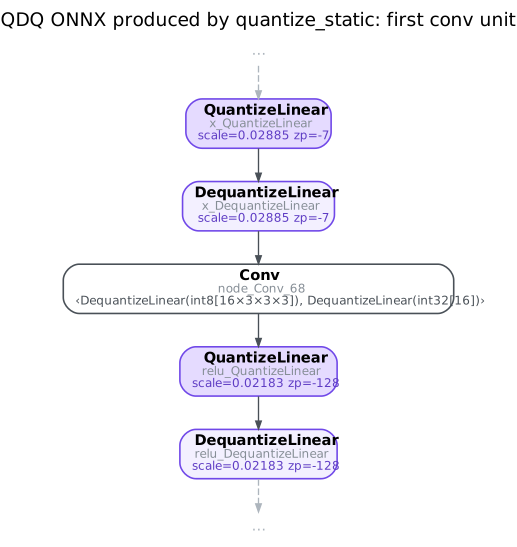
ort_default, _ = ort_quantize(fp32_onnx)first_conv =next(n.name for n in ort_default.graph.node if n.op_type =="Conv")draw_onnx(ort_default, focus=first_conv, hops=2, title="QDQ ONNX produced by quantize_static: first conv unit")
c_fp32, c_ort = onnx_op_counts(fp32_onnx), onnx_op_counts(ort_default)print(f"Relu: {c_fp32.get('Relu', 0)} in fp32 ONNX → {c_ort.get('Relu', 0)} after quantize_static")assert c_fp32["Relu"] >0and c_ort.get("Relu", 0) ==0
Relu: 4 in fp32 ONNX → 0 after quantize_static
Compared with the first conv unit exported from PT2E in section A of M09-1, there are three differences:
No Relu: the tool removes the Relu after the conv at quantization time, leaving the clamp to the following QuantizeLinear’s zero point = -128. This is what ORT does only at EXTENDED in M09-2; here it is written into the file.
The bias is already DequantizeLinear(int32[…]): the bias quantization that only happens at BASIC in M09-2 is also written into the file here.
The weight is per-tensor: the default is per_channel=False.
ORT’s tool sees only the ONNX graph, but the decisions it makes are the same kind as a PT2E quantizer’s: which edges get Q/DQ, with scales computed from calibration data.
B. Accuracy
All four .onnx files run on ORT’s CPU EP (default level ORT_ENABLE_ALL, ort_session) over the same 1024 test samples (same as M05-1):
ort_pc, _ = ort_quantize(fp32_onnx, per_channel=True)candidates = {"fp32 ONNX": fp32_onnx,"PT2E → torch.onnx.export": pt2e_onnx,"quantize_static: default (per-tensor weight)": ort_default,"quantize_static: per_channel=True": ort_pc,}xs, ys =zip(*make_loader(n=1024, seed=2, shuffle=False))x_test, y_test = torch.cat(xs), torch.cat(ys)with torch.no_grad(): y_fp32 = model(x_test)acc, snr = {}, {}for name, m in candidates.items(): out = ort_run(ort_session(m), x_test) acc[name], snr[name] = (out.argmax(1) == y_test).float().mean().item(), sqnr(y_fp32, out)table([[name, "-"if name =="fp32 ONNX"elsef"{snr[name]:.2f}", f"{acc[name]:.4f}"] for name in candidates], ["", "SQNR vs PyTorch fp32 (dB)", "accuracy"])
SQNR vs PyTorch fp32 (dB)
accuracy
fp32 ONNX
-
0.7109
PT2E → torch.onnx.export
29.20
0.7061
quantize_static: default (per-tensor weight)
27.81
0.7129
quantize_static: per_channel=True
29.68
0.7109
quantized =list(candidates)[1:]n_diff =round((max(acc[n] for n in quantized) -min(acc[n] for n in quantized)) *len(y_test))print(f"The accuracy of the three quantized versions differs by at most {n_diff} samples (out of {len(y_test)})")print(f"Highest SQNR: {max(quantized, key=lambda n: snr[n])}; lowest: {min(quantized, key=lambda n: snr[n])}")assertall(snr[n] >20for n in quantized)
The accuracy of the three quantized versions differs by at most 7 samples (out of 1024)
Highest SQNR: quantize_static: per_channel=True; lowest: quantize_static: default (per-tensor weight)
The accuracy of the three quantized versions differs by only a few samples, too small a gap to rank them. The two paths have different settings (the activation observer is Histogram or MinMax; the weight is per-tensor or per-channel), and which of these accounts for the SQNR difference is not broken down here.
The point is the flow rather than the scores: both paths produce QDQ ONNX, and ORT uses the same QDQ node fusion when running them (M09-2).
C. QOperator format
quantize_static has another output format: quant_format=QuantFormat.QOperator.
qop, warnings = ort_quantize(fp32_onnx, quant_format=QuantFormat.QOperator)print("Ops in QOperator format:", dict(onnx_op_counts(qop)))for w in warnings:if"QuantFormat"in w: # the other two warnings recommend pre-processing first and are unrelated to this sectionprint("Warning printed by quantize_static:", w.strip())
Ops in QOperator format: {'QuantizeLinear': 2, 'QLinearConv': 4, 'MaxPool': 2, 'com.microsoft.QLinearAdd': 1, 'DequantizeLinear': 2, 'ReduceMean': 1, 'Reshape': 1, 'com.microsoft.QGemm': 1}
Warning printed by quantize_static: Please use QuantFormat.QDQ for activation type QInt8 and weight type QInt8. Or it will lead to bad performance on x64.
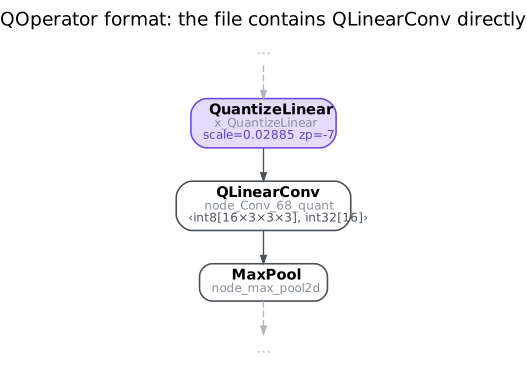
first_qconv =next(n.name for n in qop.graph.node if n.op_type =="QLinearConv")draw_onnx(qop, focus=first_qconv, hops=1, title="QOperator format: the file contains QLinearConv directly")
QOperator format writes the fused int8 ops (QLinearConv, QLinearAdd…) straight into the file, which is almost the same as the graph the CPU EP rewrites at ORT_ENABLE_EXTENDED in M09-2. ORT’s tool itself prints a warning recommending QDQ format for int8 activation + int8 weight.
The two formats differ in “who decides to swap in int8 ops”:
Format
Who decides to swap in int8 ops
Which EPs can run it
QDQ format
The EP at run time
Any EP (if it does not recognize them, it runs in fp32)
QOperator format
The quantization tool
Only EPs that implement these int8 ops
The “which EPs can run it” column is from the ORT docs; only the CPU EP was verified here. What PT2E exports is always QDQ format.
Summary
ORT’s quantize_static does the same job as PT2E: decide where to insert Q/DQ and compute scales from calibration data. It just does so on the ONNX graph.
It also folds the Relu and quantizes the bias to int32 into the file; PT2E leaves these to the backend (XNNPACK in M08, ORT in M09-2).
QDQ format leaves the decision to the EP at run time; QOperator format hard-codes the int8 ops at quantization time.