import copy

import torch
from torch.nn.utils import parametrize

from common.data import calibration_batches
from common.graph_utils import op_counts
from common.models import ConvBnReLU, ConvReLU, example_inputs
from common.pt2e import convert_pt2e, export_module, get_xnnpack_quantizer, prepare_pt2e, quiet
from common.viz import draw, draw_stages, table
from common.weight_norm import add_weight_norm, strip_weight_norm

quiet()
_ = torch.manual_seed(0)


def make(cls, wrap=True):
    """Small model with BN warmed up on a few batches; with wrap=True, apply weight_norm to conv.weight."""
    torch.manual_seed(0)
    m = cls(3, 8).train()
    with torch.no_grad():
        for _ in range(3):
            m(torch.randn(16, 3, 16, 16))
    m.eval()
    if wrap:
        add_weight_norm(m)
    return m


def ptq(gm, **convert_kwargs):
    """prepare → calibrate on 128 samples → convert; returns (prepared, converted)."""
    prepared = prepare_pt2e(gm, get_xnnpack_quantizer(is_per_channel=True)[0])
    with torch.no_grad():
        for batch in calibration_batches(128):
            prepared(*batch)
    return prepared, convert_pt2e(copy.deepcopy(prepared), **convert_kwargs)


x = torch.randn(8, 3, 16, 16)M05-5 (Optional) | weight_norm in PTQ: Fine Without BN, Remove It First With BN

torch.nn.utils.parametrize lets a parameter become “computed from other parameters”. weight_norm is one example: it replaces conv.weight with \(g \cdot v / \lVert v \rVert\) (\(g\) is stored in original0, \(v\) in original1), and every access to conv.weight recomputes it. If you are not familiar with parametrize, first read the official parametrize tutorial and the weight_norm docs. For why weight_norm splits the weight this way and what the gradients of \(g\) and \(v\) look like, I suggest first reading the blog post “Notes on Weight Normalization” (in Chinese). It uses the old torch.nn.utils.weight_norm, while this course uses torch.nn.utils.parametrizations.weight_norm; the split is the same, only the names under which \(g\) and \(v\) are stored differ.
- A. After export: the weight becomes a computation in the graph.
- B. Without BN: prepare and convert both work.
- C. With BN:
prepare_pt2eraises an error when folding BN. - D. Two fixes: remove it on the module before export, or remove it in the graph after export.
For the basic graph-editing moves see M00-4, and for BN folding see M04-1. QAT has to keep weight_norm during training and does it differently; see M06-6.
add_weight_norm(model) is a tool of this project (common/weight_norm.py); it is equivalent to calling torch.nn.utils.parametrizations.weight_norm(model.conv, dim=0) on model.conv.
A. After Export: The Weight Becomes a Computation
wn = make(ConvReLU)
with torch.no_grad():
    same = torch.allclose(make(ConvReLU, wrap=False)(x), wn(x), atol=1e-6)
print("model parameters:", [n for n, _ in wn.named_parameters()])
print("eval outputs allclose before/after applying weight_norm:", same, "(g is initialized to ‖v‖, so the values are unchanged at first)")
assert same

gm = export_module(copy.deepcopy(wn), example_inputs())
draw(gm, title="After export: the conv weight comes from _weight_norm")
model parameters: ['conv.bias', 'conv.parametrizations.weight.original0', 'conv.parametrizations.weight.original1']
eval outputs allclose before/after applying weight_norm: True (g is initialized to ‖v‖, so the values are unchanged at first)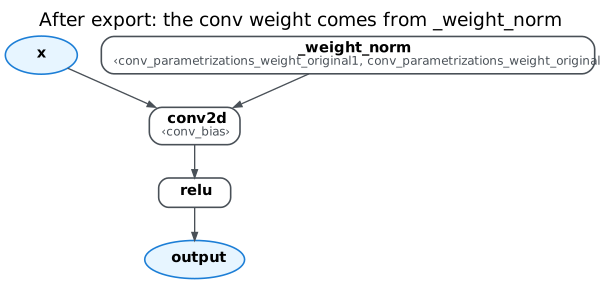
parametrize turns weight into a property, and export only traces how forward executes, so the computation \(g \cdot v / \lVert v \rVert\) goes into the graph (aten._weight_norm). The real parameters are original0 (\(g\)) and original1 (\(v\)), written under _weight_norm. Every later step that “does something to the weight” sees this call_function node, not a get_attr.
B. Without BN: prepare and convert Both Work
prepared, converted = ptq(copy.deepcopy(gm))
_, no_fold = ptq(copy.deepcopy(gm), fold_quantize=False)
draw_stages([(gm, "export"), (prepared, "prepare_pt2e"), (converted, "convert_pt2e")], title="weight_norm conv without BN")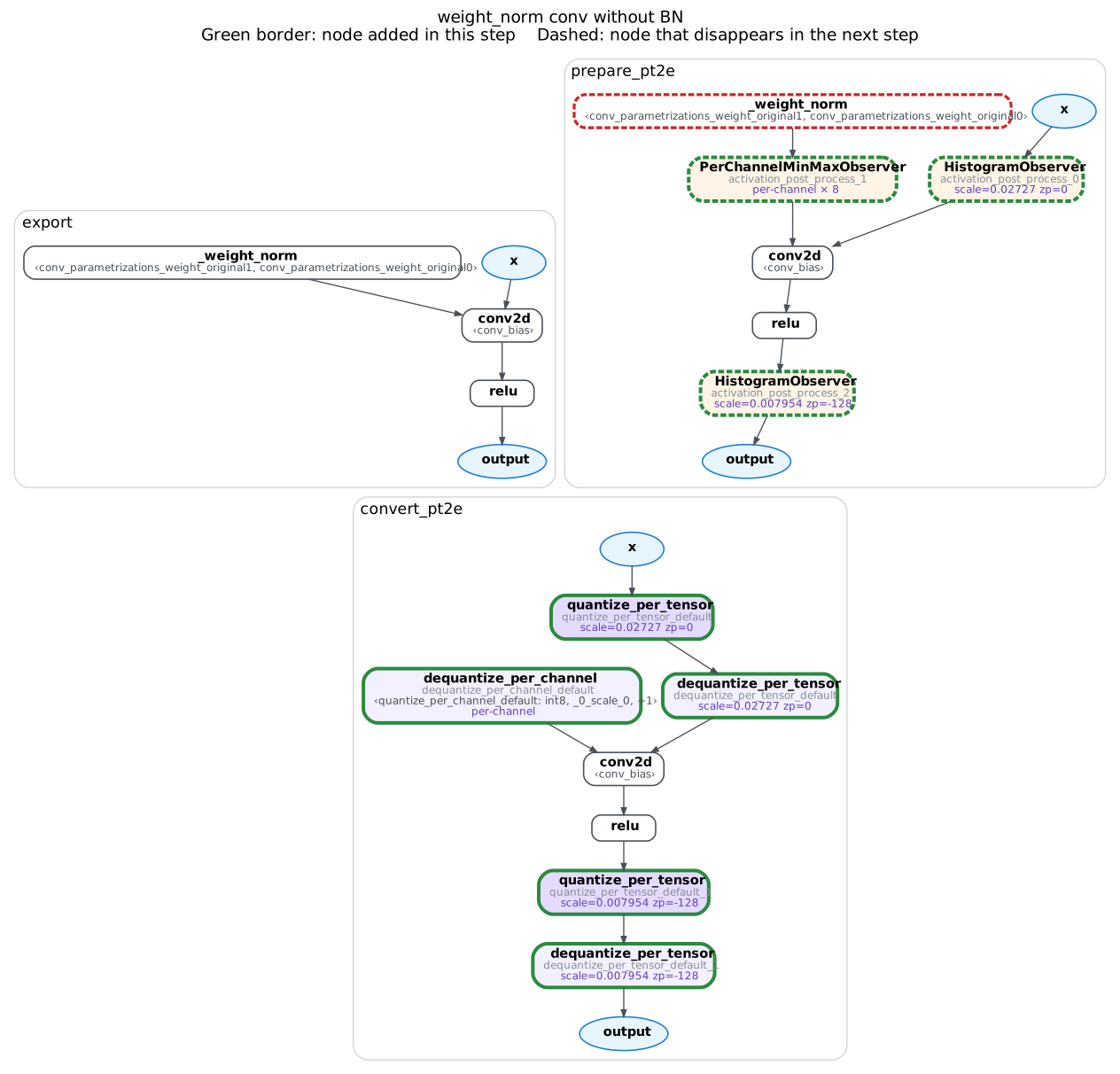
rows = [["after prepare_pt2e", "_weight_norm" in op_counts(prepared)],
        ["convert_pt2e(prepared)", "_weight_norm" in op_counts(converted)],
        ["convert_pt2e(prepared, fold_quantize=False)", "_weight_norm" in op_counts(no_fold)]]
table(rows, ["which graph", "still has _weight_norm?"])| which graph | still has _weight_norm? |
|---|---|
| after prepare_pt2e | True |
| convert_pt2e(prepared) | False |
| convert_pt2e(prepared, fold_quantize=False) | True |
assert [r[1] for r in rows] == [True, False, True]- After prepare, the weight’s observer hangs on the output of
_weight_norm: what is quantized is “the computed weight”, the same as for a regular conv. convert_pt2edefaults tofold_quantize=True, which precomputes quantize ops whose inputs are all constants into int8 constants (M02-3);_weight_norm’s inputs are all constants too, so it disappears together with the quantize. Withfold_quantize=Falseboth stay.
C. With BN: prepare_pt2e Raises an Error When Folding BN
wn_bn = make(ConvBnReLU)
with torch.no_grad():
    y_wn_bn = wn_bn(x)
gm_bn = export_module(copy.deepcopy(wn_bn), example_inputs())
draw(gm_bn, title="weight_norm conv with BN: after export")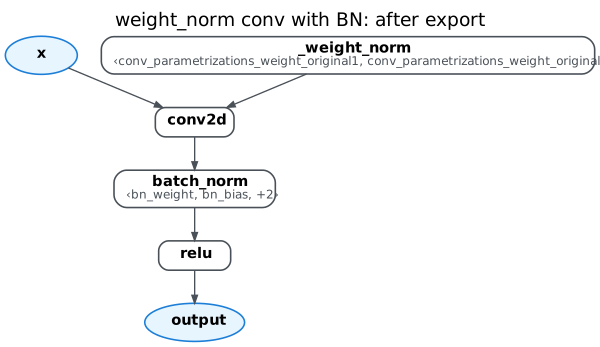
try:
    prepare_pt2e(copy.deepcopy(gm_bn), get_xnnpack_quantizer(is_per_channel=True)[0])
    error = None
except ValueError as e:
    error = e
print("prepare_pt2e →", f"{type(error).__name__}: {error}")
assert error is not None
prepare_pt2e → ValueError: Expected get_attr node, got call_functionPTQ folds BN right at the start of prepare_pt2e (M04-1): it reads the conv’s weight as a constant, multiplies by BN’s coefficients, and writes it back. The function that reads the constant is torchao’s internal _get_tensor_constant_from_node, which only accepts get_attr (from reading the source). When the weight is a _weight_norm call_function, it errors out directly instead of silently skipping.
D. Two Fixes
Fix 1: Call remove_parametrizations on the Module Before Export
leave_parametrized=True stores the currently computed weight as a regular parameter, then removes the parametrization:
parametrize.remove_parametrizations(wn_bn.conv, "weight", leave_parametrized=True)
with torch.no_grad():
    same = torch.equal(wn_bn(x), y_wn_bn)
print("parameters after remove_parametrizations:", [n for n, _ in wn_bn.named_parameters()], "; outputs torch.equal:", same)
assert same
parameters after remove_parametrizations: ['conv.weight', 'bn.weight', 'bn.bias'] ; outputs torch.equal: TrueThis fix has a trap: deepcopy a clone and remove the parametrization only on the clone, and the original model breaks too:
orig = make(ConvReLU)
clone = copy.deepcopy(orig)
parametrize.remove_parametrizations(clone.conv, "weight", leave_parametrized=True)
try:
    orig(x)
    trap = None
except AttributeError as e:
    trap = e
print("original model forward →", f"{type(trap).__name__}: {trap}")
assert trap is not None
original model forward → AttributeError: 'ParametrizedConv2d' object has no attribute 'weight'parametrize replaces the module’s __class__ with a dynamically generated ParametrizedConv2d; deepcopy does not copy the class, so the original model and the clone share the same class. When the parametrization is removed from the clone, the weight property is deleted from the shared class, and the original model can no longer find weight.
Fix 2: After Export, Replace _weight_norm in the Graph with a Constant
strip_weight_norm(gm) is a tool of this project (common/weight_norm.py): it computes the weight using the same _weight_norm in the graph, stores it as a new parameter, inserts a get_attr node, uses replace_all_uses_with to make the conv consume it instead, and then deletes _weight_norm (the graph-editing moves of M00-4).
fixed = copy.deepcopy(gm_bn)
print("weights stripped:", strip_weight_norm(fixed))
with torch.no_grad():
    same = torch.equal(fixed(x), gm_bn(x))
print("outputs torch.equal before/after strip:", same)
assert same
draw_stages([(gm_bn, "export"), (fixed, "after strip_weight_norm")], title="Fix 2: _weight_norm replaced by get_attr")
weights stripped: ['conv.weight']
outputs torch.equal before/after strip: True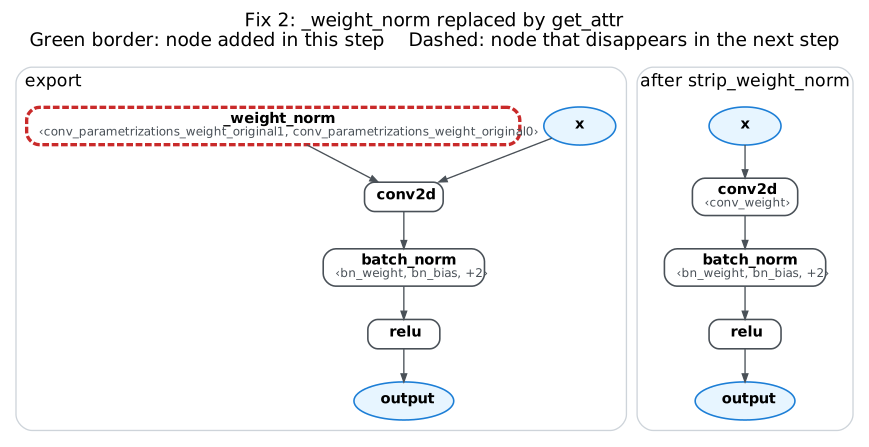
_, c_fixed = ptq(fixed)
print("prepare_pt2e and convert_pt2e both succeed; ops after convert:", dict(op_counts(c_fixed)))
assert "batch_norm" not in op_counts(c_fixed)
prepare_pt2e and convert_pt2e both succeed; ops after convert: {'quantize_per_tensor': 2, 'dequantize_per_tensor': 2, 'dequantize_per_channel': 1, 'conv2d': 1, 'relu': 1}Fix 2 does not touch nn.Module: the conv in the exported graph is an ordinary module, \(g\) and \(v\) are just parameters under it, and the graph edit changes only this graph, so there is no need to worry about dynamic classes. PTQ does not train and \(g\) and \(v\) are of no use anyway, so both fixes work.
Summary
- Export traces weight_norm’s computation into the graph, and the conv’s weight becomes
aten._weight_norm. - Without BN, PTQ works fine and convert folds it, together with quantize, into a constant; with BN, folding BN in
prepare_pt2eneeds to read a constant and errors out directly. - PTQ has no use for weight_norm: use
remove_parametrizationsbefore export (beware of the deepcopy trap), orstrip_weight_normafter export. QAT has to keep \(g\) and \(v\) during training, and prepare does not fold BN; see M06-6 for the approach.