import copy

import torch

from common.models import example_inputs, get_model
from common.pt2e import export_module, quiet
from common.viz import draw

quiet()
_ = torch.manual_seed(0)


def first_line(e):
    """Take only the first line of the exception message (the rest is mostly suggestions and stack info)."""
    return str(e).splitlines()[0]


class Scale(torch.nn.Module):
    """A small demo module: multiplies the input by k. It is only there to give call_module a target whose effect is visible."""

    def __init__(self, k):
        super().__init__()
        self.k = k

    def forward(self, x):
return x * self.kM00-4 | Graph Editing: The torch.fx Graph Operations Used Later

The first three notebooks only “read” the graph. PT2E’s prepare and convert are, at their core, both “graph editing”:
prepare_pt2einserts observers into the graph (you will do this yourself in M02-2).convert_pt2ereplaces observers with quantize/dequantize and precomputes the int8 weights (you will do this yourself in M02-3).
This notebook uses a small conv → relu graph to break the editing actions those two chapters need into six steps:
| Step | Action | API used | Where it is used later |
|---|---|---|---|
| 1 | Insert a new node | add_submodule, inserting_after, call_module |
M02-2 |
| 2 | Rewire downstream | replace_all_uses_with(delete_user_cb=...) |
M02-2 |
| 3 | Regenerate forward | recompile |
M02-2, M02-3 |
| 4 | Replace with call_function | inserting_before, call_function, erase_node |
M02-3 |
| 5 | Put a constant into the graph | register_buffer, get_attr |
M02-3 |
| 6 | Clean up and check | eliminate_dead_code, lint |
M02-3 |
If you are not familiar with the Graph/Node concepts (op kinds, args, users, …), we suggest first reading “Some Basic Concepts of PyTorch FX Graph and Node” (in Chinese), together with the official torch.fx documentation.
Run the cells in order. All six steps modify the same
gmin place; if you skip around or re-run a cell, the graph will no longer match the explanations. To start over, Restart and run everything from the top.
Starting Point: conv → relu
Under export_module() is torch.export.export(...).module(). base saves the original output, and every later step is checked against it.
x = example_inputs(4)[0]
gm = export_module(get_model("conv_relu").eval(), (x,))
with torch.no_grad():
    base = gm(x).clone()
graph = gm.graph
nodes = {n.name: n for n in graph.nodes}  # look up nodes by name: x, conv2d, relu, output...
relu = nodes["relu"]
draw(gm, title="gm before editing")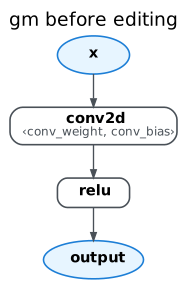
print(f"relu.args  = {relu.args}   <- what it takes (upstream)")
print(f"relu.users = {list(relu.users)}   <- who takes it (downstream)")
relu.args = (conv2d,) <- what it takes (upstream)
relu.users = [output] <- who takes it (downstream)Graph editing is almost always about these two things: “after which node to insert the new node” and “who should switch to taking the new node”.
Step 1: Insert a New Node
The target of a call_module must first be attached to the GraphModule (add_submodule). A node created inside the inserting_after(relu) context is placed after relu.
gm.add_submodule("scale_out", Scale(2.0))
with graph.inserting_after(relu):
    scale = graph.call_module("scale_out", (relu,))  # scale_out(relu)
draw(gm, highlight=["scale_out"], title="After Step 1: scale_out(relu) created")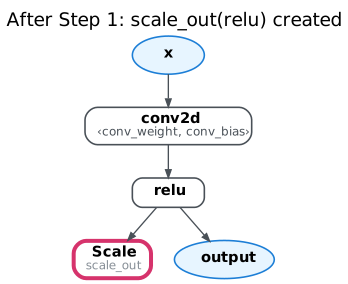
print(f"scale.users = {list(scale.users)}")
assert not scale.users
scale.users = []scale_out takes relu, but nobody takes it: output still takes relu. Creating a node does not automatically wire it into the graph; wiring up downstream is the next step.
Step 2: Rewire Downstream
The goal is to make whoever used to take relu (output) take scale_out instead. The intuitive way to write it is relu.replace_all_uses_with(scale). Let’s try it first on a copy, gm_bad:
gm_bad = copy.deepcopy(gm)
relu_bad = next(n for n in gm_bad.graph.nodes if n.name == "relu")
scale_bad = next(n for n in gm_bad.graph.nodes if n.name == "scale_out")
relu_bad.replace_all_uses_with(scale_bad)
draw(gm_bad, highlight=["scale_out"], title="Wrong: no delete_user_cb")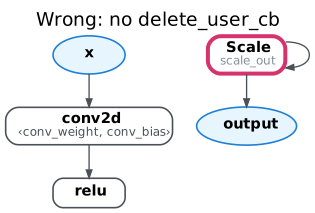
print(f"gm_bad scale_out.args = {scale_bad.args}")
try:
    gm_bad.graph.lint()
    lint_error = None
except RuntimeError as e:
    lint_error = first_line(e)
print(f"gm_bad.graph.lint(): {lint_error}")
assert scale_bad.args == (scale_bad,) and lint_error is not None
gm_bad scale_out.args = (scale_out,)
gm_bad.graph.lint(): Argument 'scale_out' of Node 'scale_out' was used before it has been defined! Please check that Nodes in the graph are topologically orderedscale_out has been changed to take itself (a self-loop on the graph), and relu is left with no one taking it. When it was created in Step 1, scale_out.args = (relu,), so scale_out itself is also a user of relu; replace_all_uses_with rewrites “all” users, including this one.
The correct approach is to exclude the new node itself with delete_user_cb:
relu.replace_all_uses_with(scale, delete_user_cb=lambda user: user is not scale)
draw(gm, highlight=["scale_out"], title="After Step 2: output now takes scale_out")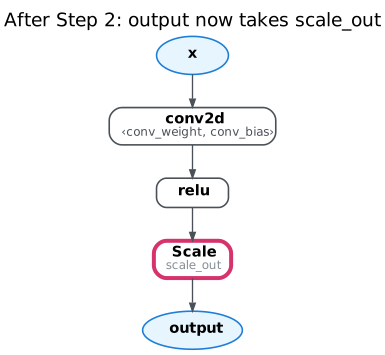
print(f"relu.users = {list(relu.users)}   scale.args = {scale.args}")
assert list(relu.users) == [scale] and scale.args == (relu,)
relu.users = [scale_out] scale.args = (relu,)The standard way to “insert a new node B after A”: B takes A, and everyone else who used to take A now takes B (except B itself). This is exactly what prepare_pt2e does to insert an observer.
Step 3: recompile
The graph has been edited, but what about the result of calling gm(x)?
with torch.no_grad():
    before_recompile = torch.equal(gm(x), base)
gm.recompile()
with torch.no_grad():
    after_recompile = torch.allclose(gm(x), base * 2)
print(f"Graph edited, not yet recompiled: output still equals the original? {before_recompile}")
print(f"After recompile: output == 2 x original output?          {after_recompile}")
assert before_recompile and after_recompile
Graph edited, not yet recompiled: output still equals the original? True
After recompile: output == 2 x original output? TrueThe forward of a GraphModule is code generated from the graph. Editing the graph does not regenerate it automatically; you must call recompile() after every edit.
Step 4: Replace call_module with call_function
Replace the call_module scale_out with an aten.mul call_function. convert_pt2e replacing an observer (call_module) with q/dq (call_function) follows the same pattern. The order is: create the new node → switch downstream to the new one → delete the old one. First, see what happens if the order is wrong:
with graph.inserting_before(scale):
    mul = graph.call_function(torch.ops.aten.mul.Tensor, (relu, 2.0))
try:
    graph.erase_node(scale)  # someone still takes scale, so it cannot be deleted
    erase_error = None
except RuntimeError as e:
    erase_error = first_line(e)
print(f"erase_node(scale) directly: {erase_error}")
assert erase_error is not None
erase_node(scale) directly: Tried to erase Node scale_out but it still had 1 users in the graph: {output: None}!While someone still takes scale_out, it cannot be deleted. Do it in the correct order:
scale.replace_all_uses_with(mul)  # first switch downstream to the new node
graph.erase_node(scale)           # only when nobody takes it can it be deleted
gm.delete_submodule("scale_out")  # drop the module too
gm.recompile()
with torch.no_grad():
    assert torch.allclose(gm(x), base * 2)
draw(gm, highlight=[mul.name], title="After Step 4: scale_out replaced with aten.mul")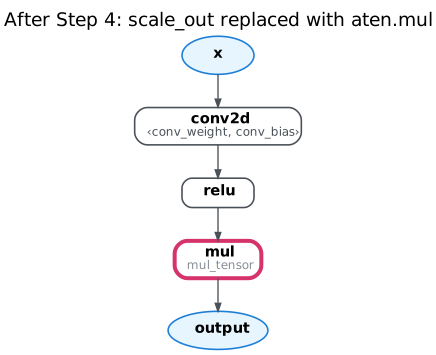
The output is still 2x. The second argument of mul, 2.0, is a Python constant written directly into the node’s arguments (you cannot see it on the graph; it is not a node).
Step 5: Put a Tensor Constant into the Graph
A Python number can be written directly into the arguments, and it corresponds to a per-tensor scale/zero point (M01 showed that the scale on q/dq is exactly this). A tensor constant (corresponding to a per-channel scale/zero point) must first be registered as a buffer and then read out with a get_attr node:
gm.register_buffer("two", torch.tensor(2.0))
with graph.inserting_before(mul):
    two = graph.get_attr("two")  # read the attribute named two on the GraphModule
    mul_t = graph.call_function(torch.ops.aten.mul.Tensor, (relu, two))
mul.replace_all_uses_with(mul_t)
graph.erase_node(mul)
gm.recompile()
with torch.no_grad():
    assert torch.allclose(gm(x), base * 2)
draw(gm, highlight=[mul_t.name], title="After Step 5: constant turned into buffer + get_attr")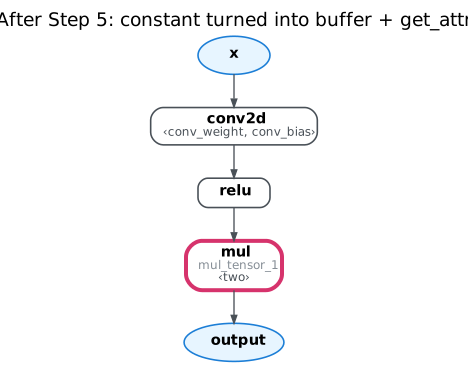
two is a get_attr, drawn inside the ‹…› of the label of the mul that uses it.
Step 6: Clean Up and Check
We deliberately create a neg that nobody uses, and then clear it out with eliminate_dead_code. lint checks that the graph structure is consistent (for example, that nodes are defined before they are used) and raises an exception if there is a problem.
with graph.inserting_after(relu):
    graph.call_function(torch.ops.aten.neg.default, (relu,))  # nobody takes it
n_before = len(graph.nodes)
graph.eliminate_dead_code()  # delete every node that has no users and no side effects
n_after = len(graph.nodes)
graph.lint()
gm.recompile()
print(f"node count: after inserting neg {n_before} -> after eliminate_dead_code {n_after}")
assert n_after == n_before - 1 and not any(n.name.startswith("neg") for n in graph.nodes)
node count: after inserting neg 10 -> after eliminate_dead_code 9After convert precomputes the quantization of the weight and replaces it with a get_attr, the original weight node has no users left, and it too is cleared out by eliminate_dead_code (M02-3).
Summary
| What to do | Action |
|---|---|
| Insert an observer | add_submodule + inserting_after + call_module + replace_all_uses_with(delete_user_cb=...) |
| observer → q/dq | inserting_before + call_function + replace_all_uses_with + erase_node (+ delete_submodule) |
| Store scale/zero point | a Python constant in the arguments, or register_buffer + get_attr |
| Wrap up | eliminate_dead_code, lint, recompile |
Inserting the observer in M02-2 is Steps 1-3; replacing observers with q/dq and pre-quantizing the weight in M02-3 is Steps 4-6.