def ptq(quantizer):
    model, x = get_model("conv_relu").eval(), example_inputs(16)
    prepared = prepare_pt2e(export_module(model, x, dynamic_batch=False), quantizer)
    with torch.no_grad():
        for batch in calibration_batches(64, batch_size=16):
            prepared(*batch)
    return convert_pt2e(prepared)


vpu = ptq(MyVPUQuantizer())
xnn = ptq(get_xnnpack_quantizer(is_per_channel=True)[0])M10 Overview | Custom Backend: Writing Hardware Constraints as a Quantizer

The backends in M08 and M09 are forgiving: they accept per-channel, asymmetric activations, arbitrary scales and dynamic batch, and any op without an int8 version stays in fp32. VPU/NPU-class hardware is usually much narrower (“How a CPU Differs from a VPU/NPU” in the M09 overview).
This chapter moves to the backend author’s side: invent a VPU and do the three things a backend has to hand over.
| What the backend author does | How this chapter does it | notebook |
|---|---|---|
| Give algorithm engineers a Quantizer | Write the eight hardware constraints as MyVPUQuantizer |
M10-1 |
| Check the graph before consuming it | A checker pass check_vpu that reads only the Q/DQ graph |
M10-2 |
| Fall back unsupported ops to CPU | A minimal partitioner partition that prints the partitioned graph |
M10-3 |
The backend itself is in vpu_quantizer.py: a file of this project, not a torchao API, and not a notebook. The M10 notebooks import it with from vpu_quantizer import …. The VPU is fictional; the constraints are common requirements of this kind of hardware (general knowledge), and this project has no real device.
An Example First: the Same conv + relu, the Q/DQ Graphs of Two Backends
Take the smallest conv + relu and run PTQ with MyVPUQuantizer and with the torchao test-version XNNPACKQuantizer. The VPU takes static shapes only, so both sides use export_module(..., dynamic_batch=False), and the calibration batch size equals the export batch size:
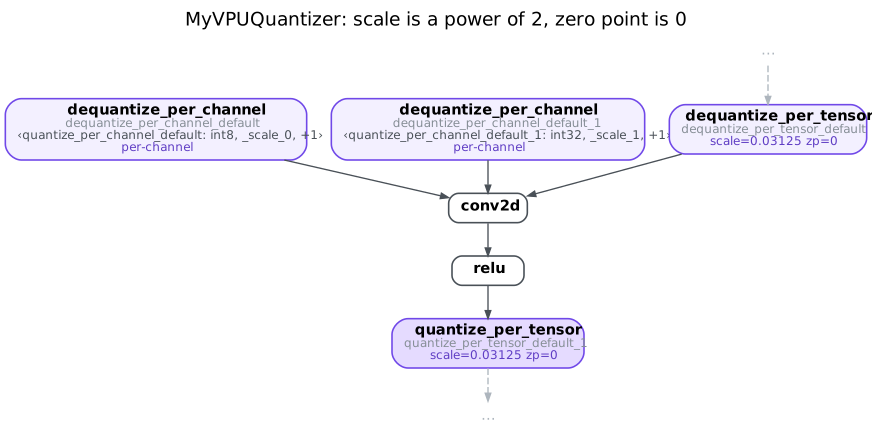
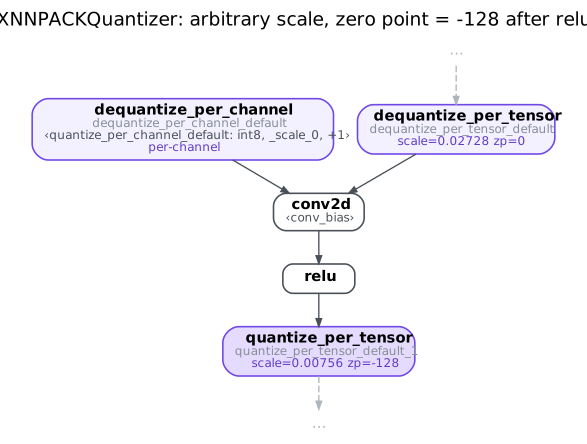
The extra int32 dequantize_per_channel on the VPU graph’s conv2d is the bias: MyVPUQuantizer quantizes bias to int32 (constraint (5)). The XNNPACK graph has no such dq, because the torchao test-version XNNPACKQuantizer does not annotate bias, so bias stays fp32.
Both graphs are one conv+relu unit; the difference is the numbers on the q/dq. Confirm it in code:
def qparams(gm):
    return [(float(n.args[1]), int(n.args[2])) for n in gm.graph.nodes
            if n.target == torch.ops.quantized_decomposed.quantize_per_tensor.default]


def is_pow2(s):
    return float(torch.log2(torch.tensor(s))).is_integer()


print("VPU quantize_per_tensor (scale, zp):", qparams(vpu))
print("XNNPACK quantize_per_tensor (scale, zp):", [(round(s, 5), z) for s, z in qparams(xnn)])
assert all(is_pow2(s) and z == 0 for s, z in qparams(vpu))
assert not all(is_pow2(s) for s, _ in qparams(xnn)) and qparams(xnn)[-1][1] == -128
VPU quantize_per_tensor (scale, zp): [(0.03125, 0), (0.03125, 0)]
XNNPACK quantize_per_tensor (scale, zp): [(0.02728, 0), (0.00756, -128)]The XNNPACK graph is perfectly reasonable on a CPU, but it cannot be placed on this VPU: the VPU wants scale \(2^k\) and zero point 0. These requirements have to be handed to the algorithm engineer before quantization, written as a Quantizer.
The Eight Constraints and the PT2E Mechanisms
| VPU constraint | PT2E approach | Where in vpu_quantizer.py |
|---|---|---|
(1) only VPU_OPS have kernels |
other ops get no annotation → stay in fp32 | VPU_OPS, the end of annotate() |
| (2) activation per-tensor symmetric | qscheme=per_tensor_symmetric |
act_spec() |
| (3) weight per-channel symmetric | qscheme=per_channel_symmetric |
weight_spec() |
| (4) scale is a power of 2 | subclass the observer, override calculate_qparams() |
Pow2MinMaxObserver etc. |
| (5) bias int32, scale = \(s_{in} \cdot s_w\) | DerivedQuantizationSpec |
bias_spec() |
| (6) add/cat/pool etc. share one scale between input and output | SharedQuantizationSpec |
_add(), _cat(), _same_scale() |
| (7) conv/add + relu fused | put the output annotation on the relu, none in between | fused_relu() |
| (8) static shape only | validate() raises on a SymInt |
validate() |
This chapter pays off three things M03 set up: validate() (M03-3), the DerivedQuantizationSpec for the int32 bias (M03-5), and un-annotated ops staying in fp32 (M03-6).
Why the Hardware Wants These Constraints
| Constraint | What the hardware saves |
|---|---|
| zero point = 0 | the cross terms of an integer conv (see below) |
| scale = \(2^k\) | the requant multiplier; only a shift is left (M10-2 C) |
| same scale for input and output | the requant before and after add/pool |
| static shape | runtime memory allocation (planned at compile time, same as M08-2 C) |
The notation follows “Affine Quantization: Scale and Zero Point” in the M01 overview: an integer \(q\) represents the real number \(s\,(q - z)\), where \(s\) is the scale and \(z\) the zero point. The subscript \(x\) means the conv’s input activation (\(s_x\) is the \(s_{in}\) of constraint (5)), and \(w\) means the weight.
One output position of a conv is the sum of products \(\sum x\,w\) over the kernel window (input channels × kernel height × width). Replace \(x\) and \(w\) by their integer representations:
\[ \sum x\,w \approx \sum s_x (q_x - z_x) \cdot s_w (q_w - z_w) = s_x s_w \sum (q_x - z_x)(q_w - z_w) \]
\(s_x\) is per-tensor and \(s_w\) has a single value within one output channel, so \(s_x s_w\) can be pulled out of the sum and left to requant. What the integer kernel has to compute is the remaining sum, which expands to:
\[ \sum (q_x - z_x)(q_w - z_w) = \sum q_x q_w - z_w \sum q_x - z_x \sum q_w + z_x z_w \sum 1 \tag{1} \]
The first term is a pure integer multiply-accumulate; the other three terms that contain \(z\) are the cross terms the table refers to:
- When \(z_w = 0\), the term with \(\sum q_x\) vanishes. \(q_x\) is the input and differs at every output position, so this term would have to be accumulated per position at inference time and cannot be saved; the only way out is \(z_w = 0\), which makes it 0. The constant term \(z_x z_w \sum 1\) goes to 0 as well. The usual weight setting, per-channel symmetric, is exactly this.
- What remains is \(z_x \sum q_w\): the activation is per-tensor, \(z_x\) is fixed at calibration time, and together with \(q_w\) both are constants, so the term can be folded into the bias ahead of time.
Verify equation (1) with random integers, for one output position and 27 products (a 3×3×3 conv):
g = torch.Generator().manual_seed(0)
q_x = torch.randint(-128, 128, (27,), generator=g, dtype=torch.int64)
q_w = torch.randint(-127, 128, (27,), generator=g, dtype=torch.int64)
z_x, z_w = 5, 3
direct = ((q_x - z_x) * (q_w - z_w)).sum()
expanded = (q_x * q_w).sum() - z_w * q_x.sum() - z_x * q_w.sum() + z_x * z_w * len(q_x)
print(f"direct {int(direct)}, expanded {int(expanded)}")
assert direct == expanded
direct -20196, expanded -20196The Flow
vpu_quantizer.py      writes the hardware constraints as annotations (MyVPUQuantizer)
  → prepare_pt2e      annotate() annotates, validate() rejects graphs it cannot handle
  → calibrate, convert   the Pow2 observers decide the scales on the Q/DQ graph
  → check_vpu()       backend: reads only the Q/DQ graph and checks the constraints (M10-2)
  → partition()       backend: ops outside the list fall back to CPU (M10-3)
The first three steps are what the algorithm engineer does with the Quantizer the backend provides; the last two are what the backend does itself once it receives the Q/DQ graph. All that is handed over in between is the Q/DQ graph, so the backend cannot just trust the quantizer’s promise: M10-2 runs the XNNPACK graph through the same check and it violates five of the seven rules.
Summary and Chapter Map
- A backend Quantizer is hardware constraints translated into annotations:
qscheme, a custom observer, Shared/Derived, “don’t annotate”, andvalidate()each handle one kind of constraint. - Rounding a power-of-2 scale up does not clip more, but the resolution gets up to 2x coarser; in exchange, requant is just a right shift.
- All the backend receives is the Q/DQ graph, so it has to check and partition on its own. The op list decides how many pieces the graph is cut into.
| notebook | Question it answers |
|---|---|
| M10-1 MyVPUQuantizer | How the eight constraints become annotations; the cost of the pow2 observer; validate(); which tensors are forced to share a scale |
| M10-2 Checker pass | Whether a Q/DQ graph is compliant; which rules the XNNPACK graph violates; the requant right-shift amounts |
| M10-3 Fallback report | Which ops fall back to CPU; subgraphs, boundaries and data moved |
What this chapter deliberately skips:
- How much accuracy each constraint costs (M10-1 prints a single SQNR line as a sanity check).
- Integer simulation: M10-2 only computes the right-shift amounts and does not implement conv in integers to compare against the Q/DQ graph; whether it is bit exact depends heavily on the backend implementation (M08 overview, “Numerical Differences from the Q/DQ Graph”).
- Whether a single-op subgraph is worth it: that needs measurements on a real device, which this project does not have.
M10 is the last chapter of the learning path. Go back to the home page for the big picture, or to the M07 overview to see how the three routes connect to here.
References
- PyTorch official tutorial: How to Write a Quantizer for PyTorch 2 Export Quantization
- RFC-0019: Extending PyTorch Quantization to Custom Backends
- Quantization whitepaper: R. Krishnamoorthi, Quantizing deep convolutional networks for efficient inference: A whitepaper (the expansion of integer conv and zero points)