M08-3 | What XnnpackPartitioner Does Not Take: How the Graph Is Split and What the Boundary Looks Like
Open In Colab
The partitioner finds the connected subgraphs the backend can handle and compiles each into one delegate; ops it cannot handle stay on the graph and are run by ExecuTorch’s own portable kernels (generic C++ implementations). In M08-2, TinyConvNet’s whole graph went into XNNPACK. Here we deliberately put a cumsum between two convs: XNNPACKQuantizer does not annotate it, and XnnpackPartitioner does not take it either (measured on executorch 1.5.0).
A. Quantization: cumsum has no annotation and runs fp32 on the Q/DQ graph.
B. Lowering: the graph is split into two delegates before and after cumsum, and fp32 is passed between the two.
C. Execution: how far the .pte output is from the Q/DQ graph’s.
This notebook needs executorch (uv sync --group executorch).
class ConvCumsumConv(nn.Module):"""conv → relu → cumsum → conv. cumsum accumulates along the channel dimension."""def__init__(self, ch=8):super().__init__()self.conv1 = nn.Conv2d(3, ch, 3, padding=1)self.conv2 = nn.Conv2d(ch, ch, 3, padding=1)def forward(self, x): y = torch.relu(self.conv1(x)) y = torch.cumsum(y, dim=1)returnself.conv2(y)model = ConvCumsumConv().eval()x = example_inputs(1)
A. Quantization: cumsum Has No Annotation
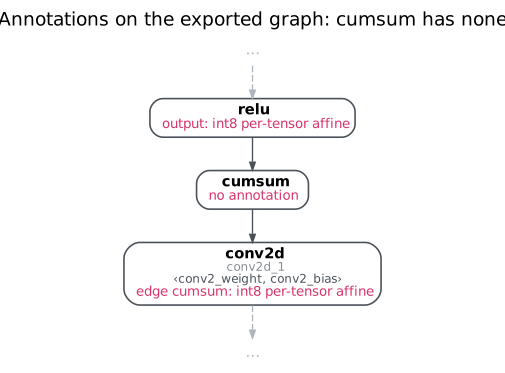
First look at the annotations only: after export, call the executorch XNNPACKQuantizer’s annotate, and draw the annotations under the nodes (M03-2):
labeled = export_module(model, x, dynamic_batch=False)get_xnnpack_quantizer("executorch", is_per_channel=True)[0].annotate(labeled)notes = annotation_notes(labeled, unlabeled=True)draw(labeled, focus=["relu", "cumsum", "conv2d_1"], hops=0, notes={k: notes[k] for k in ["relu", "cumsum"]} | {"conv2d_1": notes["conv2d_1"].split("\n")[0]}, title="Annotations on the exported graph: cumsum has none")
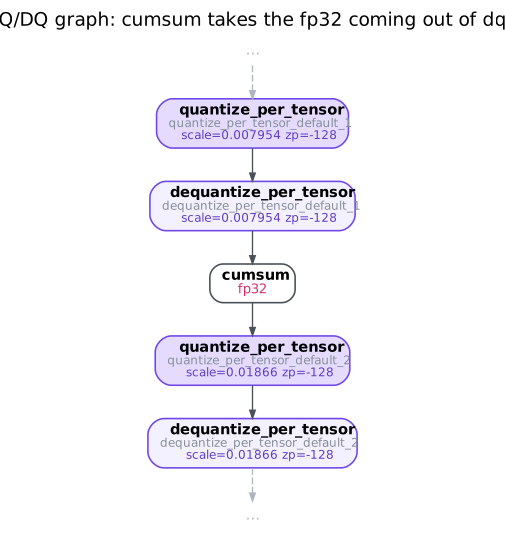
XNNPACKQuantizer has no annotator for cumsum, so cumsum has no annotation (the fallback from M03-6). Its upstream and downstream do: relu’s output must be quantized (the output of conv-relu), and conv2d_1’s input edge must be quantized. After PTQ (xnnpack_ptq, M08-2), there is one q/dq pair on each side of cumsum:
qdq = xnnpack_ptq(model, x)draw(qdq, focus="cumsum", hops=2, notes={"cumsum": "fp32"}, title="Q/DQ graph: cumsum takes the fp32 coming out of dq")
cumsum takes the fp32 coming out of dequantize, outputs fp32, and that is quantized again for conv2d_1.
B. Lowering: the Graph Is Split into Two Delegates
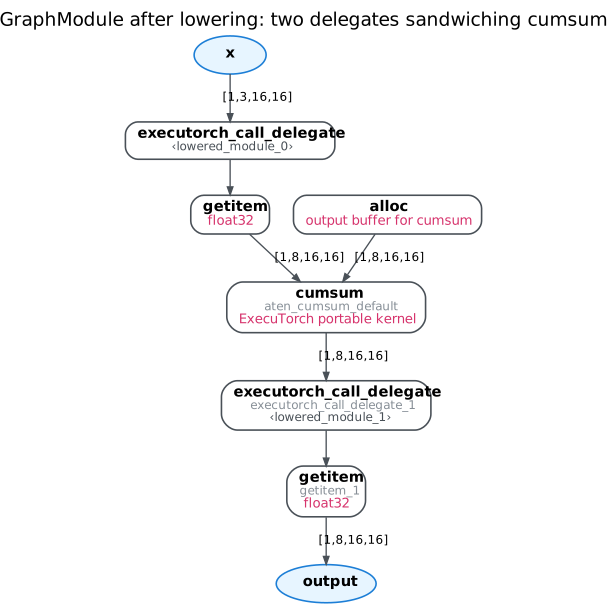
edge, pte = lower_to_xnnpack(qdq, x) # this project's wrapper: export → to_edge_transform_and_lower → to_executorch (M08-2 A)lowered = edge.exported_program().graph_moduledraw(lowered, show_shapes=True, notes={"aten_cumsum_default": "ExecuTorch portable kernel", "alloc": "output buffer for cumsum",**{n.name: str(n.meta["val"].dtype).removeprefix("torch.") for n in lowered.graph.nodesif short(n.target) =="getitem"}}, title="GraphModule after lowering: two delegates sandwiching cumsum")
Look between the two executorch_call_delegates: a getitem pulls out the previous block’s output and passes it to cumsum, and cumsum’s output goes into the next block. The edges are labeled with shapes, and under getitem is the dtype of its output (taken from node.meta["val"]): float32. The dq and q around cumsum were absorbed into the delegates on either side: the previous block ends by converting int8 back to fp32, and the next block starts by converting to int8 again.
alloc is the output buffer that to_executorch() set up for cumsum ahead of time (memory planning, M08-2 C), and getitem takes a value from the delegate’s output tuple; neither is a computation.
Count where each op went with delegation_summary:
n_sub, n_del, n_non, by_op = delegation_summary(edge)table([[op, d, nd] for op, (d, nd) insorted(by_op.items())], ["op (Edge dialect name)", "handed to XNNPACK", "stays in ExecuTorch"])
n_before =sum(op_counts(qdq).values())left = {op: nd for op, (_, nd) in by_op.items() if nd}print(f"delegates: {n_sub}; of the Q/DQ graph's {n_before} ops, {n_del} went into a delegate; left behind: {left}")assert n_sub ==2and n_del == n_before -1andset(left) == {"aten_cumsum_default", "alloc", "getitem"}assertall(n.meta["val"].dtype == torch.float32 for n in lowered.graph.nodes if short(n.target) =="getitem") # fp32 across the boundary
delegates: 2; of the Q/DQ graph's 14 ops, 13 went into a delegate; left behind: {'getitem': 2, 'alloc': 1, 'aten_cumsum_default': 1}
On the Q/DQ graph only cumsum did not go into a delegate; the rest of what is left behind, alloc and getitem, were added by lowering. Every extra boundary means one more int8 ↔︎ fp32 conversion, and one more round trip between ExecuTorch and XNNPACK.
Before quantizing, use the annotations to confirm “which ops were not annotated” (M03-2); before deployment, use this table to confirm “which ops did not go into a delegate”. The two are independent decisions:
Who decides
When unsupported
whether the quantizer annotates
An unannotated op runs fp32 on the Q/DQ graph
whether the partitioner takes it
An op it does not take stays outside the delegate and runs ExecuTorch’s portable kernel
C. Execution: the .pte vs the Q/DQ Graph’s Output
The .pte accepts only the batch 1 it was exported with (M08-2 C), so the 64 random inputs are fed one at a time:
runner = PteRunner(pte)xs = torch.randn(64, 3, 16, 16)with torch.no_grad(): y_pte = torch.cat([runner(xs[i : i +1]) for i inrange(len(xs))]) y_qdq = torch.cat([qdq(xs[i : i +1]) for i inrange(len(xs))])lsb = [n for n in qdq.graph.nodes if short(n.target) =="quantize_per_tensor"][-1].args[1]same = (y_pte == y_qdq).float().mean().item()max_lsb = ((y_pte - y_qdq).abs() / lsb).round().max().item()print(f"Bit-identical outputs: {same:.2%}; max difference {max_lsb:.0f} output LSB (output LSB = scale of the last quantize, {lsb:.4g})")
Bit-identical outputs: 99.68%; max difference 1 output LSB (output LSB = scale of the last quantize, 0.01771)
assert max_lsb <=2
Split into two blocks, it still runs. The difference from the Q/DQ graph is only a few output LSB, coming from the rounding of the integer kernels (M08 overview, “Numerical Differences from the Q/DQ Graph”). Unsupported ops do not make the export fail; that segment just does not run on XNNPACK.
Summary
Ops the quantizer does not annotate run fp32; ops the partitioner does not take stay outside the delegate and run ExecuTorch’s portable kernels.
An unsupported op in the middle splits the graph, fp32 is passed across the boundary, and extra int8 ↔︎ fp32 conversions and runtime round trips appear.
Before deployment, use get_delegation_info (delegation_summary) to confirm which ops did not go into a delegate.