import torch
from torch.export import export

from common.graph_utils import diff_ops
from common.models import example_inputs, get_model
from common.pt2e import quiet
from common.viz import draw_stages, table

quiet()
_ = torch.manual_seed(0)M00-2 | Graphs Exported in eval and train Mode Differ

Take the same ConvBnReLU: calling model.eval() or model.train() before export gives different graphs. This sets up M04 (fusion) and M06 (QAT):
| Flow | Mode | BatchNorm on the graph |
|---|---|---|
| PTQ | export after model.eval() → prepare_pt2e |
uses running mean/var, a fixed affine transform that can be folded straight into the conv |
| QAT | export after model.train() → prepare_qat_pt2e |
must compute this batch’s statistics and update the running stats, so it has to stay on the graph |
- A. Export once in each mode and see where the graphs differ.
- B. How the arguments of the
batch_normnode differ; whether the mode can still be switched after export.
A. Export Once in Each Mode
def export_in_mode(train: bool):
    model = get_model("conv_bn_relu")
    model.train() if train else model.eval()
    return export(model, example_inputs()).module()


gm_eval = export_in_mode(train=False)
gm_train = export_in_mode(train=True)
table(diff_ops(gm_eval, gm_train, "gm_eval", "gm_train", tablefmt="html"))| op | gm_eval | gm_train | delta |
|---|---|---|---|
| add_ | 0 | 1 | 1 |
| batch_norm | 1 | 1 | 0 |
| conv2d | 1 | 1 | 0 |
| relu | 1 | 1 | 0 |
The kinds of ops are almost the same; only train has an extra add_. The two graphs stacked top and bottom (parameters drawn too):
def bn_node(gm):
    return next(n for n in gm.graph.nodes if n.op == "call_function" and "batch_norm" in str(n.target))


BN_ARG_NAMES = ["input", "weight", "bias", "running_mean", "running_var",
                "training", "momentum", "eps", "cudnn_enabled"]
notes = [{"batch_norm": f"training={bn_node(gm).args[BN_ARG_NAMES.index('training')]}"}
         for gm in (gm_eval, gm_train)]
draw_stages([(gm_eval, "Export after model.eval()"), (gm_train, "Export after model.train()")],
            show_params=True, notes=notes, per_row=1, title="ConvBnReLU in eval and train")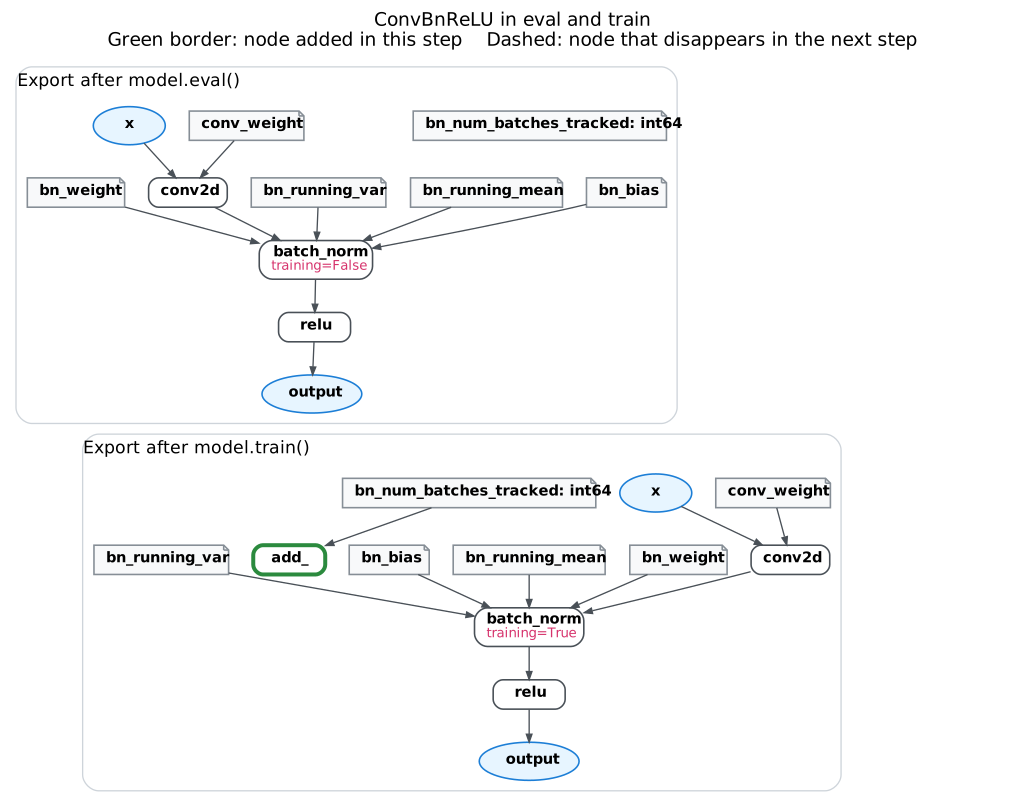
- The data flow (conv2d → batch_norm → relu) is the same on both sides, and
batch_normis the same opaten.batch_norm.default. The difference hides in itstrainingargument (shown under the node). - The extra
add_in train (green border) readsbn_num_batches_tracked: in train mode the BN forward doesnum_batches_tracked += 1, and export records it as an in-placeadd_. It has no users, and the output does not depend on it; on the eval side, nobody readsbn_num_batches_tracked.
add_node = next(n for n in gm_train.graph.nodes if n.op == "call_function" and n.name.startswith("add_"))
print(f"{add_node.name}{tuple(str(a) for a in add_node.args)}, users = {list(add_node.users)}")
assert add_node.args[0].target == "bn.num_batches_tracked" and not add_node.users
add_('bn_num_batches_tracked', '1'), users = []What about running_mean / running_var? There is no node on the graph that updates them, because the update happens inside the batch_norm op: with training=True it normalizes using this batch’s statistics and, at the same time, writes the running stats in place back to the buffers passed in. num_batches_tracked += 1 is a line of Python that nn.BatchNorm.forward executes before calling the op, so it becomes a separate add_.
B. How the batch_norm Arguments Differ
def bn_args(gm):
    return {k: (v.name if isinstance(v, torch.fx.Node) else v) for k, v in zip(BN_ARG_NAMES, bn_node(gm).args)}


ae, at = bn_args(gm_eval), bn_args(gm_train)
table([[k, ae[k], at[k], "✱" if ae[k] != at[k] else ""] for k in BN_ARG_NAMES],
["Argument", "gm_eval", "gm_train", "Differs"])| Argument | gm_eval | gm_train | Differs |
|---|---|---|---|
| input | conv2d | conv2d | |
| weight | bn_weight | bn_weight | |
| bias | bn_bias | bn_bias | |
| running_mean | bn_running_mean | bn_running_mean | |
| running_var | bn_running_var | bn_running_var | |
| training | False | True | ✱ |
| momentum | 0.1 | 0.1 | |
| eps | 1e-05 | 1e-05 | |
| cudnn_enabled | False | False |
assert [k for k in BN_ARG_NAMES if ae[k] != at[k]] == ["training"]Of the nine arguments only training differs. In other words, the mode is fixed on the graph at the moment of export: the training argument of batch_norm, plus the extra add_ in train.
So can we still switch with .train() / .eval() after export?
try:
    gm_eval.train()
    raised = None
except NotImplementedError as e:
    raised = e
print(f"gm_eval.train() → {type(raised).__name__}: {raised}")
assert isinstance(raised, NotImplementedError)
gm_eval.train() → NotImplementedError: Calling train() is not supported yet.No. The forward of a GraphModule is code generated from the graph, and .train() cannot change arguments fixed on the graph. When QAT needs to switch between training and evaluation, use move_exported_model_to_train / move_exported_model_to_eval (M06); what they do is rewrite these nodes on the graph.
Summary
- Decide eval or train before export: the mode is written into the graph (the
trainingargument ofbatch_norm, and the extraadd_in train). - PTQ exports in eval mode so that BN can be folded into the conv at
prepare_pt2e(M01-1 showed batch_norm disappearing); QAT uses train mode (M04, M06). - A GraphModule after export can no longer be switched with
.train()/.eval().